
Most retailers don't lose margin because their forecasts are broken. They lose it because the team spends half the week manually adjusting orders the system already got right or because safety stock is set by gut feeling and last year's numbers. Inventory distortion, the combined cost of stockouts and overstock, cost global retailers $1.7 trillion in 2024, according to industry research. That's not a planning problem. It's a tooling problem.
We reviewed 8 leading inventory optimization software tools for retail, focusing on demand forecasting depth, replenishment automation, multi-store scalability, and actual user feedback from G2, Capterra, and TrustRadius. This list covers mid-market retail chains through large enterprises, and it's weighted toward tools that solve real-world retail complexity, such as seasonal demand, promotions, fresh categories, and supplier variability, and not just basic reorder triggers.
If you're already evaluating platforms, LEAFIO AI's retail inventory optimization software is worth a close look. It's purpose-built for retail chains, runs on self-regulating AI algorithms, and is accessible for chains that aren't Walmart-sized. More on that below.
What Is Inventory Optimization Software?
Inventory optimization software helps retailers determine the right stock quantities at the right locations at the right time. It goes beyond basic inventory tracking by using demand forecasting, replenishment automation, and buffer management to continuously balance availability against working capital. The goal: fewer stockouts, less overstock, and less manual intervention from your planning team.
Why Inventory Optimization Software Matters for Retail
Every empty shelf is a lost sale. Every overflowing backroom is tied-up cash. Out-of-stock situations directly cost retailers 4.1% of total sales, and when your operating margin is 1 to 2%, that's not a rounding error. Retailers using AI-powered inventory solutions report average reductions of 15% in stockouts and 20% in excess inventory carrying costs, according to multiple industry analyses.
Without dedicated inventory optimization software, retail teams typically face the following:
- Manual overrides eating planner time: planners spend 20 to 30% of their week correcting system recommendations instead of doing strategic work
- Safety stock set by habit, not data: buffers sized on last year's worst-case scenario rather than current demand signals
- Promotions that create stockouts or waste: demand spikes that the replenishment cycle can't keep up with
- Imbalanced distribution across stores: some branches drowning in stock while others can't fill a shelf
- No visibility into slow-moving SKUs: until the markdown season hits and it's too late
The AI market in inventory management is projected to grow from $9.6 billion in 2025 to $27.23 billion by the end of the decade. That investment reflects proven ROI, and the gap between retailers running spreadsheet-based planning and those using purpose-built optimization is widening every year. See also: Best Demand Planning Software for tools focused specifically on the forecasting layer, or our roundup of the best supply chain compliance software for retailers for the wider picture beyond inventory alone.
How We Picked the Best Inventory Optimization Software
We evaluated a wide range of tools and ultimately selected 8 that truly stand out based on specific criteria. Let’s be honest about what really makes a difference versus what you often see as just marketing fluff on vendor websites.
- Retail-specific forecasting depth: does the algorithm handle seasonality, promotions, fresh products, and new SKUs, or does it just extrapolate average sales?
- Replenishment automation quality: can the system generate and execute orders with minimal manual override, or does it just produce recommendations that a planner still has to approve one by one?
- Multi-echelon coverage: does the tool optimize across distribution centers and stores together, or only at one level of the supply chain?
- ERP and POS integration: we checked which ERPs each tool connects to natively versus via custom API work that adds cost and implementation time
- Scalability for retail chains: tools designed for 3-store boutiques don't belong on a list for operations with 50 to 500 locations
- G2 and Capterra user ratings: we filtered for tools with enough verified reviews to distinguish real user experience from marketing claims
- Implementation realism: we looked at actual timelines reported by users, not the optimistic estimates in vendor pitch decks
- Pricing accessibility: enterprise pricing that requires 6 months of negotiation before you see a number is noted as such
Quick Comparison: Best Inventory Optimization Software at a Glance
Here's a side-by-side view of the 8 tools. Scroll down for full reviews.
| Tool | Best For | Price Range | Free Trial? | Key Feature |
|---|---|---|---|---|
| LEAFIO AI | Mid-to-large retail chains | Custom pricing (modular) | Yes (demo) | Self-regulating AI replenishment |
| RELEX Solutions | Large enterprise retailers | Contact for pricing | Demo only | Unified retail + supply chain planning |
| Blue Yonder | Global enterprise supply chains | $5,000–$15,000/month (est.) | Demo only | AI + ML demand sensing at scale |
| ToolsGroup | Probabilistic forecasting needs | Contact for pricing | Demo only | Stochastic demand modeling |
| Netstock | SMB and growing retail chains | From ~$500/month | Yes (demo) | Fast ERP overlay, visual dashboards |
| EazyStock | ERP-heavy mid-market teams | Contact for pricing | Demo only | ERP-native inventory health automation |
| Inventory Planner | Small retailers and e-commerce | From ~$99/month | Yes (14-day trial) | SKU-level purchase recommendations |
| Kinaxis | Enterprise scenario planning | Contact for pricing | Demo only | Real-time concurrent planning |
8 Best Inventory Optimization Software: In-Depth Reviews
1. LEAFIO AI: Best Inventory Optimization Software for Mid-to-Large Retail Chains
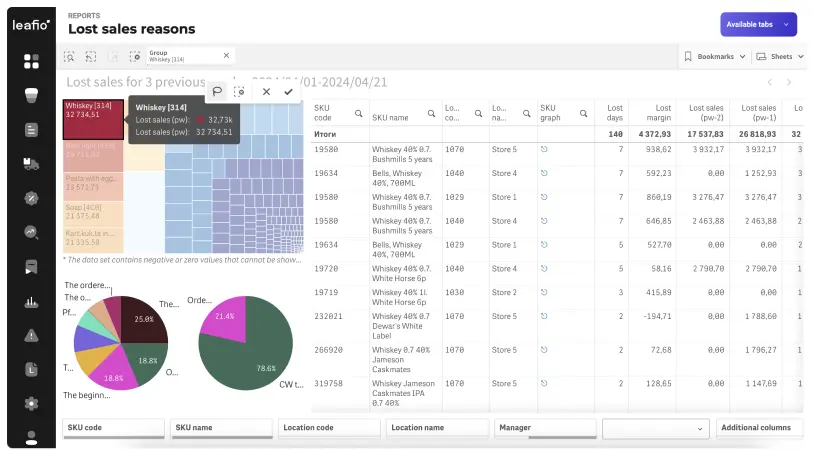
LEAFIO AI is purpose-built for retail, not adapted from a manufacturing or logistics platform with retail as an afterthought. The company has been operating since 2014 and has completed over 200 implementations across retail chains in more than 20 countries. Their inventory optimization software runs on self-regulating AI algorithms that continuously adjust order recommendations based on actual demand patterns, seasonal shifts, promotional impacts, and supplier variability. You don't need a planner to babysit the system every day; that's the point.
Where LEAFIO AI stands out from legacy tools is the depth of the replenishment logic. The platform handles multi-echelon distribution (DC to stores), calculates dynamic buffers per SKU, manages promotional uplift without requiring manual adjustment, and covers fresh product categories, which is where most competitors fall short.
In one comparable rollout, European grocery chain Kolo cut overstock by 43% and lost sales by 13% while lifting sales 20% and turnover 17% within a single quarter of switching to LEAFIO AI.
Key features:
- Self-regulating AI replenishment: algorithms adapt to current demand signals without needing manual rule updates; the system recalibrates buffers automatically when conditions change
- Multi-echelon optimization: covers distribution center replenishment through store-level ordering in a single planning cycle, which reduces the imbalances most retail chains live with daily
- Promotion management: pre-built promotional uplift modeling that adjusts order volumes for planned campaigns, rather than requiring planners to manually override every promotional SKU
- Direct Supplier PUSH distribution: algorithmic stock distribution from direct suppliers to store networks, particularly useful for retail chains buying outside the DC structure
- Demand forecasting with fresh product support: handles short shelf-life categories and new SKUs with limited sales history, a common gap in general-purpose tools
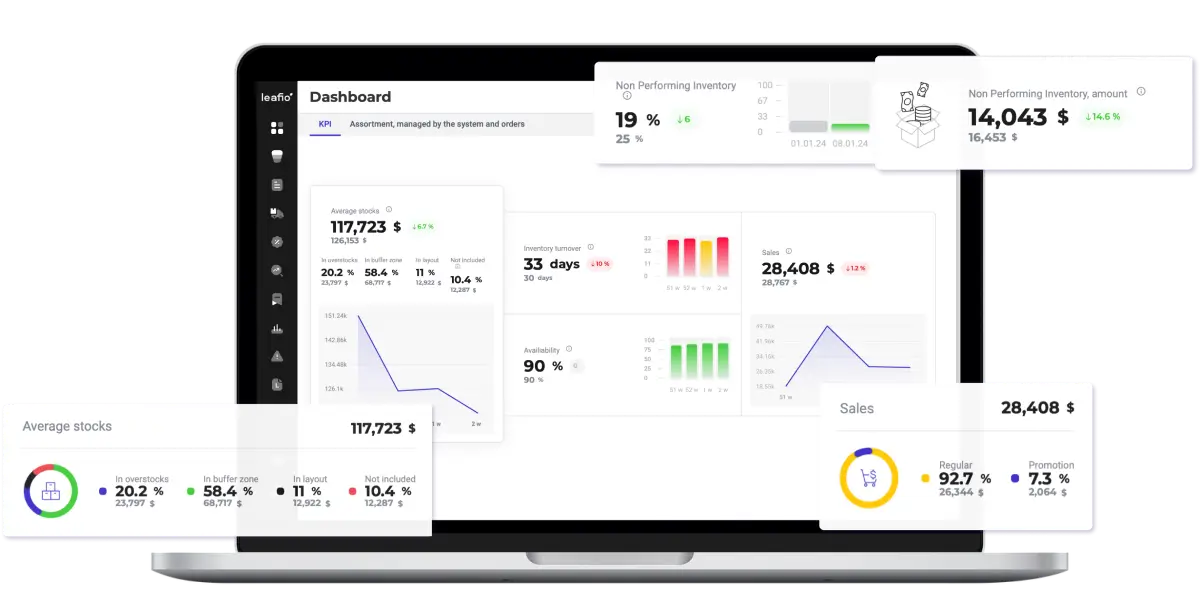
- Analytics and KPI dashboards: turnover rates, lost sales, surplus identification, and availability metrics visible at category, store, and SKU level
| ✅ Pros | ❌ Cons |
|---|---|
| Rated 5.0 on G2 with 25 G2 awards in 2025, including Best Usability, Easiest Setup, and Best Estimated ROI | Less suited for non-retail verticals; if you're managing manufacturing or complex logistics outside retail, the depth isn't there |
| Faster time-to-value than enterprise platforms—implementations run 2 to 4 months, not 6 to 12 | Some users report a learning curve for new team members navigating the full feature set |
| Modular pricing based on stores and SKUs makes it significantly more accessible for mid-market chains than RELEX or Blue Yonder | |
| Retail-native platform — covers inventory, shelf, assortment, and promotions in a single ecosystem |
Pricing: Custom, modular pricing based on store count and SKU volume. Significantly more accessible than enterprise alternatives. Pricing is available upon request.
Best for: Mid-to-large retail chains (grocery, FMCG, specialty) with 20 to several hundred stores looking for AI-driven replenishment automation without enterprise complexity.
2. RELEX Solutions: Best for Large Enterprise Retail Planning

RELEX is the enterprise standard for retail-specific supply chain planning, trusted by chains like Dollar Tree, Lidl, and AutoZone. The platform covers demand forecasting, replenishment, merchandising, space planning, pricing, and workforce management in a single unified data model. That breadth is its biggest selling point, but its biggest practical challenge.
Key features:
- AI-native forecasting engine that handles fresh products, seasonal peaks, and promotional demand across all retail categories
- Unified planning across demand, inventory, space, and pricing — no separate modules that don't talk to each other
- Real-time inventory diagnostics with AI-assisted root cause analysis for availability issues
- Named a Leader in the 2025 Gartner Magic Quadrant for Supply Chain Planning
| ✅ Pros | ❌ Cons |
|---|---|
| Exceptional retail depth | Implementation timelines run 6 to 12 months for large chains |
| Strong customer satisfaction (4.8 on Gartner Peer Insights with 84 reviews) | Total cost of ownership is high |
| Handles full enterprise complexity well | Limited flexibility for mid-size retailers who don't need the full enterprise stack |
Pricing: Enterprise SaaS subscription: contact for pricing. Costs increase as modules and scope expand.
Best for: Large retail enterprises that need unified end-to-end planning across all supply chain and merchandising functions.
3. Blue Yonder: Best for Global Enterprise Supply Chains
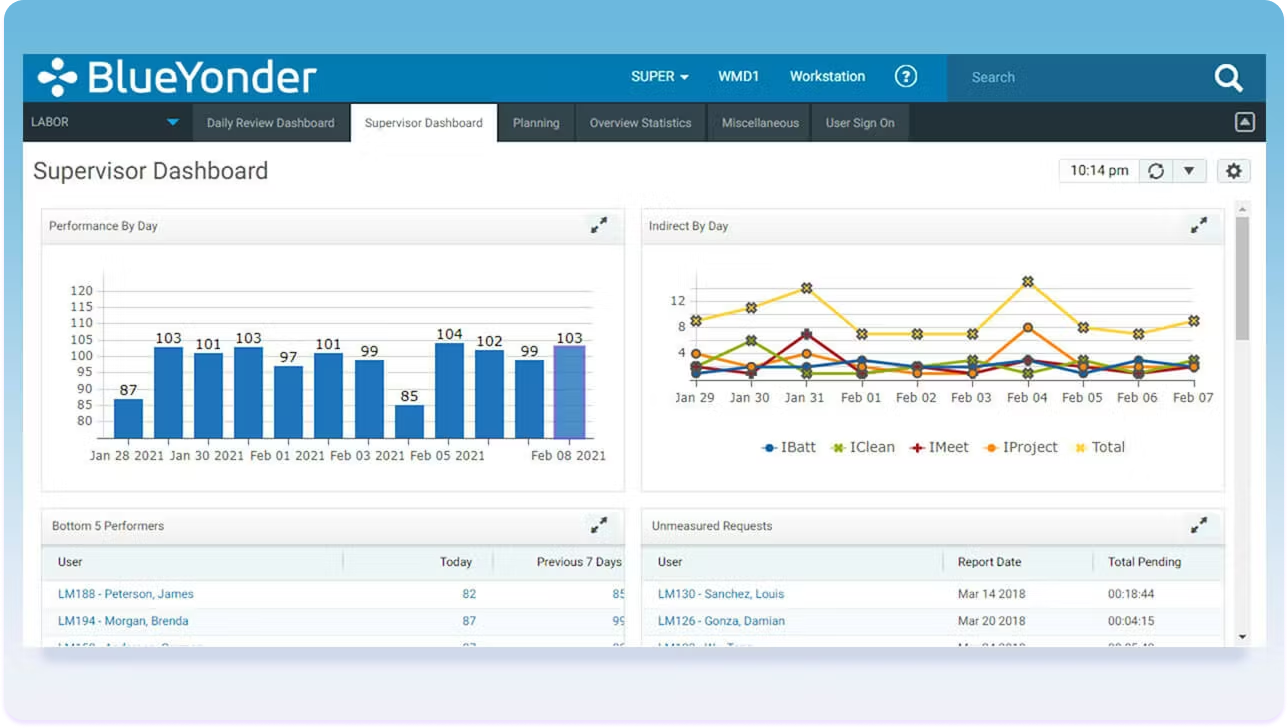
Blue Yonder (formerly JDA Software) is the platform of choice for global enterprises managing millions of SKUs across thousands of locations. Walmart uses it. The platform covers demand sensing, inventory optimization, warehouse management, and transportation in a connected AI-powered suite. The scale is genuinely impressive; over Thanksgiving 2025, Blue Yonder surfaced inventory availability for over 1.2 billion SKUs in 10 to 12 milliseconds for its customers.
Key features:
- Multi-dimensional demand sensing using AI and ML across global retail networks
- Real-time inventory visibility across warehouses, DCs, and stores with scenario planning capabilities
- Integrated warehouse management with AI-driven slotting and resource optimization
- Connected planning from demand through fulfillment in a single platform
| ✅ Pros | ❌ Cons |
|---|---|
| Unmatched scale for global operations | G2 rating is 3.6 (11 reviews): limited review volume, but the feedback cites reporting gaps and customization complexity |
| Strong AI innovation roadmap | Pricing is well above mid-market budgets |
| Full supply chain coverage from planning to execution | Implementation is intensive |
Pricing: Estimated $5,000 to $15,000/month based on industry benchmarks; one-time implementation fees of $10,000 to $30,000 depending on scope. Contact for accurate pricing.
Best for: Large global retailers and enterprises requiring connected planning and execution across complex, multi-tier supply chains.
Retailers that need similar enterprise-scale capabilities but want to compare implementation complexity, cost, or retail specialization should also evaluate Blue Yonder competitors before committing to the broader ecosystem.
4. ToolsGroup: Best for Probabilistic Inventory Planning

ToolsGroup takes a different approach to demand modeling. Instead of single-point forecasts, it uses stochastic (probabilistic) modeling to represent demand as a range of likely outcomes, then sets inventory buffers accordingly. For categories with high demand variability, this can meaningfully outperform conventional forecasting.
Key features:
- Probabilistic demand modeling that quantifies forecast uncertainty rather than hiding it in safety stock
- Service optimizer that balances inventory investment against fill rate targets per SKU
- Machine learning models updated continuously with new sales data
- Strong performance on slow-moving and intermittently demanded SKUs
| ✅ Pros | ❌ Cons |
|---|---|
| Genuinely differentiated forecasting approach | The modeling approach has a steeper learning curve for planning teams accustomed to conventional systems |
| Strong for complex, variable demand profiles | Implementation requires significant data preparation |
| Good analyst recognition | It is not retail-native in the way RELEX or LEAFIO AI are |
Pricing: Contact for pricing. Enterprise-tier investment.
Best for: Retailers and distributors with high SKU complexity and significant demand variability who want sophisticated probabilistic planning.
5. Netstock: Best for Growing Retail Chains on a Budget
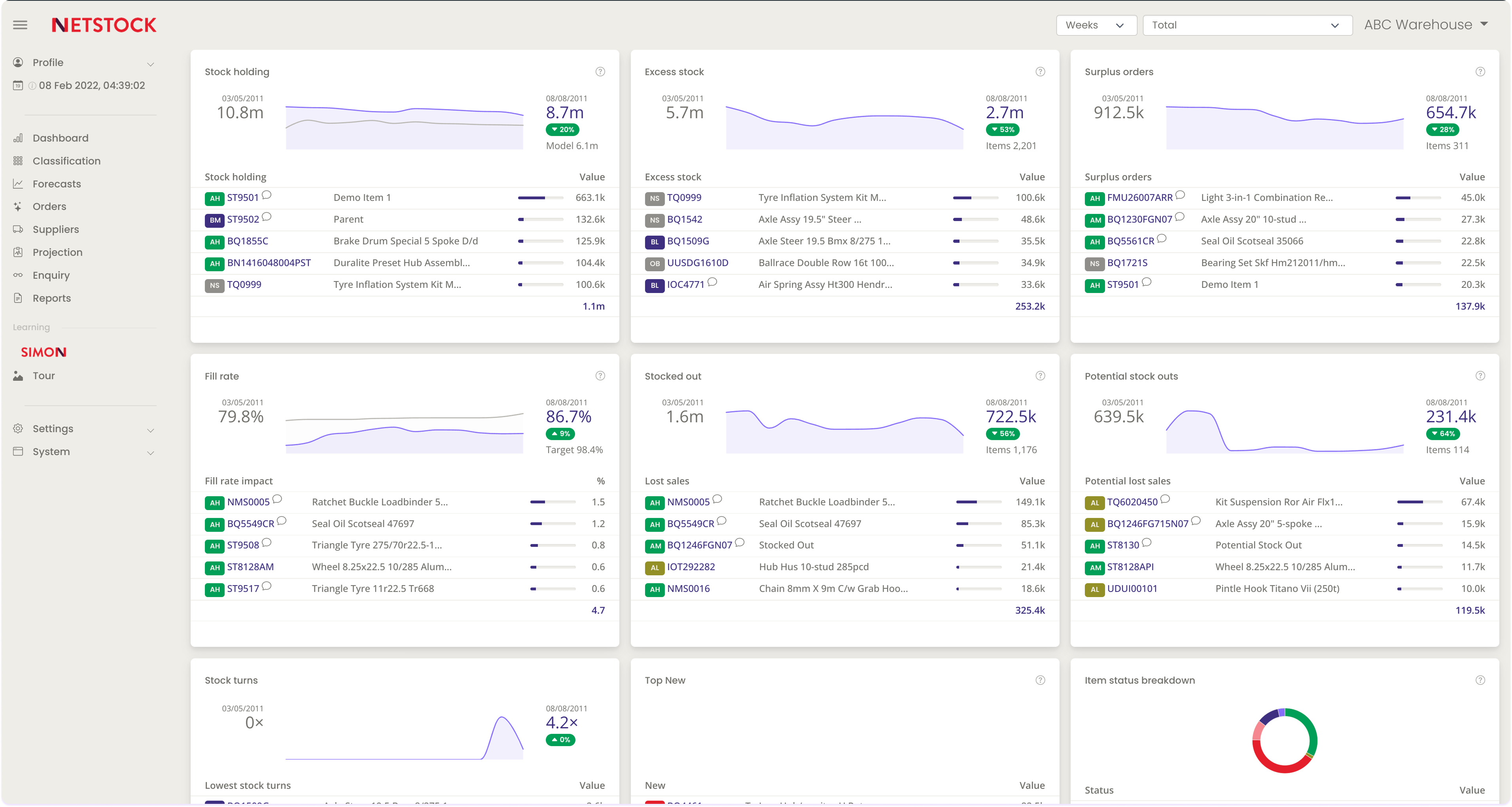
Netstock positions itself as a fast-to-implement, cost-accessible overlay for existing ERP systems. You connect it to your ERP, and it starts generating replenishment recommendations based on demand analysis and inventory classification. For smaller chains that can't justify an enterprise platform, it's a practical starting point.
Key features:
- ERP-agnostic integration: connects to a wide range of existing systems without heavy custom development
- Inventory classification and ABC/XYZ analysis for prioritizing planning focus
- Demand-driven replenishment recommendations with visual dashboards
- Supplier performance tracking and order management
| ✅ Pros | ❌ Cons |
|---|---|
| Fast implementation | Less algorithmic depth than purpose-built optimization platforms |
| Accessible pricing | Limited multi-echelon planning capability |
| Intuitive interface praised by user reviews | Works better as an upgrade from spreadsheets than as a replacement for enterprise tools |
| Strong for businesses transitioning away from spreadsheets |
Pricing: From approximately $500/month, varying by SKU and location count. Demo available.
Best for: SMBs and growing retail chains with up to 20 to 30 stores looking to upgrade from manual planning without enterprise-level investment.
Growing chains that need deeper retail automation or DC-to-store capabilities may also want to review Netstock alternatives before choosing an ERP-connected planning overlay.
6. EazyStock: Best for ERP-Heavy Teams Needing Inventory Health Automation
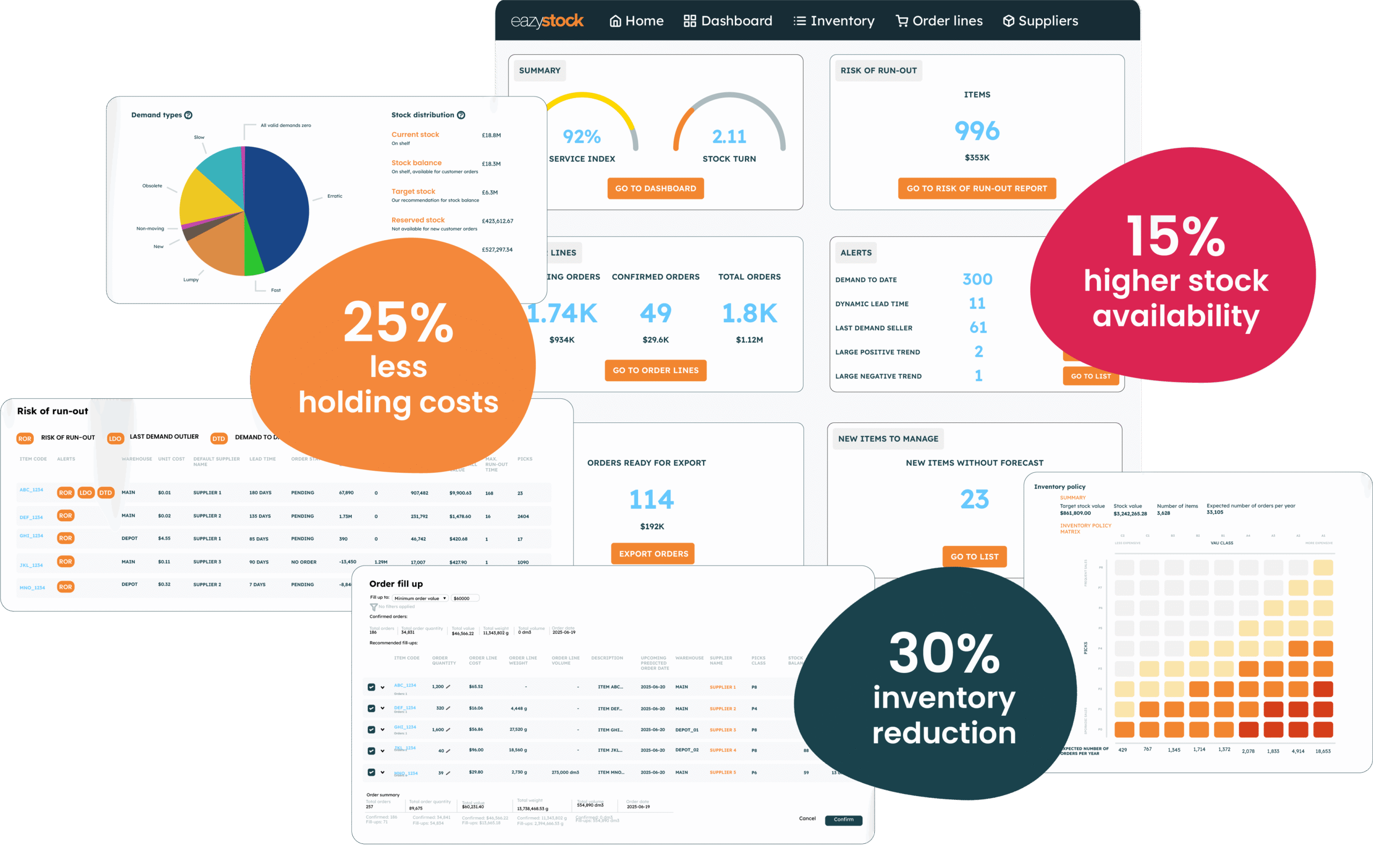
EazyStock is purpose-built to sit on top of existing ERP systems and fill the inventory optimization gap that ERP modules typically leave. It connects to SAP Business One, Dynamics 365, Epicor, and others, then adds classification, buffer calculation, and demand-driven replenishment on top of the ERP's basic stock management.
Key features:
- ERP-native integration with major mid-market ERP platforms
- Automated inventory segmentation and reorder point calculation
- Safety stock optimization based on service level targets
- Demand classification for slow movers, seasonal items, and lumpy demand profiles
| ✅ Pros | ❌ Cons |
|---|---|
| Purpose-built ERP extension with minimal disruption to existing workflows | Can feel rigid in fast-paced or highly promotional retail environments |
| Good fit for teams that want better optimization without replacing their ERP | Limited standalone capabilities outside the ERP context |
| Less AI-native than newer platforms |
Pricing: Contact for pricing. Modular based on ERP and user count.
Best for: Mid-market retailers and distributors running established ERP systems who need better inventory science without a platform migration.
7. Inventory Planner: Best for Small Retailers and E-commerce
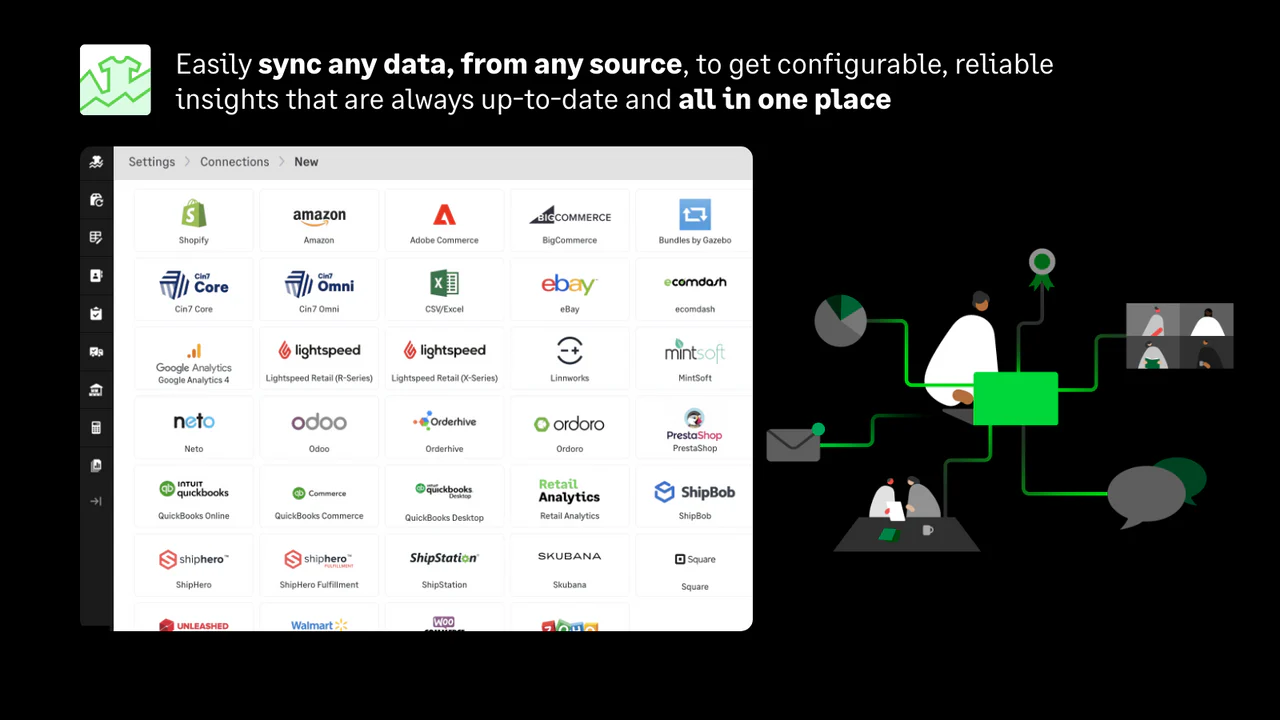
Inventory Planner focuses on purchase recommendations for small retailers. It connects to e-commerce platforms (Shopify, WooCommerce, and Amazon) and generates replenishment suggestions based on historical sales and lead times. It's not enterprise software, but for a 1- to 5-location retailer managing a complex SKU mix, it covers the basics well.
Key features:
- SKU-level purchase recommendations based on sell-through rate and lead times
- Multi-channel inventory sync across e-commerce and physical store locations
- Replenishment calendar and supplier order management
- Demand forecasting with variance analysis by SKU
| ✅ Pros | ❌ Cons |
|---|---|
| Easy to implement | Not built for large multi-store retail chains |
| E-commerce native | Limited multi-echelon planning |
| Affordable entry pricing | The AI layer is less sophisticated than platforms designed for retail chains at scale |
| Accessible for teams without a dedicated supply chain analyst |
Pricing: From approximately $99/month, scaling with SKU count. 14-day free trial available.
Best for: Small retailers, e-commerce brands, and boutique chains with simple replenishment needs and tight budgets.
8. Kinaxis: Best for Enterprise Scenario Planning Across the Supply Chain
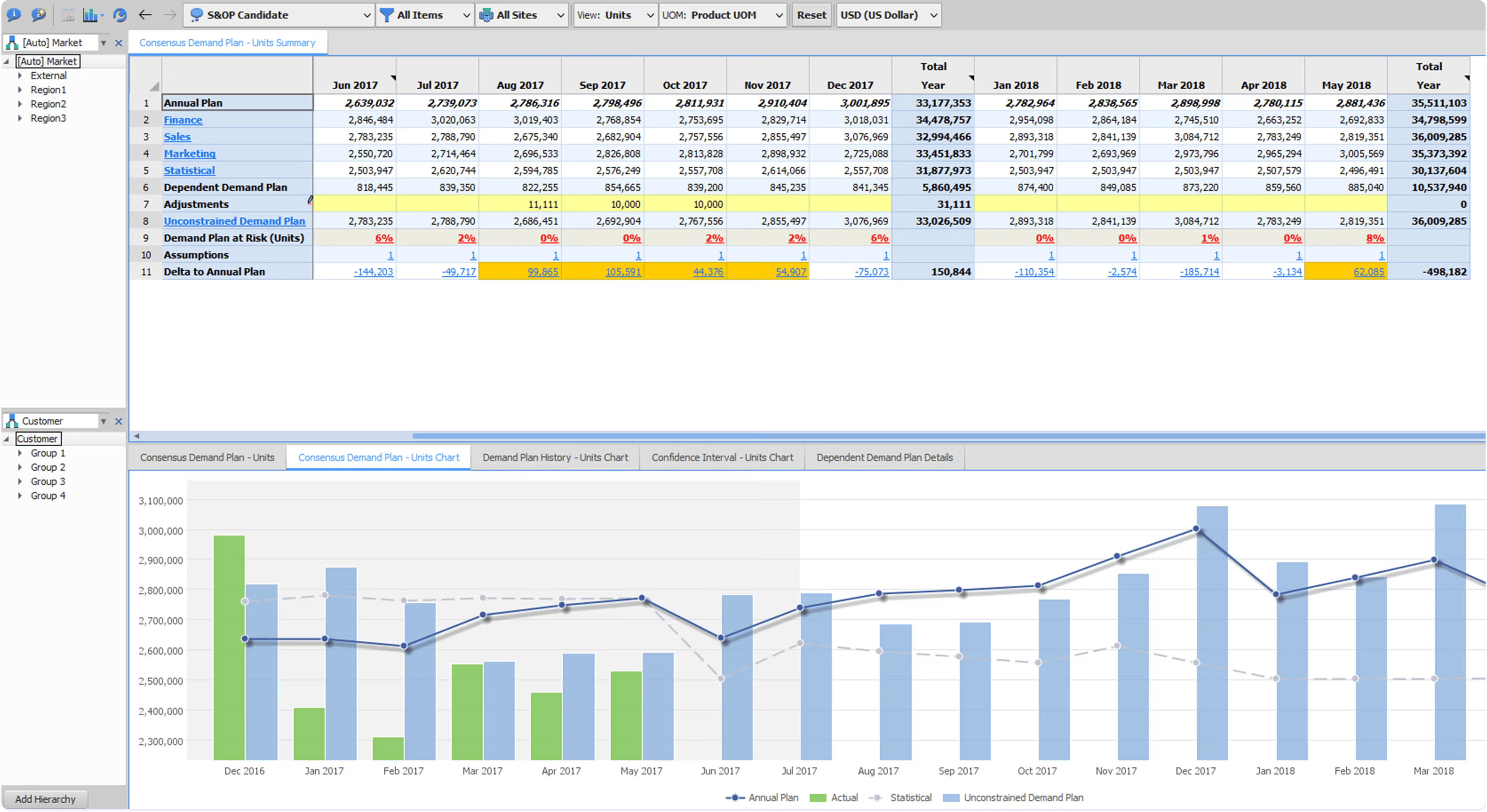
Kinaxis (RapidResponse) is designed for enterprises that need to model supply chain scenarios in real time, simultaneously running current operations and what-if analysis on the same data. It's used heavily in manufacturing and high-tech, but also in retail for large chains with complex global sourcing. The concurrent planning capability is a genuine differentiator at enterprise scale.
Key features:
- Concurrent planning that runs actuals and scenarios simultaneously without separate plan versions
- Real-time supply chain visibility with exception management and alerting
- Demand sensing and supply balancing across multi-tier networks
- Strong integration capabilities with major ERP and planning systems
| ✅ Pros | ❌ Cons |
|---|---|
| Exceptional for scenario planning and response speed | Primarily designed for manufacturing and complex supply chains |
| Strong at connecting demand signals to supply constraints in real time | Retail-specific features (planogram, shelf, promotions) are limited compared to RELEX or LEAFIO AI |
| Significant implementation investment required |
Pricing: Contact for pricing. Enterprise investment, typically for organizations with complex global supply chains.
Best for: Large enterprises with multi-tier global supply chains that need real-time scenario planning alongside operational execution.
Retailers evaluating concurrent planning but looking for a more retail-specific approach should also compare Kinaxis competitors across forecasting, replenishment automation, implementation requirements, and total cost.
How to Choose the Right Inventory Optimization Software for Your Business
There's no universal answer here. The right tool depends on your business shape, and buying the most powerful option on the market rarely pays off if it's 10 times more than you need.
1. Start with your store count and SKU complexity. A 5-store specialty retailer and a 200-store grocery chain have fundamentally different needs. If you're running under 20 locations with a stable SKU mix, tools like Netstock or Inventory Planner give you 80% of the value at a fraction of the cost. Above 50 stores with high SKU turnover, fresh categories, or active promotional calendars, you need a platform designed for that reality. LEAFIO AI's automated replenishment software is built exactly for this range.
2. Be honest about your pain points. Are you losing margin to stockouts on key SKUs? That's a forecasting and replenishment problem. Are your planners spending half the week on manual overrides? That's an automation problem. Are you carrying too much safety stock everywhere? That's a buffer calibration problem. The tools that solve each of these well are not always the same.
3. Check integration requirements before anything else. Map your current ERP, WMS, and POS stack. Then verify which integrations are native (no custom work required) versus configured (some development cost) versus custom (significant technical investment). A tool that needs 3 months of IT work to connect to your ERP costs more than its license fee.
4. Ask about multi-echelon coverage. Many tools optimize store replenishment. Fewer handle DC-to-store distribution together. If you're running a distribution center network, the inability to optimize across levels leaves real money on the table — stock sitting in the DC that should be at the shelf, or stores over-ordered because the DC supply wasn't factored in.
5. Test before committing. Every serious vendor on this list offers a demo. Go beyond the demo to a pilot on a real category if possible. The difference between what the platform looks like in a sales presentation and how it performs on your actual data is where most implementation surprises live.
ERP vs. Specialized Inventory Optimization Software: When to Choose Each
Your ERP almost certainly has an inventory module. SAP, Oracle, NetSuite, Microsoft Dynamics—they all include reorder point logic, stock tracking, and basic replenishment triggers. So why pay separately for optimization software?
The honest answer: ERP inventory modules are built for control, not optimization. They track what you have and generate orders when stock falls below a threshold. That threshold is usually set manually, updated infrequently, and doesn't account for demand variability, supplier performance, promotional uplifts, or seasonal shifts.
Specialized inventory optimization software replaces static thresholds with dynamic, AI-driven calculations that adjust continuously. The practical gap shows up in three places: forecast accuracy, automation coverage, and SKU-level granularity at scale. Your ERP won't model 50,000 SKUs across 150 stores with individual demand profiles. A purpose-built tool will.
When your ERP is good enough: single location, limited SKU count, low demand variability, and stable supplier relationships. If your planning team isn't spending meaningful time on manual corrections and you're not losing sales to stockouts, the ERP module may be sufficient.
When you need specialized software: multi-store operations, active promotional calendars, fresh or seasonal categories, high SKU velocity, or any situation where your planners are clearly doing work the system should be doing for them.
How AI Enhances Inventory Optimization
Rule-based replenishment systems do what you tell them. AI-powered systems figure out what the right rule should be and update it when conditions change.
The practical differences are AI handles demand volatility without manual parameter updates; it accounts for thousands of signals (seasonality, weather, promotions, and local events) simultaneously at the SKU level; and it catches emerging problems, such as slow movers building up or supplier lead times shifting, before they become margin problems.
Most legacy tools on the market still rely heavily on rule-based logic with AI features bolted on as a reporting layer. The gap between rule-based and genuinely AI-native is widest in replenishment accuracy and the reduction in manual overrides. LEAFIO AI is one of the clearer examples of a platform where the AI is the engine, not the dashboard—its self-regulating algorithms continuously calibrate buffers based on real demand, not static parameters set during implementation.
How to Launch an Inventory Optimization Solution That Scales
The transition from spreadsheets or a legacy system to a modern platform doesn't have to take a year. With the right preparation, mid-market retail chains go live in 8 to 16 weeks.
- Clean your master data first. SKU hierarchy, supplier lead times, and store attributes need to be accurate before any algorithm can work with them.
- Start with a pilot category. Pick one high-impact category (high volume, high variability) and run the optimization there first. Build confidence before rolling out across all categories.
- Define your KPIs before go-live. Stockout rate, overstock value, inventory turnover, and planner time on overrides. Baseline these before launch so you can measure actual impact.
- Train the team on interpretation, not just operation. The platform should reduce manual work, but your planners still need to understand what the system is recommending and why.
- Review buffer performance at 30 and 90 days. AI-driven tools improve as they learn your demand patterns. Plan a formal review of KPI changes at both milestones.
LEAFIO AI's implementation team has completed over 200 retail rollouts worldwide. Customers typically achieve positive ROI within the first year, with ROI reaching 300 to 400% by year three. Explore the LEAFIO AI inventory optimization platform to see what the rollout looks like for a chain your size.
FAQ: Inventory Optimization Software
What is the best inventory optimization software for retail in 2026?
LEAFIO AI is consistently rated among the best inventory optimization software for mid-to-large retail chains, earning a 5.0 on G2 and 25 G2 awards in 2025. For enterprise retailers with global supply chains, RELEX Solutions and Blue Yonder are strong alternatives. The best choice depends on your store count, budget, and whether you need retail-specific depth or broader supply chain coverage.
What features should I look for in inventory optimization software?
The core features to evaluate are AI-driven demand forecasting, automated replenishment, multi-echelon stock distribution (from DC to stores), promotion management, and real-time inventory visibility. Look for tools that handle seasonal demand and supplier variability, not just average sales velocity. Integration with your ERP or POS system is also essential before you sign anything.
How much does inventory optimization software cost?
Pricing varies widely. Mid-market tools like LEAFIO AI use modular, store-and-SKU-based pricing that's more accessible than enterprise alternatives. Blue Yonder and RELEX typically run custom enterprise contracts. Most vendors in this space don't publish list prices publicly—expect a discovery call before you see numbers.
Is there free inventory optimization software available?
True free tiers are rare in retail inventory optimization. Most vendors offer free demos or trial access rather than permanent free plans. Tools like Netstock and Inventory Planner offer demo access, and LEAFIO AI provides a free demo of its full platform. If you're running a small single-store operation, entry-level tools like Zoho Inventory have freemium options, but they lack the algorithmic depth of purpose-built optimization software.
What inventory optimization software works best for mid-size retail chains?
LEAFIO AI is purpose-built for mid-to-large retail chains with 20 to several hundred stores. It balances AI-driven automation with practical retailer workflows, and its modular pricing makes it significantly more accessible than enterprise platforms like RELEX or Blue Yonder. Netstock is another option for smaller chains that need solid forecasting without a full-platform commitment.
How does inventory optimization software integrate with ERP systems?
Most purpose-built inventory optimization tools connect via API to common ERP systems like SAP, Oracle, Microsoft Dynamics, and 1C. LEAFIO AI supports integrations with major ERP and WMS platforms used in retail. EazyStock is specifically designed to layer onto existing ERP setups. Before selecting software, map your current tech stack and verify which integrations are native versus custom-built; custom integrations add cost and implementation time.
How long does it take to implement inventory optimization software?
For mid-market retailers, implementation typically takes 2 to 4 months with a well-prepared data set. LEAFIO AI has completed over 200 implementations worldwide, and customers typically see initial ROI within the first year. Enterprise platforms like RELEX and Blue Yonder have longer timelines — 6 to 12 months is common — due to higher customization requirements and multi-department rollouts.
How does AI improve inventory optimization workflows?
AI replaces static reorder-point rules with dynamic, SKU-level demand models that account for seasonality, promotions, supplier lead times, and external signals. The practical result is fewer manual overrides, reduced safety stock bloat, and better shelf availability without overspending on working capital. LEAFIO AI's self-regulating algorithms, for example, continuously adjust buffers based on real sales patterns rather than static averages.
Can inventory optimization software reduce stockouts without increasing overstock?
Yes, this is the core problem the category solves. Retailers using AI-powered inventory solutions report average reductions of 15% in stockouts and 20% in excess inventory carrying costs. The mechanism is more accurate SKU-level forecasting combined with automated replenishment that adjusts to demand signals continuously, rather than relying on annual or seasonal reorder parameters.
What is the difference between inventory management and inventory optimization software?
Inventory management software tracks what you have — stock levels, locations, movements. Inventory optimization software tells you what you should have and when to replenish it. Optimization adds demand forecasting, replenishment automation, and buffer calculation on top of basic tracking. Most modern platforms combine both, but the optimization layer is what drives the measurable financial outcomes: fewer stockouts, less overstock, and lower working capital requirements.


Have a question?

Katrina Walker
Especialista em Otimização de Estoque de Varejo no Brasil