

Most retail supply chains don't fail because the software is missing. They fail because the software in use was built for a different problem. An ERP replenishment module works fine when demand is stable and suppliers are reliable. Put it through a promotional week across 80 stores with variable lead times, and it starts generating stockouts on your fastest movers while your slow movers sit untouched.
We reviewed 8 best retail supply chain software platforms to help you find the right fit. The list covers tools built for different scales and needs: from mid-market chains that need fast deployment and AI-driven replenishment to global enterprise retailers where WMS, transportation, and supplier visibility are non-negotiable. Criteria included demand forecasting depth, DC-to-store distribution logic, ERP integration, AI capability (genuine versus marketed), and implementation realism for actual retail operations.
One platform worth flagging early: LEAFIO AI stands out as the only tool on this list purpose-built for retail chains at mid-to-large scale, combining inventory optimization, automated replenishment, and shelf planning in a single system rather than patching three separate tools together. If closing the gap between your supply plan and what actually reaches the shelf is the problem you're trying to solve, it's worth looking at closely.
What Is Retail Supply Chain Software?
Retail supply chain software is a platform that manages the flow of goods from suppliers to stores, covering demand forecasting, inventory planning, automated replenishment, and distribution across a retail network. It draws on sales data, supplier lead times, and service-level targets to generate ordering and allocation decisions — automatically, not manually. Modern platforms add AI-driven forecasting, promotional uplift modeling, multi-location distribution logic, and integration with ERP and POS systems, so stock levels stay aligned with actual store demand rather than chain-wide averages.
Why Retail Supply Chain Software Matters
Retail inventory distortion is an expensive and persistent problem. According to research cited by Food Logistics, stockouts alone cost retailers $1.2 trillion annually, while overstocks generate an additional $562 billion in losses from discounts and spoilage. The same research found that 80% of companies that invested in supply chain technologies saw revenue growth within the first 12 months. The math on doing nothing is not kind.
Without dedicated retail supply chain software, most chains run into the same set of problems:
- Replenishment fires reactively; purchase orders go out after a stockout, not before
- Safety stock is calculated from fixed rules that ignore seasonality and demand variability
- Promotional periods create stockouts on fast movers while slow movers pile up in the same category
- DC-to-store distribution is disconnected from actual shelf demand at each location
- Planning teams spend 20-30% of their time overriding what the system recommended, rather than managing category strategy
- ERP replenishment modules handle stable demand adequately but break down at promotional scale
How We Picked the Best Retail Supply Chain Software
Selecting tools for this list started from one practical question: does this platform actually change how replenishment decisions are made when demand changes, or does it reformat the same rule-based logic into a better interface? That drove most of the evaluation. We reviewed product documentation, ran through demos, and pulled user feedback from G2 and Gartner Peer Insights. Here is what separated the stronger platforms from the rest:
- Demand forecasting depth. The difference between a fixed reorder point and a model that updates continuously from live sales data is significant. We prioritized the latter.
- DC-to-store distribution logic. For retail chains, allocating stock from a distribution center to stores is a distinct planning problem from purchase order generation. Fewer tools solve it well.
- AI depth versus AI marketing. Many platforms describe themselves as AI-powered while running rule-based automation under the hood. We tried to be specific about which is which for every platform reviewed.
- ERP and POS integration. Retail SCM software that can't connect cleanly to your existing systems creates more work than it saves. We checked SAP, Oracle, and NetSuite compatibility for each tool.
- Promotional and seasonal planning. Uplift modeling for campaigns and seasonal demand curves are where most replenishment failures happen. Tools without them are incomplete for FMCG and grocery.
- Implementation realism. Enterprise platforms are powerful. They are also expensive and take months to deploy. A platform your team can actually adopt in a reasonable timeframe is worth more than a feature list that takes 18 months to unlock.
- Scalability for multi-store networks. Single-store tools don't belong on a retail chain shortlist. We focused on platforms that scale from 20 to 1,000+ locations.
Quick Comparison: Best Retail Supply Chain Software at a Glance
Here is a snapshot of all eight platforms before the in-depth reviews. LEAFIO AI appears first because it is the strongest retail-specific option for chains that need AI-driven planning without enterprise-level implementation overhead.
| Tool | Best For | Price Range | Free Trial? | Key Feature |
|---|---|---|---|---|
| LEAFIO AI | Mid-to-large retail chains | Custom pricing | Yes (demo) | Unified retail SCM: inventory + replenishment + shelf planning |
| RELEX Solutions | Enterprise grocery & specialty retail | Custom pricing | Demo only | Gartner MQ Leader 2025; AI-native demand + supply planning |
| Blue Yonder | Global enterprise retailers | Custom pricing | Demo only | End-to-end AI supply chain at enterprise scale |
| Manhattan Associates | Omnichannel retail, WMS-heavy | Custom pricing | Demo only | Cloud-native WMS + OMS in one Active Platform |
| Oracle SCM / NetSuite | Mid-to-enterprise ERP users | From ~$999/mo (NetSuite) | Yes | Retail SCM inside a full ERP ecosystem |
| Infor Nexus | Retailers with complex global supplier networks | Contact for pricing | Demo only | Multi-enterprise supplier visibility network |
| Kinaxis Maestro | Enterprise retailers needing scenario planning | Contact for pricing | Demo only | Concurrent planning + rapid what-if simulation |
| SAP IBP | Large enterprise retailers on SAP ecosystem | Contact for pricing | Demo only | ERP-integrated SCM, broadest ecosystem coverage |
8 Best Retail Supply Chain Software: In-Depth Reviews
1. LEAFIO AI: Best Retail Supply Chain Software for Mid-to-Large Chains
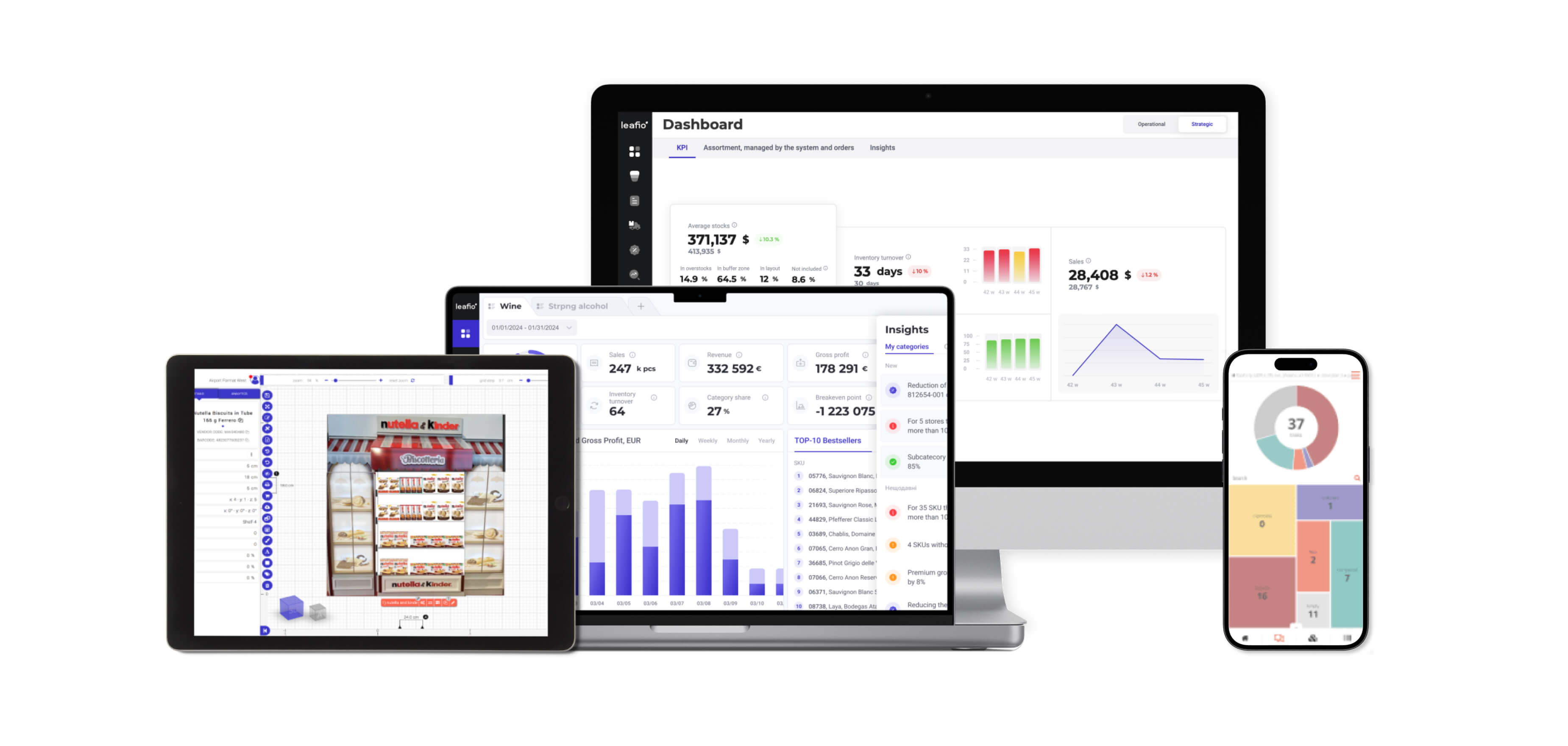
LEAFIO AI is the platform we would put at the top of this list for any retail chain running a distribution center that feeds multiple stores. Not because the interface is the most polished or the pricing is the most visible. But because the planning logic is built specifically for the problems retail chains actually face: DC-to-store distribution, promotional demand spikes, assortment changes mid-season, and out-of-stocks that happen despite a warehouse that looks adequately stocked.
The core of the platform is the inventory optimization software module, which uses AI-driven demand forecasting and a buffer system to manage replenishment at the SKU and store level. Each product gets a buffer profile: green means stock is adequate, yellow means order soon, and red means stockout risk. Those zones don't sit static: they recalculate based on average daily usage, supplier lead times, and the service-level target configured per category. Replenishment triggers before the shelf empties, not after.
What separates LEAFIO AI from most planning tools is the DC-to-store distribution module. Most replenishment platforms stop at the purchase order. LEAFIO AI's automated replenishment goes further: instead of stores submitting their own orders, the system calculates how to allocate stock across the network algorithmically, based on where demand is going and what each store's buffer looks like right now. Store managers don't order. The system distributes. For a supply chain team managing 50 or 200 locations, that operational difference matters considerably.
Promotion planning is handled inside the same logic. Uplift modeling is built into the buffer calculation, so stock builds before a campaign starts, not after the first day of stockouts reveals that the manual order inflation was wrong. Seasonal demand curves are similarly embedded, so the planning team isn't manually adjusting safety stock before every Q4.
The platform also includes shelf planning software as part of the broader LEAFIO AI Retail Platform. Inventory decisions, assortment planning, and shelf layout are connected through a shared data layer, which means when an SKU is added or dropped from the range, the replenishment logic and the planogram update together, without a manual handoff between teams.
Key Features:
- AI demand forecasting and buffer replenishment. Statistical and ML models per SKU and store, with green/yellow/red buffer zones that recalculate from live sales data. Replenishment triggers before stockout, not after.
- DC-to-store algorithmic distribution. Calculates stock allocation across the store network from the distribution center. Removes manual store ordering for direct-supplier products.
- Promotional and seasonal demand planning. Uplift modeling and seasonal demand curves built into buffer calculations with no manual order inflation before campaigns.
- Shelf planning integration. Planogram generation connects to inventory and assortment data, so layout and replenishment update from the same source.
- ERP integration. Connects to SAP, Oracle, and major retail ERP systems for real-time data, purchase order generation, and supplier management.
LEAFIO AI: Pros and Cons
| ✅ Pros | ❌ Cons |
|---|---|
| Retail-specific DC-to-store distribution logic, rare in the market | Pricing available only through direct contact; no public tiers |
| Promotions, seasonality, and new product introductions handled in the planning logic | Full implementation for large multi-format chains takes several weeks |
| Shelf planning integrated with replenishment in a unified platform | Primarily designed for retail; less suited to pure manufacturing or 3PL operations |
| 5.0/5 on G2, highest of all tools reviewed here | |
| Deploys in weeks for mid-sized chains, not months |
Real-world results support the vendor’s gains. After implementing LEAFIO AI Inventory Optimization, Daily, a convenience store chain from Georgia that grew from 170 to 227 stores during the project saw sales increase by 23%, inventory turnover improve by 16% (from 30 to 24 days), and average shelf availability rise by 8%. 99.5% of orders are generated and sent automatically.
Pricing: Custom pricing based on chain size and module selection. Request a free demo →
Best for: Mid-to-large retail chains that need automated DC-to-store replenishment, AI-driven demand forecasting, and shelf planning in a single retail-specific platform.
2. RELEX Solutions: Best for Enterprise Grocery and Specialty Retail
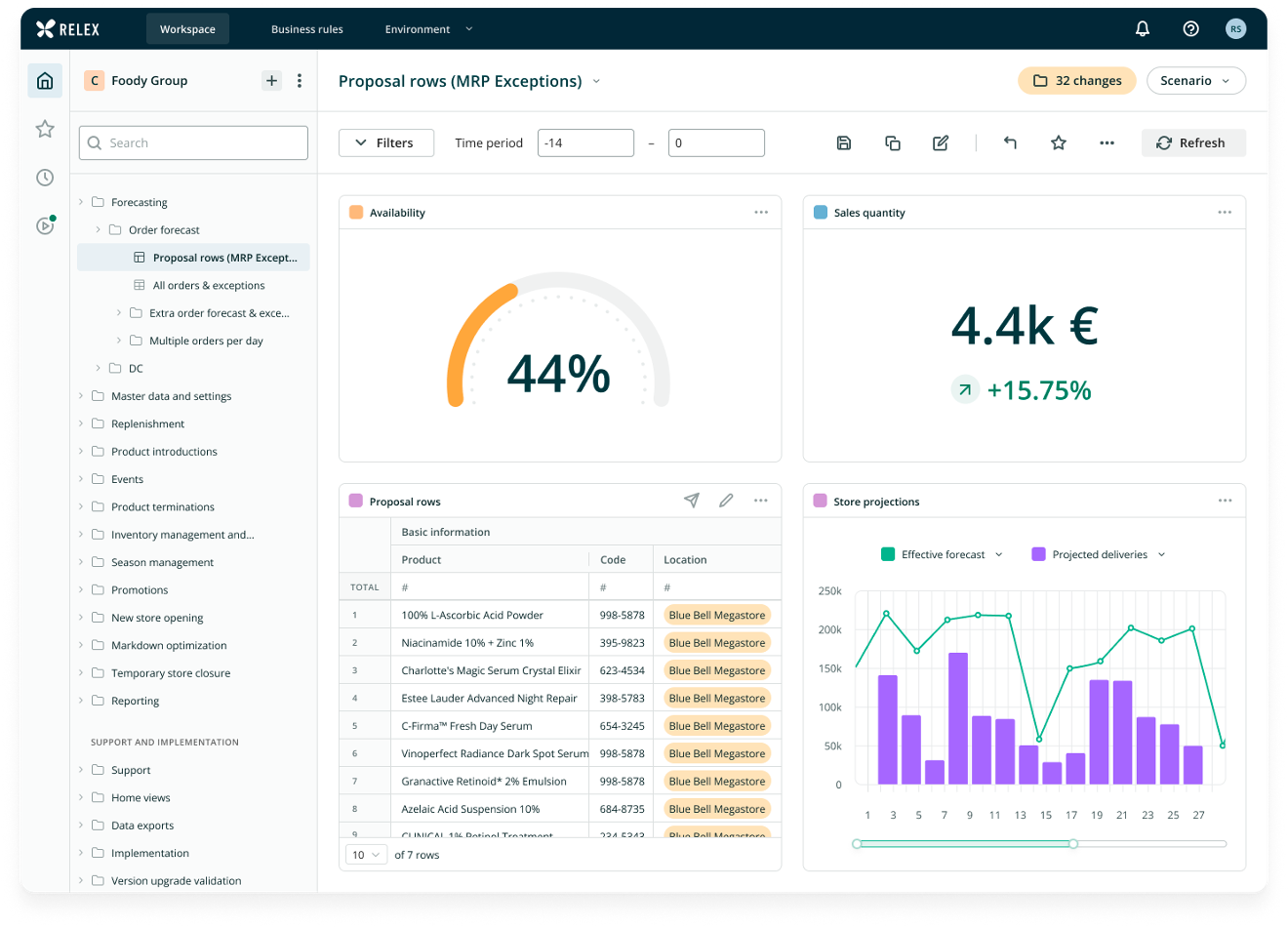
RELEX Solutions is what most enterprise grocery chains end up evaluating when they have outgrown basic ERP replenishment. The platform covers demand forecasting, automated replenishment, space management, and workforce planning, which sounds broad, but for a large food retailer running weekly promotions across 500 stores, having replenishment talk to space planning without a manual data handoff is the point. RELEX was recognized as a Gartner Magic Quadrant Leader in 2025 for Supply Chain Planning, which reflects both platform maturity and commercial traction.
The replenishment engine is AI-native in a meaningful sense: forecast models update from POS data continuously, not on a weekly batch cycle. In high-turnover categories (fresh, dairy, seasonal), that speed difference is where stockouts happen or don't. RELEX holds a 4.8/5 rating on Gartner Peer Insights from 84 verified reviews, with users consistently praising forecast accuracy and the platform's flexibility in configuring business rules without customization.
Key Features:
- AI-powered demand forecasting with continuous updates from POS data
- Automated replenishment order generation for stores and distribution centers
- Promotion planning with pre-built uplift models integrated into replenishment logic
- Space and assortment planning modules connected to replenishment decisions
- Unified platform: supply chain, space, and workforce planning in one system
RELEX Solutions: Pros and Cons
| ✅ Pros | ❌ Cons |
|---|---|
| Gartner Magic Quadrant Leader 2025 — strong independent validation | Enterprise pricing and multi-month implementation — not accessible for mid-market budgets |
| AI-native replenishment engine, not rule-based automation with AI branding | Full value requires adoption across multiple modules, not just replenishment |
| Strong track record in grocery and FMCG with complex promotional calendars | Steep onboarding curve for less technical planning teams |
Pricing: Custom pricing. Contact RELEX directly for a demo.
Best for: Large retail and grocery chains where AI-driven forecasting, promotion planning, and unified supply chain visibility are required at enterprise scale.
Retailers that need unified planning but want a faster or more modular deployment can also compare Relex Solutions alternatives before committing to an enterprise-wide rollout.
3. Blue Yonder: Best for Global Enterprise Retailers
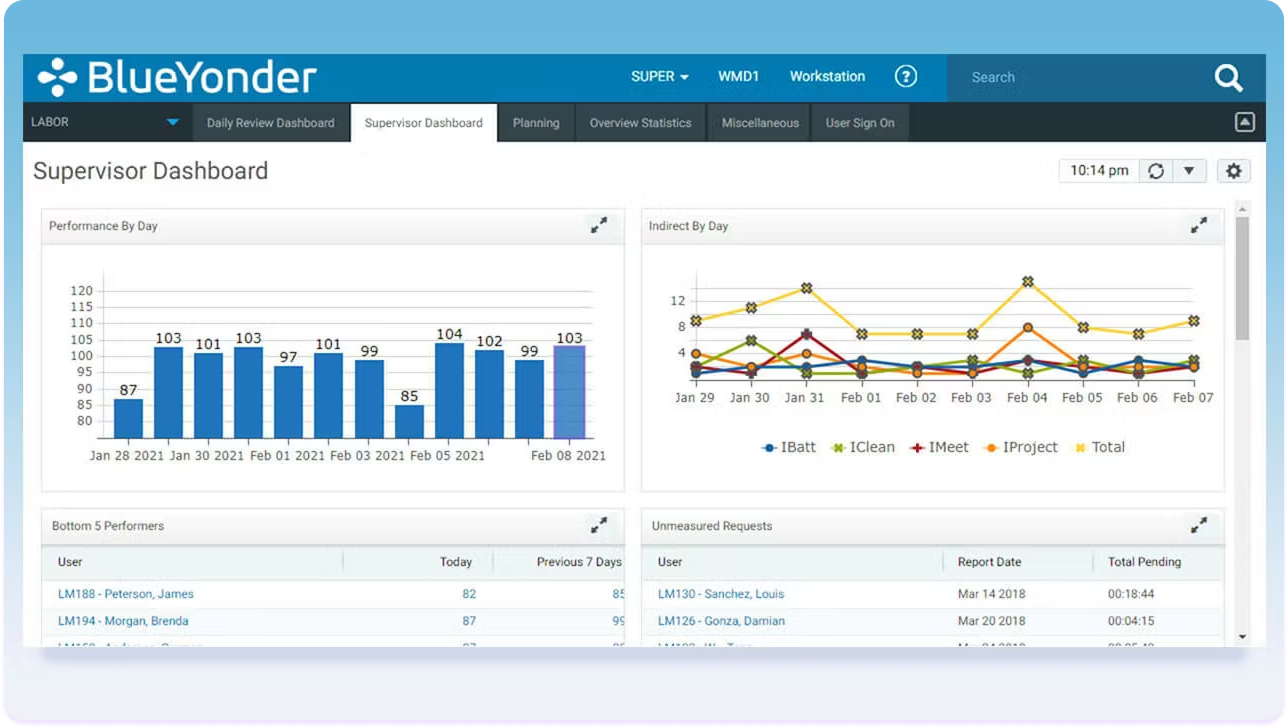
Blue Yonder (formerly JDA) is the market's reference point for AI-driven supply chain planning at a global scale. The platform covers demand planning, replenishment, allocation, warehouse management, transportation, and workforce. Over the 2025 Thanksgiving weekend, the platform processed delivery date estimates for 1.2 billion SKUs in under 12 milliseconds per request. That's less a feature than a signal of what you're buying into.
The replenishment module uses real-time signals from POS systems, supply chain events, and external data to update inventory positioning decisions continuously. For retailers already embedded in the Blue Yonder ecosystem, that integration is genuinely seamless. For everyone else, Blue Yonder is harder to justify as a standalone retail SCM. The value is in the ecosystem, and the ecosystem is expensive to enter. Blue Yonder holds a 4.5/5 rating on Gartner Peer Insights from 255 reviews.
Key Features:
- AI demand sensing with real-time updates from POS and supply chain signals
- Automated replenishment across stores, DCs, and multi-tier distribution networks
- Integrated WMS, TMS, and workforce planning within the Blue Yonder Luminate platform
- Store clustering and localized replenishment planning at enterprise scale
Blue Yonder: Pros and Cons
| ✅ Pros | ❌ Cons |
|---|---|
| Handles replenishment at global enterprise scale across complex networks | Cost and complexity rule it out below enterprise scale |
| Tight integration with WMS and transportation in the same suite | Full value requires investment across the broader Blue Yonder ecosystem |
| 255 Gartner Peer Insights reviews — strong validation depth | Implementation is measured in months, not weeks; steep learning curve on legacy UI |
Pricing: Contact for pricing. No public tiers.
Best for: Global enterprise retailers where supply chain planning, WMS, and logistics are managed in a single integrated environment.
For organizations that do not need the full enterprise ecosystem, Blue Yonder alternatives may provide a more focused path to retail planning and replenishment with lower implementation overhead.
4. Manhattan Associates: Best for Omnichannel Retail and WMS-Driven Operations
Manhattan Associates has been building retail supply chain technology for decades, and its transition to a cloud-native microservices architecture through the Manhattan Active platform is a meaningful upgrade from its legacy roots. The platform is strongest in WMS and OMS for omnichannel operations: Pet Supplies Plus runs its 730+ store network on Manhattan's cloud-native WMS, and PacSun processed roughly 40,000 units per day from closed store locations during COVID using Manhattan Active Omni's ship-from-store capabilities.
The supply chain planning module was added to the Active Platform in 2024, which enables better orchestration across WMS, OMS, and planning when a retailer uses multiple Manhattan products. The strength here is integration within the Manhattan ecosystem, not standalone planning depth. Replacing a Manhattan system mid-growth is a 3-4 year project for even a mid-sized retailer, which means vendor selection carries significant long-term commitment.
Key Features:
- Cloud-native WMS and OMS unified in the Manhattan Active Platform
- Supply chain planning module added in 2024, integrating with WMS and OMS data
- Omnichannel fulfillment capabilities including ship-from-store and BOPIS
- Strong retail and e-commerce track record, available on Google Cloud Marketplace
Manhattan Associates: Pros and Cons
| ✅ Pros | ❌ Cons |
|---|---|
| Industry-leading WMS for complex omnichannel retail operations | The supply chain planning module is newer and less mature than dedicated planning vendors |
| Cloud-native microservices architecture for flexibility and scalability | Zero public pricing; requires sales conversation to get to numbers |
| Strong case study portfolio across large retail and e-commerce brands | Implementation is a years-long commitment for large networks |
Pricing: Custom pricing. No public tiers. Contact Manhattan Associates for a quote.
Best for: Enterprise omnichannel retailers where WMS, OMS, and fulfillment capabilities are as important as supply chain planning.
5. Oracle SCM / NetSuite: Best for Mid-to-Enterprise ERP Users
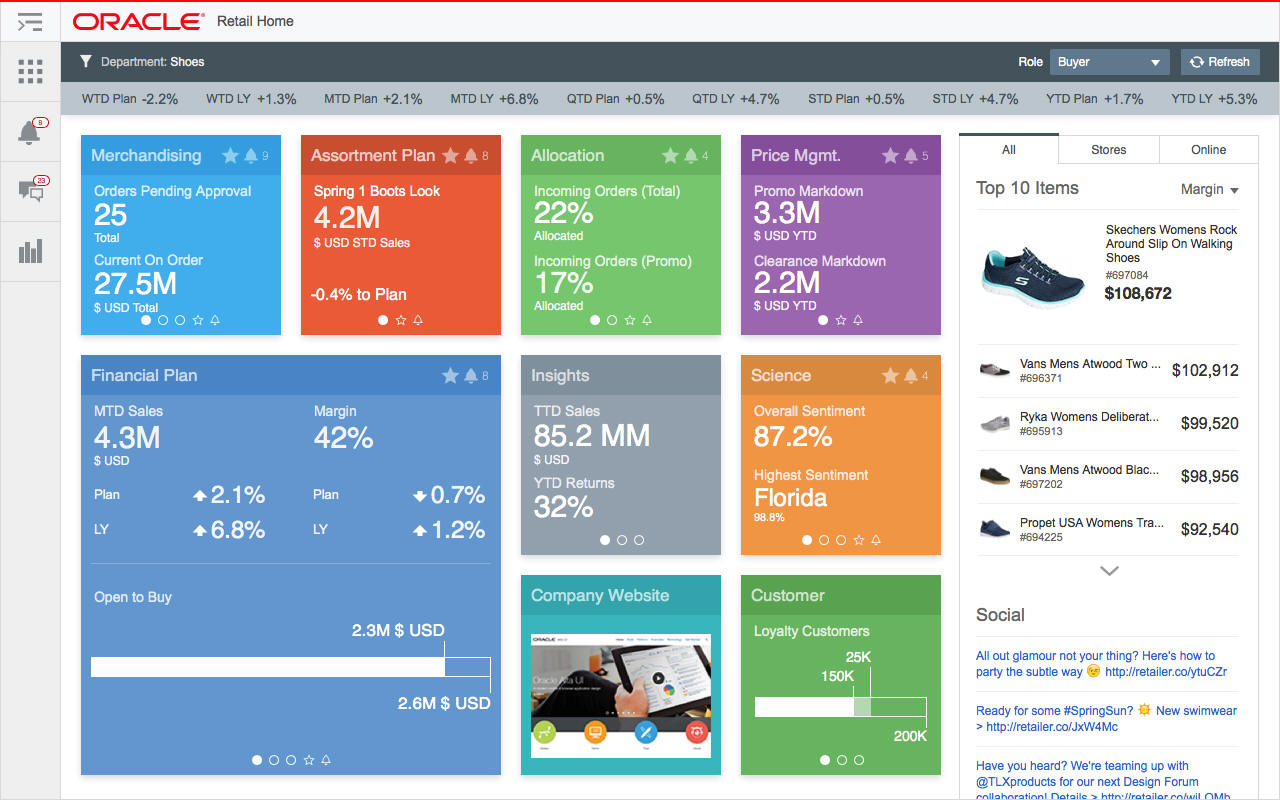
Oracle SCM / NetSuite covers two related but distinct products. Oracle SCM Cloud is Oracle's enterprise supply chain suite for large retailers, covering procurement, supply planning, order management, manufacturing, and logistics with AI/ML capabilities, including demand sensing and supplier risk monitoring. NetSuite is the mid-market ERP that includes demand-driven replenishment and inventory management as core modules within the broader platform.
The strength here is integration: if you're already on NetSuite or Oracle, adding SCM capabilities doesn't require a separate vendor or data bridge. For retailers with stable, relatively simple replenishment needs, that native integration is genuinely valuable. Where Oracle falls short is specialized retail complexity: promotional uplift modeling, DC-to-store distribution, and store-level customization are where dedicated retail platforms outperform Oracle's native capabilities. NetSuite starts at approximately $999/month, which makes it one of the few platforms on this list with a public pricing anchor.
Key Features:
- Demand-driven replenishment with automated purchase order generation (NetSuite)
- AI/ML demand sensing and backlog prioritization (Oracle SCM Cloud)
- Real-time inventory visibility across multiple locations and warehouses
- Integration with Oracle's broader ERP, finance, and logistics modules
Oracle SCM / NetSuite: Pros and Cons
| ✅ Pros | ❌ Cons |
|---|---|
| No separate integration required if already on Oracle or NetSuite | Replenishment logic is less sophisticated than dedicated retail planning tools for complex chains |
| NetSuite offers public pricing starting at ~$999/month, rare transparency in this market | Oracle SCM Cloud implementation costs are significant; complex retail scenarios often need partner customization |
| Covers replenishment, finance, fulfillment, and reporting in one platform | AI features in Oracle are add-ons or pilots rather than core to most customer deployments |
Pricing: NetSuite starts at approximately $999/month. Oracle SCM Cloud pricing is custom; contact Oracle for details.
Best for: Mid-market to enterprise businesses already on or evaluating Oracle or NetSuite ERP that want supply chain planning included in the core platform.
6. Infor Nexus: Best for Retailers With Complex Global Supplier Networks

Infor Nexus (formerly GT Nexus) is a cloud-based multi-enterprise supply chain platform that connects retailers with their suppliers, logistics providers, manufacturers, brokers, and financial partners on a single shared network. Over 94,000 organizations are connected on the platform. It creates a single source of truth for orders, shipments, and payments across all supply chain tiers, which is its main differentiator in the retail context.
Where Infor Nexus is strongest is supplier visibility and collaboration for global retail operations: fashion, apparel, and consumer goods retailers with extended supplier networks benefit most. The platform is particularly well-suited for organizations generating more than $100 million in annual revenue with complex, multi-tier supply chains. It holds 40 verified reviews on Gartner Peer Insights. For retailers with primarily domestic supply chains or those needing deep demand forecasting, the platform's focus on network connectivity makes it less relevant than planning-focused tools.
Key Features:
- Multi-enterprise supply chain network connecting suppliers, manufacturers, logistics providers, and banks
- Real-time visibility and a control tower for disruption management across all supply chain tiers
- AI-driven analytics for identifying potential bottlenecks and optimizing logistics
- Financial supply chain management, including multi-bank network and working capital tools
Infor Nexus: Pros and Cons
| ✅ Pros | ❌ Cons |
|---|---|
| Genuine multi-enterprise visibility across global supplier networks — rare capability | Less suited to retailers with primarily domestic supply chains or planning-first needs |
| Strong for retailers managing complex import operations and multi-tier supplier compliance | Cost and implementation complexity can be high for smaller organizations |
| Reduces manual data entry through centralized order and shipment tracking | Fewer reviews publicly available than enterprise competitors on G2 and Gartner |
Pricing: Contact for pricing. Demo available on request.
Best for: Global retailers and apparel brands with complex multi-tier supplier networks who need real-time visibility and collaboration across the extended supply chain.
7. Kinaxis Maestro: Best for Enterprise Retailers Needing Rapid Scenario Planning
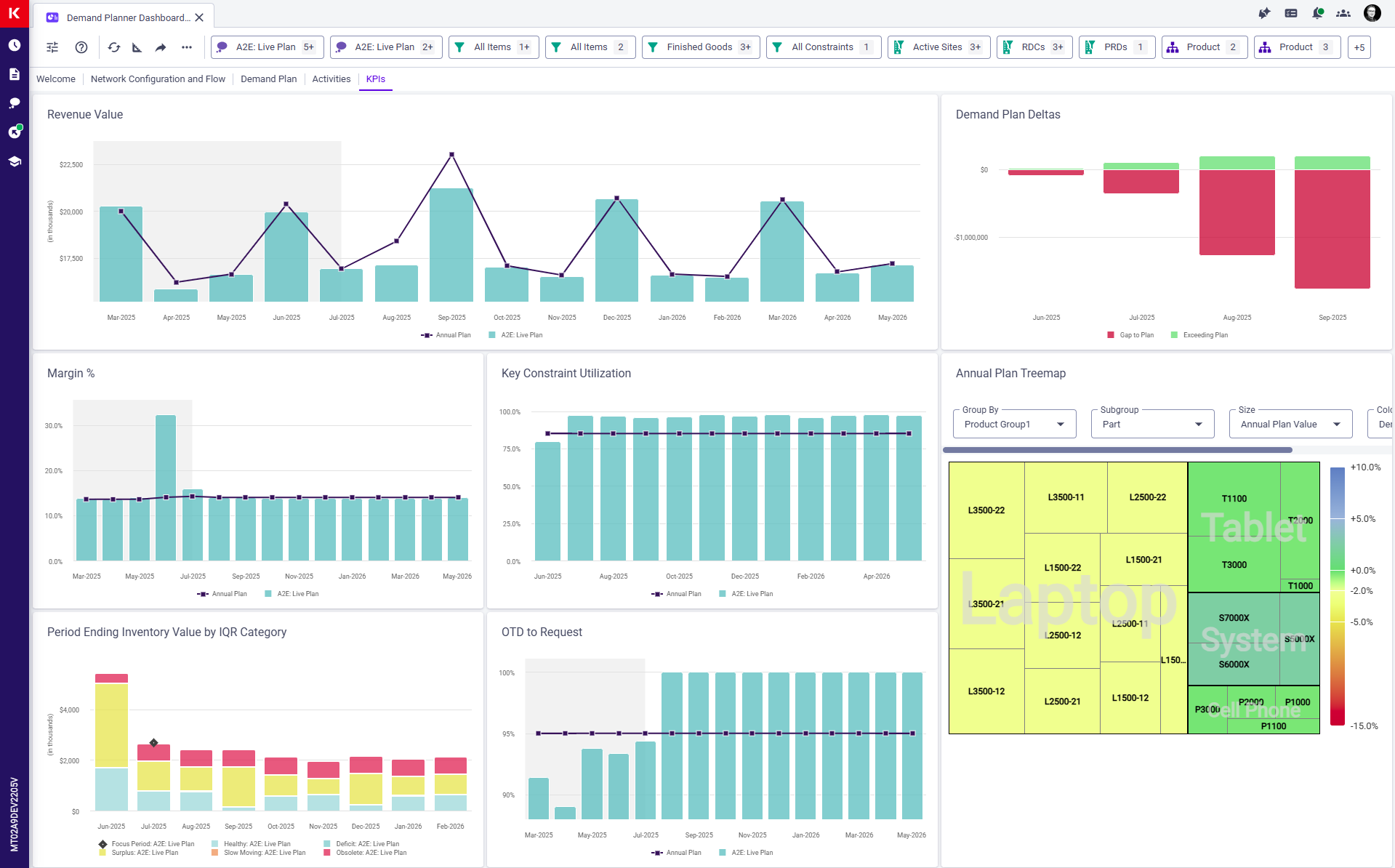
Kinaxis Maestro (formerly RapidResponse) is built on the idea that supply chain decisions need to be made faster than batch planning cycles allow. Its concurrent planning architecture means any change — a demand spike, a supplier delay, a production constraint — recalculates the supply-demand balance across the entire network in real time, not overnight. That capability is most valuable for retailers with highly volatile demand or those managing supply chains across multiple geographies and channels simultaneously.
Kinaxis holds a 4.4/5 rating on Gartner Peer Insights from 208 reviews, with users valuing its scenario modeling and agility for S&OP and IBP processes. The platform is less focused on retail-specific execution. There is no planogram integration or DC-to-store distribution module, and it is most commonly deployed as a planning and scenario layer above existing ERP systems rather than as a standalone retail SCM. Integrating Kinaxis with Oracle ERP is noted as challenging in multiple user reviews.
Key Features:
- Concurrent planning that recalculates supply-demand balances in real time across the network
- What-if scenario modeling for disruptions, demand changes, and supply constraints
- S&OP and IBP process support for aligning commercial and supply chain decisions
- AI-driven predictive insights and automated decision-making recommendations
Kinaxis Maestro: Pros and Cons
| ✅ Pros | ❌ Cons |
|---|---|
| Best-in-class scenario planning speed — no other platform recalculates as fast | Not designed for retail-specific execution (DC-to-store, shelf planning, store-level ops) |
| 208 Gartner reviews — strong, validated feedback pool | Integration with non-SAP ERP systems can be challenging |
| Effective for complex S&OP/IBP processes at enterprise scale | Enterprise pricing and complexity; overkill for chains under 100 stores |
Pricing: Custom pricing. Contact Kinaxis for a demo and quote.
Best for: Enterprise retailers needing rapid scenario planning and S&OP capabilities on top of an existing ERP, particularly those with high supply chain volatility.
For retailers that need stronger store-level execution than a scenario-planning layer provides, an alternative to Kinaxis may offer a better fit for DC-to-store replenishment, shelf planning, and day-to-day retail operations.
8. SAP IBP: Best for Large Enterprise Retailers Already on SAP
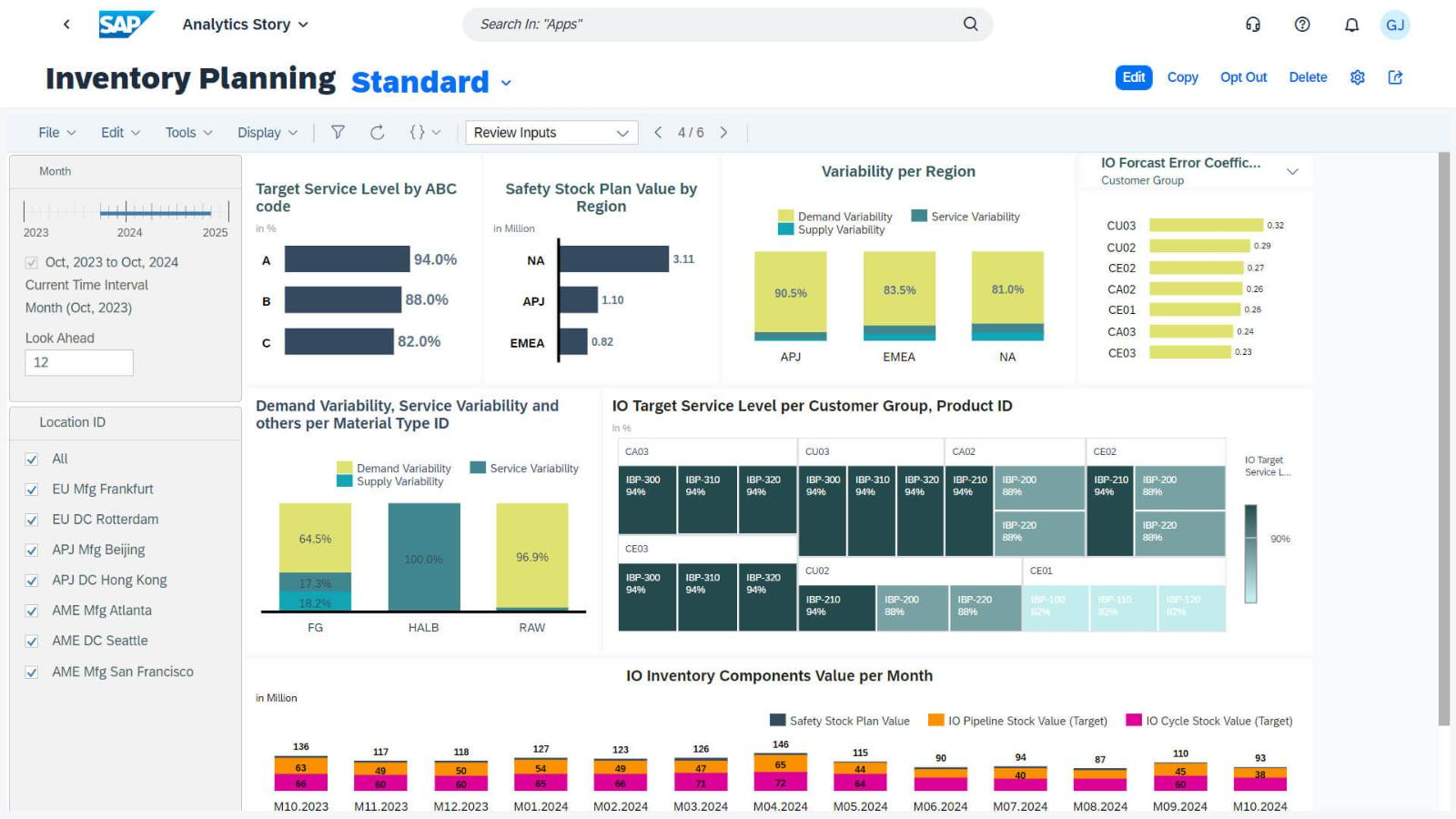
SAP IBP (Integrated Business Planning) is SAP's cloud-based supply chain planning suite covering demand planning, inventory optimization, supply planning, and S&OP. Its AI copilot, Joule, gives planners conversational access to analytics without requiring technical expertise. For retailers already running on SAP S/4HANA or SAP ERP, IBP is the natural extension. The integration is native, the master data flows without a separate connector, and the planning layer connects directly to execution.
On G2, SAP IBP holds a 4.3/5 rating. User feedback is mixed: the forecasting and modeling capabilities are well-regarded, but several reviewers note the platform requires too many manual interventions and that AI integration in practice lags behind what's marketed. McKinsey's supply chain research found that 76% of companies that implemented advanced planning systems report needing little manual workaround; SAP IBP users are closer to the 41% who still say their systems require too much manual intervention. It's a powerful tool inside the SAP ecosystem; outside it, the case weakens considerably.
Key Features:
- Demand planning and supply planning integrated within the SAP cloud ecosystem
- AI copilot Joule for conversational analytics access for non-technical planners
- Inventory optimization and S&OP capabilities connected to SAP ERP execution
- Scenario planning and what-if analysis for demand and supply volatility
SAP IBP: Pros and Cons
| ✅ Pros | ❌ Cons |
|---|---|
| Native integration with SAP ERP removes the need for separate data connectors | Value is largely limited to retailers already on the SAP stack |
| Joule AI copilot lowers the technical barrier for planning team adoption | Users report more manual interventions required than marketing suggests |
| Broad ecosystem of SAP partners and implementation support | Custom pricing; enterprise implementation costs are significant |
Pricing: Custom pricing. Contact SAP for a quote based on your environment.
Best for: Large enterprise retailers already running SAP ERP who want a native supply chain planning layer without adding a separate vendor relationship.
How to Choose the Right Retail Supply Chain Software for Your Business
The right tool depends on where your supply chain actually breaks down, not on which platform has the longest feature list. Here is a practical way to think through the decision.
1. How many stores and SKUs are you managing? A chain with 15 locations has different needs than one with 300. Once you're managing more than 20-30 stores, manual or semi-automated replenishment creates planning bottlenecks. Tools like LEAFIO AI or RELEX are designed for this scale. Oracle NetSuite covers the middle ground. Enterprise platforms like Blue Yonder and Kinaxis are appropriate once your complexity and budget match their scope.
2. Do you have DC feeding stores, or do you order directly into single locations? DC-to-store distribution is a distinct planning problem. Most replenishment tools, including ERP modules, don't solve it well. If your stores depend on allocation from a central warehouse, confirm whether any platform you're evaluating handles that specifically and not just purchase order generation.
For retailers where the bottleneck starts after orders leave the DC, comparing the best last-mile delivery software can help evaluate route optimization, real-time tracking, and proof-of-delivery capabilities.
If the bigger issue is warehouse execution rather than planning, our guide to the best warehouse management software compares systems for inventory control, picking, receiving, and fulfillment.
3. What does your ERP environment look like? If you're on SAP, SAP IBP is a natural extension. If you're on Oracle, Oracle SCM Cloud is worth evaluating before adding a separate vendor. If you're not deeply committed to either, specialized retail platforms often outperform ERP modules on demand forecasting and promotional planning.
4. How honest are you about implementation capacity? RELEX, Blue Yonder, and Kinaxis are genuinely powerful. They also require months of implementation and dedicated project teams. A platform your team can actually use in 60 days may generate more value than an enterprise system that takes 18 months to deploy. LEAFIO AI typically deploys across a mid-sized chain in weeks, which is a meaningful practical difference.
5. Where does your replenishment actually break? Stockouts during promotions point to a forecasting gap. Chronic overstock on slow movers means safety stock calculations ignore demand variability. Emergency orders after supplier delays mean your lead time planning isn't reactive enough. Different failure modes point toward different tools; buying features you don't need is common and avoidable.
6. Where do you want to be in two years? If you're growing your store count, invest in a platform that scales with you. Switching supply chain software mid-growth is expensive and disruptive. Ask each vendor specifically how their pricing changes as you add locations.
ERP vs. Specialized Retail Supply Chain Software: When to Choose Each
If your business already runs on Oracle, SAP, or NetSuite, the question of whether to add a specialized retail SCM platform is worth thinking through carefully. The honest answer depends on how complex your replenishment actually is.
ERP supply chain modules are designed for breadth, not depth. They automate basic reorder-point logic and purchase order generation reasonably well. Where they fall short: demand forecasting sophistication, multi-echelon distribution planning, and promotional replenishment. For a retailer managing 50,000 SKUs across 200 stores with weekly promotions and a DC network, native ERP replenishment creates planning bottlenecks that a specialized tool resolves.
Specialized retail SCM platforms like LEAFIO AI inventory optimization or RELEX Solutions are purpose-built for what ERP modules treat as edge cases: demand variability, seasonal uplift, store-level customization, and algorithmic distribution from DC to shelf. The implementation investment is higher. So is the upside.
A practical rule: if your replenishment team spends more than 20% of their time on exceptions and manual overrides, a specialized platform will pay for itself. If replenishment is a background process that rarely needs intervention, your ERP may be sufficient for now.
How AI Enhances Retail Supply Chain Software
Most retail SCM platforms that claim AI aren't using it in the replenishment or forecasting engine. They're using it in the dashboard — surfacing an insight that a human buyer then has to act on manually. That's useful, but different from a system where the forecast model itself is machine learning-based and updates from live sales data.
The practical difference shows up during demand shifts. A system running on fixed reorder points misses the promotional spike, the competitor stockout, and the weather event. An AI-native platform detects the shift in the sales signal and adjusts before the next order cycle. Promotions are where this gap is most expensive: a buyer manually inflating a purchase order before a campaign is making an educated guess. A system with built-in uplift modeling calculates the expected demand increase from historical data automatically. Legacy platforms can add this as a module, but it rarely integrates as cleanly as tools built with AI demand planning at the core from the start. LEAFIO AI and RELEX Solutions are the two platforms on this list where AI sits in the replenishment engine, not just in the reporting layer.
How to Launch a Retail Supply Chain Solution That Scales
The biggest implementation mistake is treating retail SCM software as a technical project rather than an operational one. The data setup and ERP integration have a checklist. The harder part is the planning team that has managed replenishment manually for years and doesn't trust the system's recommendations yet. Both need solving. Here is the sequence that works for LEAFIO AI rollouts:
- Get the data right first. Clean inventory records and at least 12 months of sales history are the foundation. Inaccurate stock counts produce inaccurate recommendations, and that erodes trust faster than anything else.
- Configure buffer profiles before go-live. Green/yellow/red zones per product category based on actual lead times and service-level targets. Default settings are a starting point, not a final configuration.
- Connect ERP data feeds. Sales, inventory, and master data integration typically takes one to two weeks with the LEAFIO integration team.
- Run in parallel for two to four weeks. Let the system generate recommendations while buyers keep doing what they normally do. Compare outcomes. This is the fastest way to build internal confidence.
- Phase the rollout by supplier or category. Start where manual replenishment is most painful—variable lead times or highest seasonal swings.
- Review analytics after 90 days. On-shelf availability trending up and emergency orders trending down is what success looks like.
After six to twelve months, most teams see planning capacity increase while time per order drops. The bandwidth that frees up tends to go toward category strategy rather than emergency replenishment.
Frequently Asked Questions
What is retail supply chain software?
Retail supply chain software is a platform that manages the flow of goods from suppliers to stores, covering demand forecasting, inventory planning, automated replenishment, and distribution across a retail network. It draws on sales data, supplier lead times, and service-level targets to generate ordering and allocation decisions automatically. Modern platforms add AI-driven forecasting, promotional uplift modeling, multi-location distribution logic, and integration with ERP and POS systems.
What is the best retail supply chain software in 2026?
For mid-to-large retail chains, LEAFIO AI is the strongest option: it combines inventory optimization, automated replenishment, and shelf planning in a single retail-specific platform, rated 5.0/5 on G2. For enterprise grocery with complex supplier networks, RELEX Solutions is the benchmark, recognized as a Gartner Magic Quadrant leader in 2025. Blue Yonder and Manhattan Associates suit global enterprise retailers where WMS and logistics integration are as important as planning.
How much does retail supply chain software cost?
Oracle NetSuite starts at approximately $999 per month as a full ERP with built-in SCM functionality. Most specialized retail supply chain platforms (LEAFIO AI, RELEX, Blue Yonder, Manhattan Associates, Kinaxis, and Infor Nexus) use custom pricing based on chain size, store count, and modules selected. For a mid-sized retail chain of 30-100 stores, expect annual license costs in the range of tens to hundreds of thousands of dollars depending on scope.
What features should I look for in retail supply chain software?
The essential features are demand forecasting that adapts to actual sales data rather than fixed reorder points, automated replenishment across stores and distribution centers, promotion and seasonality planning, ERP and POS integration, and real-time inventory visibility. For chains managing their own store estate, DC-to-store distribution logic is a distinct and critical capability that most ERP modules and e-commerce tools don't handle. AI-native forecasting, not rule-based automation marketed as AI, makes a measurable difference at scale.
What is the difference between ERP and specialized retail supply chain software?
ERP platforms like SAP, Oracle, and NetSuite include supply chain modules built for breadth rather than depth. They handle basic reorder-point logic and purchase order generation well. Specialized platforms like LEAFIO AI or RELEX Solutions are purpose-built for retail complexity: demand variability, seasonal uplift, store-level customization, and algorithmic distribution from DC to shelf. If your planning team spends more than 20% of their time on manual overrides and exceptions, a specialized tool will typically pay for itself.
What retail supply chain software works for mid-size chains, not just enterprise?
LEAFIO AI is designed specifically for mid-to-large retail chains and deploys in weeks rather than months. It is the most practical option outside the enterprise tier. Oracle NetSuite covers mid-market with built-in SCM if you need a full ERP alongside supply chain functionality. Most other platforms on this list (RELEX, Blue Yonder, Manhattan Associates, and Kinaxis) are enterprise-first and require 3-6 months of implementation with dedicated project teams.
How does AI improve retail supply chain management?
AI improves retail supply chain management in three specific ways. Demand forecasting: AI models update continuously from live POS data, catching demand shifts before the next order cycle, where traditional rule-based systems react after the stockout. Promotional planning: AI calculates expected demand uplift from historical campaign data automatically, replacing manual purchase order inflation. Distribution: AI-native platforms calculate optimal stock allocation across a store network algorithmically, removing manual store ordering entirely.
How long does it take to implement retail supply chain software?
LEAFIO AI typically deploys across a mid-sized chain in several weeks. Oracle NetSuite can be operational for basic replenishment within days for smaller operations. Enterprise platforms like RELEX Solutions, Blue Yonder, and Kinaxis require 3-6 months for full implementation, including data preparation, ERP integration, configuration, and parallel running. The timeline is roughly proportional to ERP complexity and the number of locations and SKUs involved.