

Global retailers lose an estimated $1.73 trillion a year to inventory distortion, the combined cost of empty shelves and stock nobody wants, according to IHL Group research reported by Chain Store Age. Most of that money is not lost to bad luck. It is lost because someone applied one reorder rule, one service level, and one shelf allocation to categories of stock that behave nothing alike.
Types of inventory sounds like a textbook question, but the classification a team uses shapes almost everything downstream. It affects how demand gets forecast, how safety stock gets set, when markdowns start, and what earns a spot on an end cap versus a back-room shelf. A can of soup and a case of strawberries are both inventory, and both eventually leave the store, but they call for opposite management approaches.
This glossary works through the various types of inventory from four angles: production stage, operational function, physical status, and classification method. These are the same categories that show up across most types of inventory in supply chain operations. The guide closes with a retail-specific view and a few practical management tips. The job might be stocking a single grocery store or running inventory classification across a 200-location chain. Either way, the goal stays the same: know which type of inventory is being looked at before deciding how to manage it.
What Is Inventory? A Working Definition
Inventory, or stock, is any good a business holds that it plans to sell, use in production, or consume in its own operations. The terms get used interchangeably, and different types of stock simply describe the same underlying idea from different angles. That is a wide net, and it is exactly why different types of inventory exist. A distributor's pallets, a pharmacy's controlled-substances cabinet, and a convenience store's hot dog roller are all inventory, but each needs different counting, ordering, and shrinkage rules.
Most inventory guides are written with a factory floor in mind, tracking materials from raw input to finished product. Retailers face a different set of pressures: seasonal swings, expiration dates, promotional spikes, and shelf space that is always in short supply. The categories below cover both worlds. Wherever it matters, this guide flags what changes when the inventory in question sits on a retail shelf rather than a factory line.
The 4 Main Types of Inventory (by Production Stage)
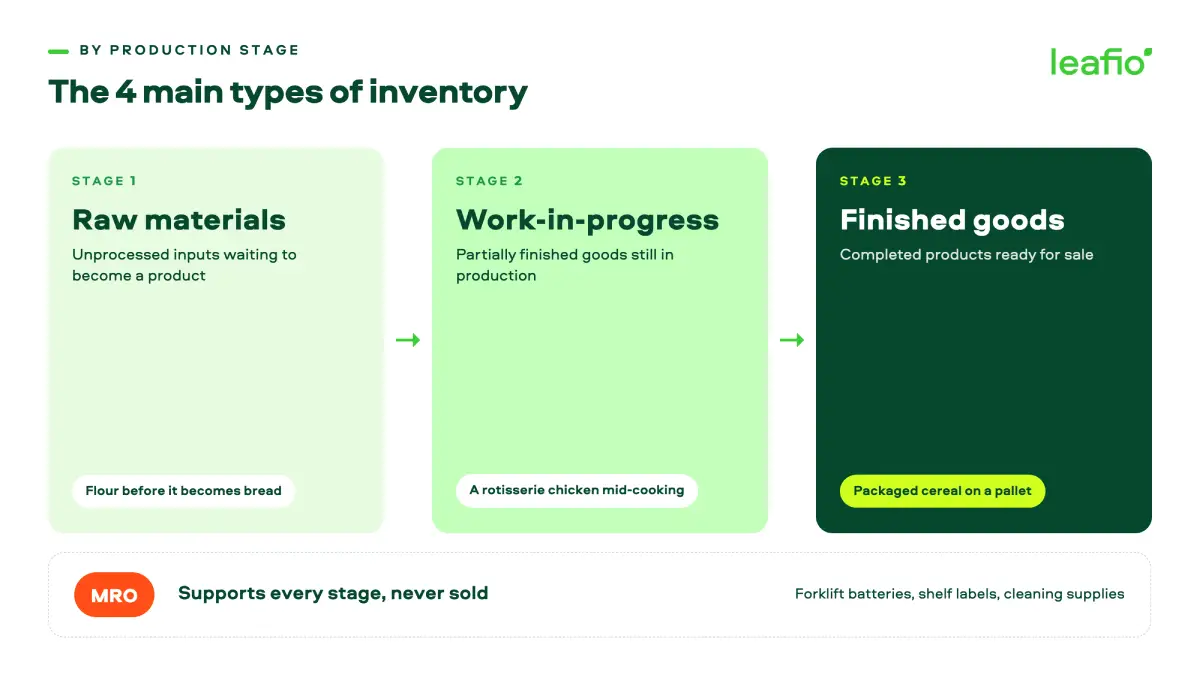
The oldest and most common way to sort inventory follows a product's journey from input to sale. These four types of inventory apply to almost any business that makes or sells physical goods, from a food manufacturer to a grocery chain sourcing private-label products.
| Type | Definition | Who Uses It | Example |
|---|---|---|---|
| Raw Materials | Unprocessed inputs waiting to become part of a finished product | Manufacturers, food producers, private-label retailers | Flour before it becomes bread |
| Work-in-Progress (WIP) | Partially finished goods still moving through production | Manufacturers, co-packers, in-store bakeries and delis | A rotisserie chicken halfway through cooking |
| Finished Goods | Completed products ready for sale | Retailers, wholesalers, manufacturers | Packaged cereal on a warehouse pallet |
| MRO | Supplies that keep operations running but are not sold | Warehouses, stores, plants | Forklift batteries, shelf labels, cleaning supplies |
Raw Materials Inventory
Raw materials inventory covers the unprocessed inputs a business holds before production turns them into something sellable. Think wheat before it is flour, or steel before it is a shelf bracket. Retailers rarely hold much of this themselves unless they run a private-label, in-store bakery, or deli program. In that case, flour, produce, and packaging count as raw materials too. The main risk is tying up cash in inputs that outpace what production can actually use. Match purchase volume to a realistic prep schedule rather than to a supplier's best bulk-order price.
Work-in-Progress (WIP) Inventory
WIP inventory is anything that has left the raw-material stage but is not a finished good yet. A car with an engine installed but no seats is WIP. So is a rotisserie chicken halfway through cooking in a grocery deli. WIP sits between two other categories on the balance sheet. It is one of the harder inventory types to value accurately, since its cost builds hour by hour as labor and materials get added. Track it separately from finished goods so a demand model does not mistake half-finished stock for sellable stock.
Finished Goods Inventory
Finished goods are products ready to sell, whether they are sitting on a store shelf, in a distribution center, or in transit to a customer. For most retailers, this is the inventory type that matters most day to day, since it is the only category that generates revenue the moment it moves. Inventory turnover matters more here than raw carrying cost, because slow-moving finished goods tie up shelf space that could hold something that actually sells.
MRO Inventory (Maintenance, Repair & Operations)
MRO inventory keeps the lights on rather than going out the door: cleaning supplies, shelf labels, forklift parts, POS printer ribbon. It is easy to under-manage because it never shows up in a sales report. A stockout of shelf tags or scanner batteries can quietly slow an entire store. Lighter, less frequent ordering cycles usually work fine here, since a stockout costs labor time rather than lost sales.
Types of Inventory by Operational Function
Beyond where a product sits in production, inventory also plays a functional role in balancing supply against demand. This is where types of inventory management gets more strategic. Each function answers a different question. How much is needed for normal operations, how much extra covers something going wrong, and how much is being held that nobody really wants?
Cycle Stock (Working Stock)
Cycle stock is the inventory expected to sell between one replenishment order and the next. A store that sells 40 units of a product a week and reorders weekly carries roughly 40 units of cycle stock. The right level depends on more than past sales: forecast demand, replenishment frequency, and order quantities or minimums all shape it too. It forms the baseline every other inventory function gets layered on top of.
Safety Stock
Safety stock is the buffer held to absorb demand spikes or a late delivery without running out. It is not extra for its own sake. A sound safety stock calculation weighs demand variability against supplier lead time and the service level a category needs. A pharmacy holding a life-critical medication needs a much higher service level, and therefore more safety stock relative to sales, than a discretionary snack aisle.
Anticipation Stock (Seasonal Inventory)
Anticipation stock is built ahead of a predictable demand surge, like holiday decorations before December or sunscreen before a heat wave. Unlike safety stock, which guards against uncertainty, anticipation stock responds to demand that is fairly confident to arrive. Get the timing wrong in either direction, and a retailer either runs out during the one week that mattered or ends up marking down leftover stock in January.
Pipeline Inventory (In-Transit Stock)
Pipeline inventory, also called in-transit stock, is anything shipped but not yet arrived. Think of goods on a truck between a distribution center and a store, or a container still at sea. It counts as inventory on the books even though nobody can sell it or restock a shelf with it yet. That is why lead-time visibility matters so much for accurate planning.
Decoupling Inventory (Buffer Stock)
Decoupling inventory sits between two stages of a process so a delay in one does not immediately stall the other. In manufacturing that might mean a buffer between two production stations. In retail, it more often shows up as backroom stock that decouples shelf replenishment from delivery schedules. A late truck does not have to mean an empty shelf that afternoon.
Speculative Inventory
Speculative inventory is purchased ahead of an expected price increase or supply shortage rather than in response to confirmed demand. It is a calculated bet: a retailer might buy extra of a commodity-driven product before a known tariff change or supplier price hike takes effect. It carries real risk, since the anticipated shortage or price jump might not fully materialize.
Consignment Inventory
Consignment inventory sits on a retailer's shelf but stays the supplier's property until it actually sells. It shows up in specialty retail and some CPG relationships, where a vendor absorbs the risk of unsold stock in exchange for guaranteed shelf placement. It reduces a retailer's tied-up capital, but it needs clear tracking, since consignment stock should not count toward the retailer's own inventory valuation.
Dead Stock (Obsolete Inventory)
Dead stock is inventory that has stopped moving and has little realistic chance of selling at full price. Think last season's fashion, expired promotional packaging, or a discontinued SKU nobody remembered to pull from the reorder list. It is the most expensive type of inventory to carry, since it ties up cash and shelf space while actively losing value every week it sits there. US retailers alone were sitting on $740 billion in unsold goods as of 2022, a 12% jump in a single year, according to McKinsey. That overhang is exactly what pushes so many chains toward steep, margin-eating markdowns.
Baltic Petroleum, an 86-store gas station and convenience chain in Lithuania, used to run replenishment store by store with no shared visibility into what was piling up where. After centralizing ordering on LEAFIO retail inventory optimization, the chain cut overstock by 50% and grew sales 62%, reaching payback within a single month.
Types of Inventory by Physical Status or Location
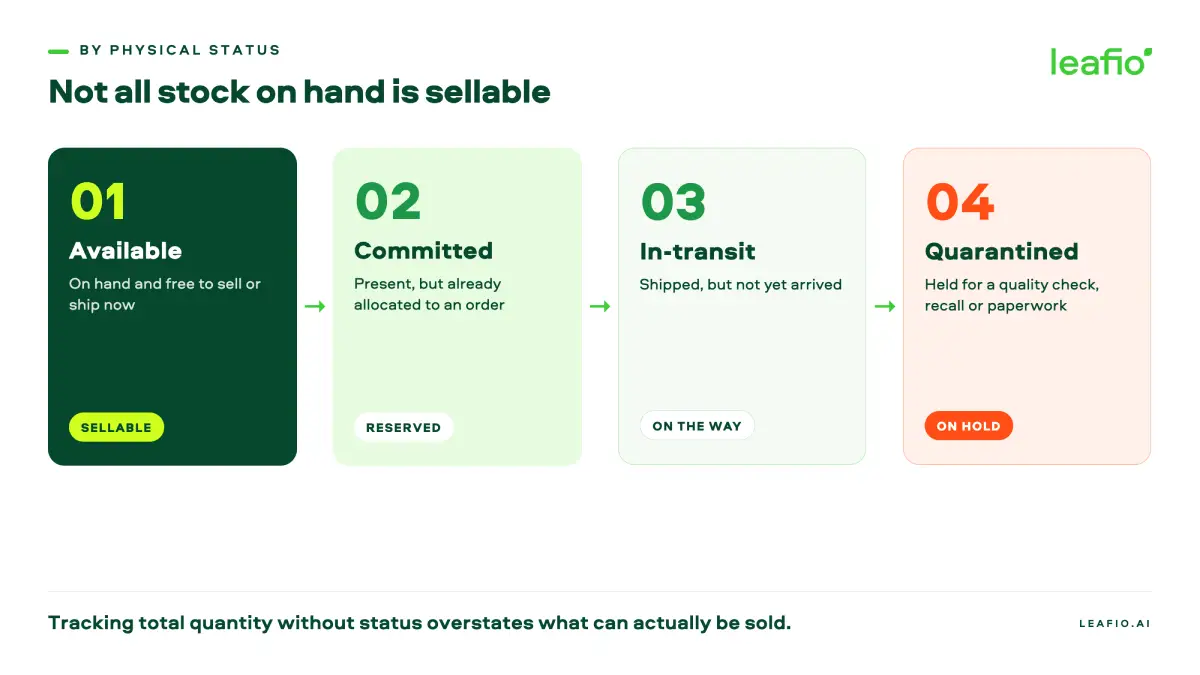
A third lens for classifying inventory has nothing to do with why it is being held. It has everything to do with where it physically sits and whether anyone can use it right now. This matters for inventory accuracy, since a system that only tracks total quantity on hand, without status, will overstate what is actually sellable.
Available Stock
Available stock is inventory physically on hand and free to sell or ship immediately, with no restrictions attached. It is the number a store associate or an online storefront should be checking before promising a customer that a product is in stock.
Committed Stock
Committed stock is physically present but already allocated to a specific order, transfer, or reservation. It cannot be sold again without creating a shortage somewhere else. Confusing committed stock with available stock is a common cause of overselling, especially across omnichannel operations where one unit might get claimed twice at once.
In-Transit Stock
In-transit stock overlaps with the pipeline inventory covered earlier: goods that have left one location but have not arrived at the next. The distinction that matters operationally is visibility. Without a live feed from carriers or suppliers, in-transit stock is effectively invisible to planners until it shows up on a receiving dock.
Quarantined / Held Stock
Quarantined stock is set aside pending a quality check, a recall investigation, or missing paperwork. It cannot be sold or moved until that hold clears. Pharmacies, and any retailer selling perishable or regulated goods, deal with this constantly, and a slow quarantine process can quietly turn otherwise sellable stock into dead stock.
Inventory Classification Methods Every Manager Should Know
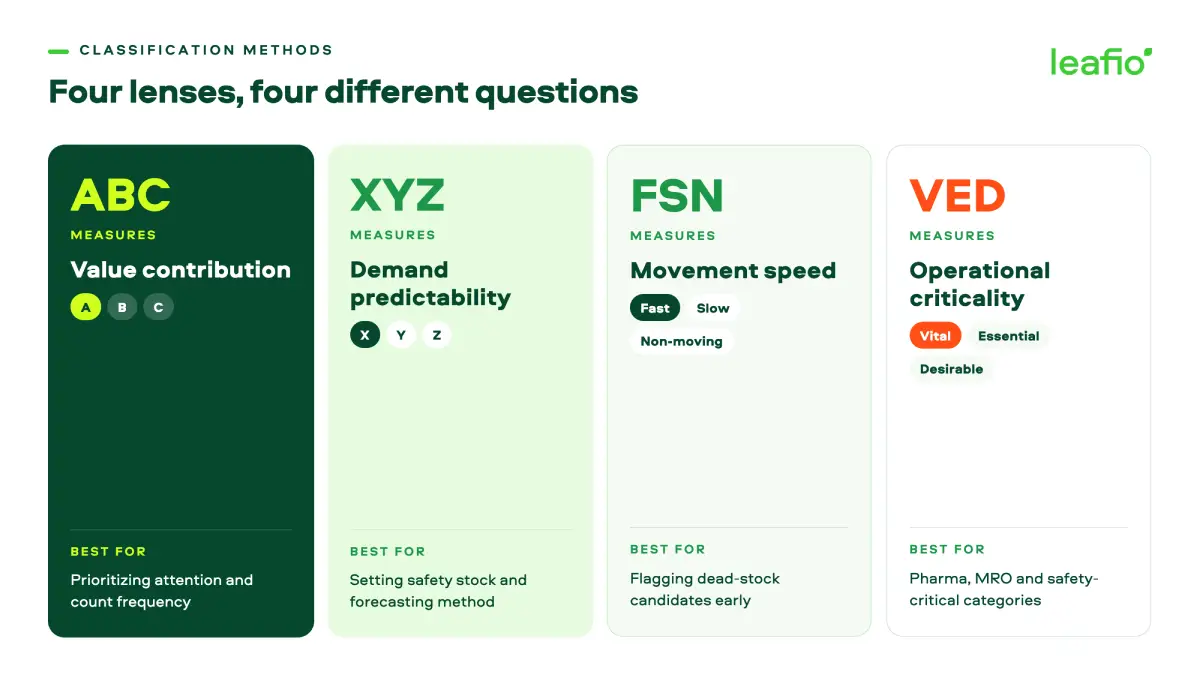
Knowing which type of inventory is on the shelf is only half the job. The other half is deciding how much attention each item deserves, and that is where formal classification methods come in.
| Method | What It Measures | Best For |
|---|---|---|
| ABC Analysis | Value contribution (revenue or margin) | Prioritizing management attention and count frequency |
| XYZ Analysis | Demand variability and predictability | Setting safety stock and choosing a forecasting method |
| FSN Analysis | Movement speed: fast, slow, or non-moving | Flagging dead-stock candidates early |
| VED Analysis | Criticality to operations | Pharma, MRO, and safety-critical categories |
ABC Analysis
ABC analysis sorts inventory by value contribution, typically revenue or margin. A-items are the small share of SKUs that drive most of the value and get the tightest control and the most frequent counts. C-items are the long tail of low-value SKUs that need looser oversight, so the team's attention stays where it counts most.
XYZ Analysis
XYZ analysis classifies inventory by how predictable its demand is rather than by value. X-items have stable, easy-to-forecast demand. Z-items swing unpredictably and need wider safety stock margins or a different demand forecasting approach, regardless of how much revenue they generate.
FSN Analysis (Fast / Slow / Non-moving)
FSN analysis groups inventory by how quickly it moves off the shelf. Fast-moving items usually justify more frequent replenishment, though the right cycle stock level still depends on ordering cadence, case pack sizes, and lead time, not movement speed alone. Non-moving items are the earliest warning sign of dead stock, and catching them here, before they get officially written off, is usually cheaper than liquidating them later.
VED Analysis (Vital / Essential / Desirable)
VED analysis ranks inventory by how critical it is to keep operations running, not by sales volume. It shows up most in pharmacies and MRO management. A low-value item, like a specific safety valve or a life-saving medication, can be operationally vital even though it barely registers in a standard ABC analysis.
According to Supply Chain Dive, more supply chain leaders are stratifying SKUs by value and velocity as portfolios grow more volatile. One parts distributor cited in that reporting now redefines its inventory segments every quarter as contracts shift. The same reporting found that 74% of supply chain leaders were already using or planning to use AI in demand planning. That points to classification and forecasting increasingly being handled together rather than as separate exercises.
Inventory Types in Retail: Industry-Specific View
Every classification above applies across industries, but retail adds pressures a generic definition does not capture. Expiration dates, promotional calendars, and demand that shifts by season and even by weather all come into play. These three types of inventory deserve their own category.
Perishable / Fresh Inventory
Perishable inventory covers anything with a shelf life short enough that timing, not just quantity, decides whether it sells or gets written off: produce, dairy, bakery, and prepared foods. Fresh inventory management needs tighter replenishment cycles, FIFO rotation, and usually a write-off process kept separate from dry goods. The cost of overstocking here shows up within days rather than months, since spoilage does not wait for a scheduled markdown the way dry goods do. Retail shrink overall, which includes spoilage alongside theft and operational error, cost the industry an estimated $90 billion last year, according to Retail Dive. Even so, several major chains reported shrink dropping to pre-pandemic lows. That came from tighter operational control, not new prevention spending alone.
Promotional Inventory
Promotional inventory is stock built up specifically to support a planned markdown, feature display, or trade promotion. It behaves like an anticipation stock, but with a harder deadline. Once the promotion ends, unsold promotional inventory quickly becomes dead stock, especially if it carries promotion-specific packaging that cannot be sold at the regular price.
Seasonal Inventory
Seasonal inventory is anticipation stock applied to a full calendar season rather than a single event: patio furniture in spring, coats in fall. The harder part is not the peak but the tail end. Seasonal inventory that does not clear before next season's stock arrives usually gets marked down at a loss.
Retailers managing all of this by category in spreadsheets tend to find the gaps only after a stockout or a write-off. Kolo, a European grocery chain, migrated its entire live auto-order system to LEAFIO Inventory Optimization in a single overnight cutover, with no gradual rollout and no supply gap. Within one quarter, overstock fell 43%, inventory turnover improved 17%, and sales grew 20% as automated replenishment replaced fragmented manual ordering across the network.
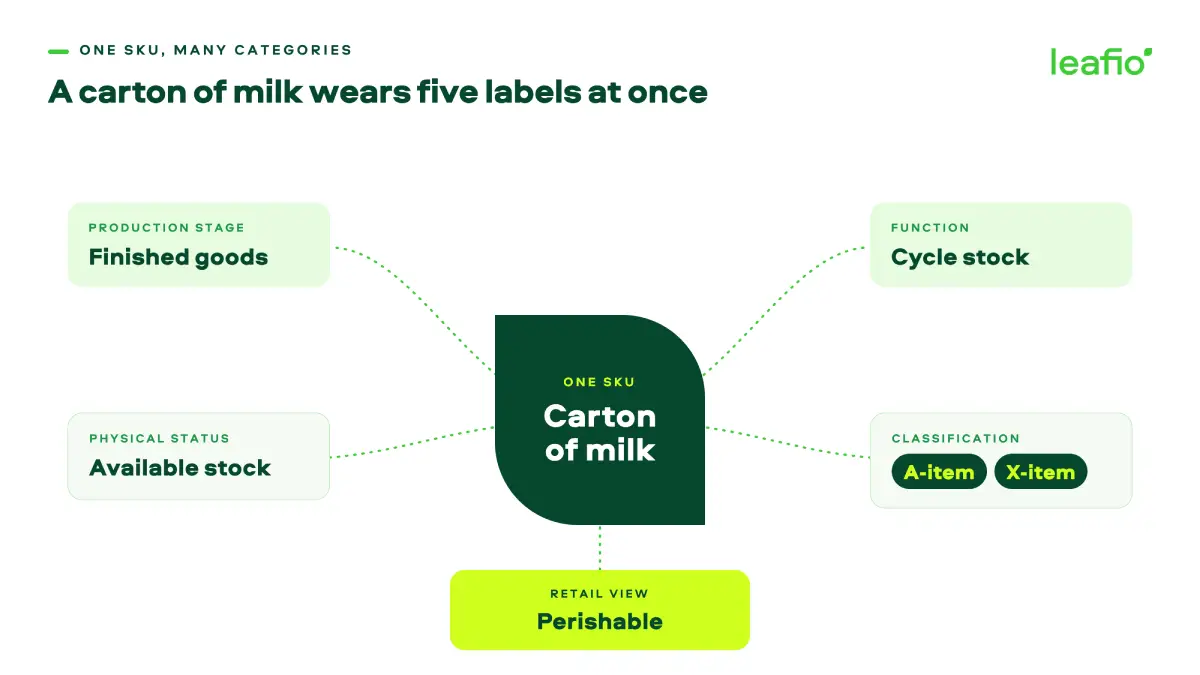
One thing worth remembering before moving to management tactics: none of the categories above compete with each other, and a single SKU usually belongs to several at once. A carton of milk is finished goods by production stage and cycle stock by function. It is available stock by status, likely an A-item and an X-item by classification, and perishable inventory from a retail-management perspective. None of those labels contradicts the others. They are different lenses applied to the same physical stock, and a system that only tracks one of them is missing most of the picture.

How to Manage Different Inventory Types Effectively
Classification only helps if it changes what a team actually does. These three practices turn the types of inventory above into a working system instead of a taxonomy exercise.
Match Replenishment Strategy to Inventory Type
Cycle stock, safety stock, and seasonal or promotional inventory each need different reorder logic, not one formula applied to every SKU. Automated replenishment lets planners set tighter reorder points for perishables, wider buffers for critical MRO items, and longer lead-time cushions for imported raw materials. That removes the temptation to default to one blanket policy that fits nothing particularly well.
Track the Right KPIs for Each Category
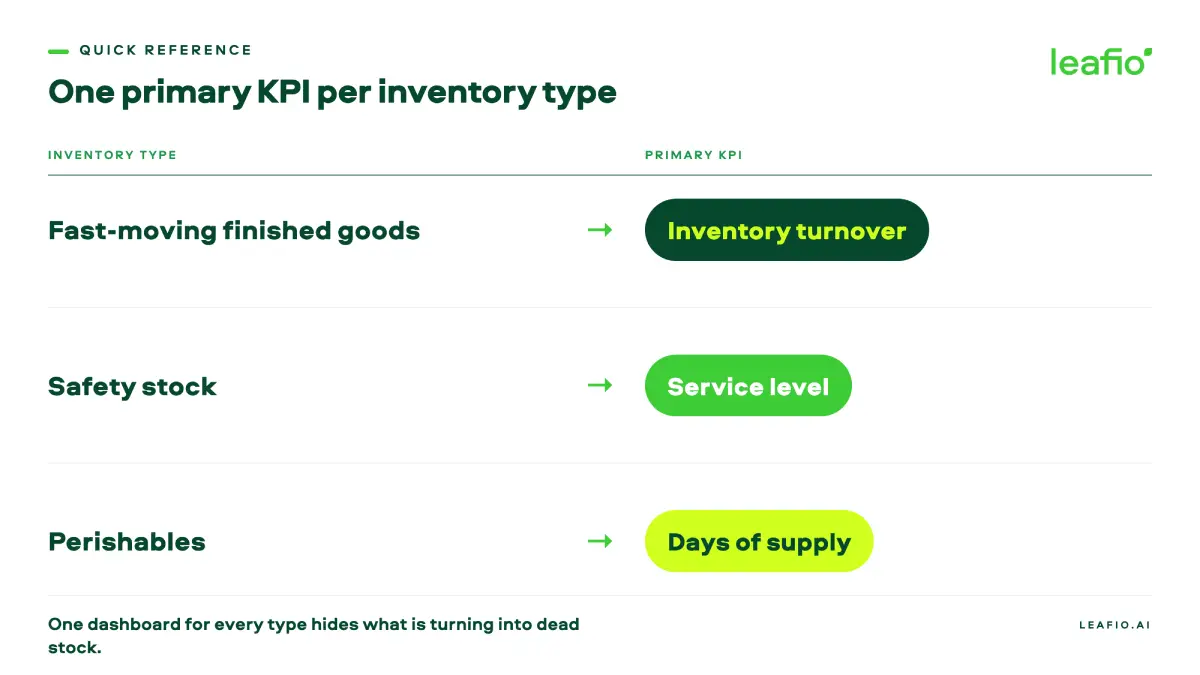
Inventory turnover matters most for fast-moving finished goods. Service level matters most for safety stock, and days of supply matter most for perishables. A single KPI dashboard applied across every inventory type tends to hide the categories quietly turning into dead stock. They get buried inside averages that look fine overall.
Use AI to Monitor and Optimize All Types Simultaneously
Manually re-running ABC, XYZ, and FSN analysis across a large assortment is realistic maybe once a quarter. That means slow-moving or newly volatile SKUs can drift for months before anyone notices. AI-driven inventory optimization closes that gap mechanically. It tracks each SKU's demand velocity and variability continuously and reclassifies items as those signals shift. The moment a SKU moves into a different category, replenishment parameters like safety stock and service targets get recalculated, rather than waiting for the next scheduled review.
FAQ
A few questions come up again and again once the categories above are clear on paper but still fuzzy in daily practice.
What are the types of inventory?
The main types of inventory fall into four broad groups. By production stage: raw materials, WIP, finished goods, MRO. By operational function: cycle stock, safety stock, anticipation stock, dead stock, and others. By physical status: available, committed, in-transit, quarantined. By classification method: ABC, XYZ, FSN, VED. Most businesses use a mix of all four to fully understand what they are holding.
What is the difference between cycle stock and safety stock?
Cycle stock is the inventory expected to sell during a normal replenishment cycle, sized from forecast demand, order frequency, and order quantities. Safety stock is the extra buffer held on top of cycle stock to absorb demand spikes or supplier delays without running out. One covers expected demand, and the other covers uncertainty.
What are some examples of types of inventory?
Raw materials means flour before baking. WIP means a half-assembled product. Finished goods means packaged items ready for sale. Safety stock means extra units held for demand spikes. Dead stock means unsold items unlikely to sell at full price. Consignment inventory means supplier-owned stock on a retailer's shelf.
How many types of inventory are there?
There is no single fixed number. Inventory can be classified along at least four dimensions: production stage, operational function, physical status, and value or movement, and each dimension has its own subtypes. Most retailers end up tracking somewhere between ten and fifteen distinct inventory types across these dimensions.
What is dead stock in inventory?
Dead stock is inventory that has stopped selling and has little realistic chance of moving at full price. That could be a discontinued SKU, expired promotional packaging, or last season's fashion. It ties up cash and shelf space while losing value, which is why FSN analysis and regular inventory reviews aim to catch it early.
What is WIP inventory?
WIP, or work-in-progress inventory, is anything that has moved past the raw-material stage but is not yet a finished, sellable product. In retail, that might be a half-prepared deli item; in manufacturing, it is a product mid-assembly. It is one of the harder inventory types to value accurately, since its cost builds incrementally.
What is the best inventory classification method for retail?
There is no single best method, since ABC analysis, XYZ analysis, FSN analysis, and VED analysis each answer a different question. Most retail inventory teams combine at least two, commonly ABC for value and FSN for movement speed, to get a fuller picture than any one method provides alone.


Have a question?

Kristi Miller
Retail optimization expert