

Publisher disclosure: This comparison is published by LEAFIO AI, one of the two vendors compared. Ratings were checked on November 17, 2026. Confirm details with each vendor.
Based on reviews, both platforms score high on G2. LEAFIO AI Retail Platform holds 5.0/5 based on 30+ reviews, and Quant holds 4.8/5 based on 50+ reviews.
The better choice depends on where your planning starts. Quant fits chains whose core need is space planning, with demand planning added as a module. LEAFIO AI fits mid-sized retail chains that want forecasting, replenishment, promotions, assortment, and shelf decisions connected in one system.
Quant is developed by Quant Retail s.r.o., a Czech company founded in 2001. It started in space planning and category management. Today it also offers demand planning and automatic replenishment.
This LEAFIO AI and Quant comparison covers reviews, platform scope, shelf and stock workflows, pricing model, and implementation. You will find a quick comparison table, a review breakdown, a feature-by-feature comparison, and a verdict below.
Quick Comparison: LEAFIO AI vs. Quant at a Glance
| Category | LEAFIO AI | Quant |
|---|---|---|
| Best for | Mid-sized retail chains in grocery, convenience and fuel, pharmacy, health and beauty, DIY, liquor, pet, toy, and electronics | Retail chains whose core need is space planning, planograms and category management |
| Platform scope | LEAFIO AI Retail Platform with four modules: Assortment Performance, Shelf Efficiency, Inventory Optimization, Promotion Intelligence | Planograms, floor planning, category management, Demand Planning, Automatic Replenishment, store execution |
| Buying model | Each solution can be bought separately or as a platform | Per-user editions (Planogramming; Retail Planning adds demand planning) |
| Pricing model | One-time implementation fee plus a subscription based on stores, SKUs, and modules; no per-seat fees | Per-user annual subscription; contact for pricing |
| Free trial | Demo only | Free trial available |
| G2 rating | 5.0/5 based on 30+ reviews | 4.8/5 based on 50+ reviews |
| Founded / HQ | 2014 / Lewes, Delaware, USA | 2001 / Tupadly, Czech Republic |
| Scale | 250+ retailers in 45+ countries, 30,000+ stores | 130+ customers in 60+ countries, according to Quant |
| Key difference | Assortment, shelf, and stock decisions on one data model, priced by network size | Long space planning track record, priced per user, with a free trial |
LEAFIO AI vs. Quant Based on Reviews
Both vendors earn high marks from users, and they win on different criteria. LEAFIO AI leads on ease of use and fit for business needs. Quant leads on ongoing product support.
Ratings. LEAFIO AI Retail Platform holds 5.0/5 on G2 based on 30+ reviews. Quant holds 4.8/5 on G2 based on 50+ reviews. On Gartner Peer Insights, Quant holds 4.6/5 from 8 ratings in the retail space planning market.
Head-to-head on G2. G2's comparison page summarizes how reviewers rate the two products (checked November 2026):
- Reviewers found LEAFIO AI easier to use, set up, and administer.
- Reviewers felt LEAFIO AI meets their business needs better.
- Reviewers preferred the direction of LEAFIO AI's product roadmap.
- Reviewers rated Quant higher for the quality of ongoing product support.
Who writes the reviews. On G2, 80% of LEAFIO AI reviews come from mid-market companies. Quant's largest reviewer group is enterprise, at 40.7% of reviews. This matches each vendor's focus: LEAFIO AI targets mid-sized chains, while Quant also serves large networks.
What Quant users say. Quant reviewers often praise ease of use, responsive support, and value for money. Individual reviews mention a learning curve, menus that are not always clear, and integration issues with other software.
What Is Quant?
Quant's core is space planning: planograms, floor plans, and category management. Quant generates store-specific planograms automatically from sales data and user-defined templates.
Over time, Quant added a Demand Planning module with daily forecasts by product and store. Its Automatic Replenishment module runs in fully or semi-automatic mode and uses planogram capacity when it calculates orders. Quant describes demand planning as a complement to its widely used space planning solution.
According to Quant, the platform serves 130+ customers in 60+ countries. Dr.Max has used Quant since 2013 across about 800 pharmacies in the Czech Republic and Slovakia. Quant sells per-user editions: Planogramming, and Retail Planning, which adds demand planning.
| Pros | Cons |
|---|---|
| 20+ years of space planning expertise, strong in pharmacy and grocery | Per-user pricing grows as more planners and store staff join |
| Automatic store-specific planograms linked to replenishment | Demand planning sits in the higher Retail Planning edition |
| High ratings for support on G2 and Gartner Peer Insights | Some reviewers mention a learning curve and unclear menus |
| Published editions and a free trial | Smaller vendor team: 11 to 50 employees, per Gartner Peer Insights |
Quant fits best when space planning is the main job and a team wants a proven planogram tool with a trial before buying.
What Is LEAFIO AI?
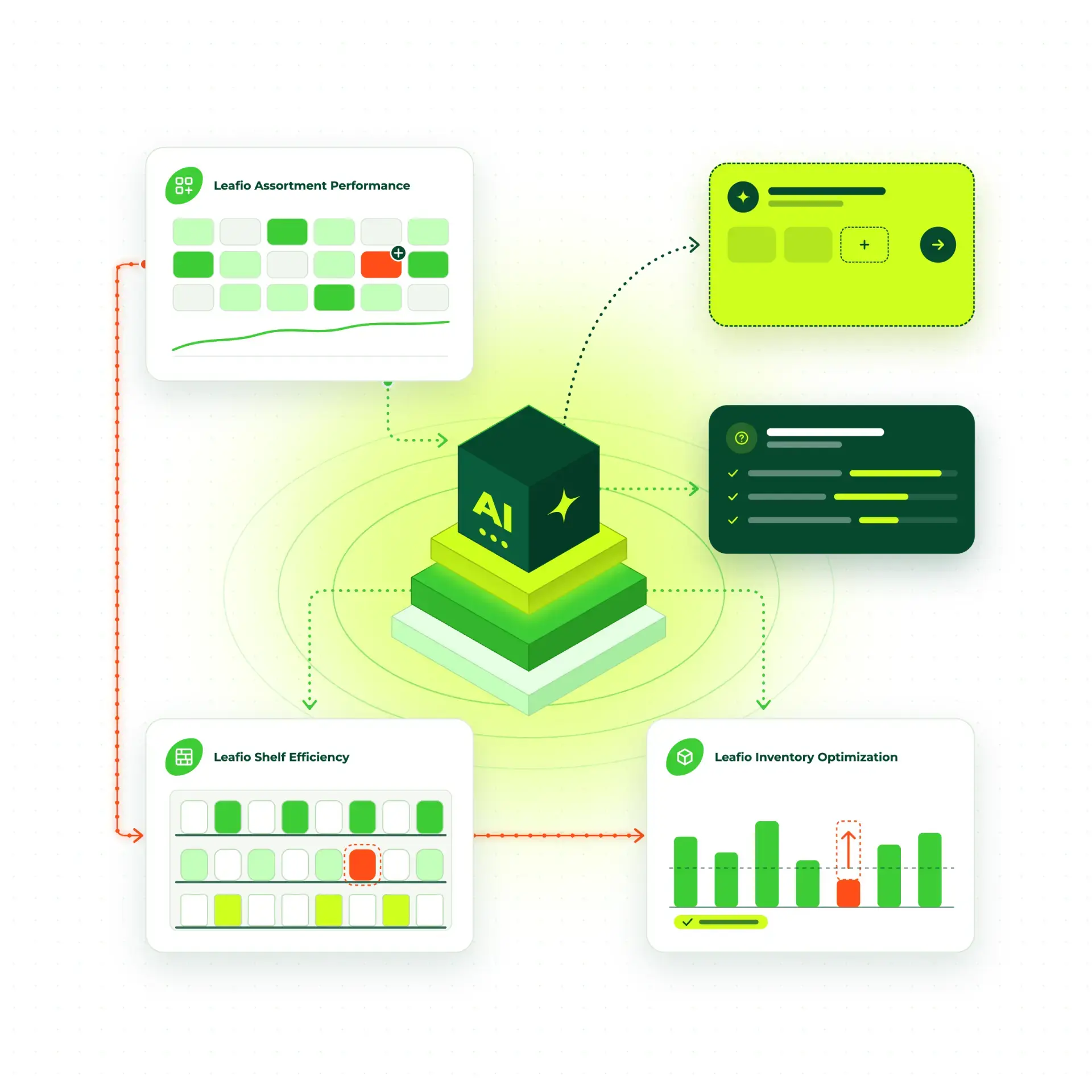
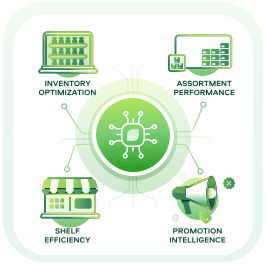
LEAFIO AI Retail Platform helps mid-sized retail chains decide what to sell, how to display it, how much to stock, and when to promote. It has four modules: Assortment Performance, Shelf Efficiency, Inventory Optimization, and Promotion Intelligence. Each solution can be bought separately. LEAFIO AI was founded in 2014 and works with 250+ retailers in 45+ countries.
For teams comparing it with Quant, the closest match is LEAFIO Shelf Efficiency, the planogram module. The main difference appears when Shelf Efficiency works together with LEAFIO Inventory Optimization and Assortment Performance.
Key features
- Automated planograms. Facings are allocated by quantity, revenue, or profit in the proportion the category manager sets, with ABC classes shown on the planogram.
- Format planograms for clusters. One planogram is published once and distributed to every store in the cluster.
- Assortment changes on the shelf. When Assortment Performance and Shelf Efficiency run together, each planogram flags items to add or remove.
- Planograms on forecasted sales. When Shelf Efficiency runs with Inventory Optimization, planners can choose to build a December planogram on forecasted December sales.
- Shelf data in replenishment. Where the retailer switches it on, facings and shelf capacity from published planograms feed the replenishment model.
- Managed SKU replacement and delisting. With Assortment Performance and Inventory Optimization, replenishment uses the old item's demand and stock when a new SKU replaces it.
- Promotion forecasting. Promotion Intelligence forecasts uplift for new SKUs from promotional analogs.
In LEAFIO AI Retail Platform, assortment decisions reach shelf planning and replenishment automatically. Forecast and planogram data can flow back where the retailer chooses.
| Pros | Cons |
|---|---|
| Assortment, shelf, and stock modules share one data model and one integration | Demo only, no free trial |
| No per-seat fees; pricing scales with stores, SKUs, and modules | Fewer G2 reviews than Quant so far (30+ vs. 50+) |
| Rated easier to use, set up, and administer than Quant on G2 | G2 reviewers rate Quant higher for ongoing support |
| Start with one module and add others by extending the same integration | A full implementation typically takes 4 to 6 months |
How LEAFIO AI compares to Quant
- ✅ Better at: connecting assortment, shelf, and replenishment decisions; promotion forecasting; pricing that does not grow with every new user.
- ❌ Worse at: no free trial; a shorter history in pure space planning; ongoing support scores on G2.
Real results from LEAFIO AI customers
- Plum Market, a US grocery chain with 25+ stores and over 14,000 SKUs, uses LEAFIO Shelf Efficiency. Preparing a new store now takes 4.5 days instead of more than 14. In six supermarkets, dairy sales rose 11.4% and profit 12.3% like-for-like from Q1 2023 to Q4 2024.
- Marché Leo's, a Canadian grocery chain with about 10,000 SKUs, uses LEAFIO Shelf Efficiency. Its new Toronto store opened on 100% LEAFIO-generated planograms from day one. Before, preparing a new store took about two weeks of manual work.
- Baltic Petroleum, 86 fuel stations in Lithuania, uses LEAFIO Inventory Optimization and Shelf Efficiency. It reached +62% sales, −50% overstock, and +8% availability. Payback came within one month, with a first-year ROI of 1,581%.
- Pharmacy 911, a network of 1,700+ pharmacies, manages planograms with LEAFIO Shelf Efficiency. When the case was published, 1,500+ of its pharmacies already ran on the system.
Best for: mid-sized chains that want shelf, assortment, and stock decisions connected, priced by network size rather than seats.
Bottom line: LEAFIO AI matches Quant on planograms and goes further where shelf decisions must drive replenishment.
See LEAFIO Shelf Efficiency on your own categories. Book a demo to see automated planograms and replenishment working together for your store network. Book a demo →
LEAFIO AI vs. Quant: Feature-by-Feature Comparison
The main differences between LEAFIO AI and Quant appear once shelf decisions must work with stock, assortment, and promotions. Quant leads on store execution tools and a fast trial start.
Planogram creation and automation
Both tools generate planograms automatically. Quant builds store-specific planograms from sales data and templates and adds floor planning. LEAFIO Shelf Efficiency allocates facings by quantity, revenue, or profit and publishes format planograms to whole store clusters. Verdict: even, with Quant's long space planning history as a real strength.
Demand forecasting and replenishment
Quant's Demand Planning module forecasts demand daily by product and store, and its Automatic Replenishment runs in automatic or semi-automatic mode. In LEAFIO AI, replenishment is a core module. The target stock level follows demand, and ordering pauses while stock sits above target. New SKUs get a forecast from similar products and can receive a first order once activated. Verdict: LEAFIO AI, for chains where stock is the main problem.
How shelf and stock decisions connect
Quant links planograms and orders, so planogram capacity is reserved for replenishment. LEAFIO AI adds the assortment step to this chain. An SKU status in Assortment Performance tells Shelf Efficiency to place or remove the item and tells Inventory Optimization to start or stop ordering. Shelf planners get the change 3 to 7 days before activation. Verdict: LEAFIO AI, when assortment decisions are part of the scope.
Promotions and assortment
Quant's demand forecast accounts for promotions, and its category management covers assortment planning. LEAFIO Promotion Intelligence forecasts uplift for new SKUs from promotional analogs. It also blocks planned promotions on discontinued items, except sell-out promotions. Assortment Performance recommends SKUs to add, remove, or replace, counting supplier back margin when that data is shared. Verdict: LEAFIO AI.
Store execution and mobile
Quant offers planogram sharing and compliance, task management, forms, surveys, and shelf labels in one store toolkit. LEAFIO AI gives store teams the Shelf Efficiency mobile app for planogram execution and photo-based compliance checks. Verdict: Quant, for its wider store communication toolkit.
Integrations and security
LEAFIO AI integrates with SAP, Microsoft Dynamics 365, Oracle Retail, NetSuite, PDI Enterprise, and others through SFTP, S3, or API. It holds ISO/IEC 27001:2022 certification and hosts customer data in a certified data center in Germany. Quant supports single sign-on through Microsoft Entra; ask Quant for its list of ERP connectors. Verdict: LEAFIO AI, based on its published ERP list and certification. Check Quant's details directly.
Pricing model
Quant charges per user per year, with published editions. LEAFIO AI charges a one-time implementation fee plus a subscription based on stores, SKUs, and modules, with no per-seat fees. A small central team may find per-user pricing simpler. A chain that wants many planners and store users in the system gets more predictable costs with LEAFIO AI. Verdict: depends on team size.
Implementation and time to value
According to Quant, automatic replenishment can launch in a matter of weeks, and its free trial lets teams test planogramming first. A typical LEAFIO AI implementation takes 4 to 6 months, depending on the number of modules and the chain. The first measurable results usually come after a one-month pilot, which is part of the implementation. Verdict: Quant, for a quick start on planograms alone.
Why Consider Alternatives to Quant?
Quant is a well-rated tool. Teams usually look at Quant alternatives when their needs change.
- Your user count is growing. Per-user pricing rises as more planners, buyers, and store staff need access.
- Stock is the bigger problem than the shelf. If overstock and lost sales cost more than layout, replenishment should sit at the core of the system.
- Promotions drive a large share of sales. Chains that run frequent promotions need promotion forecasting for new and discontinued items.
- Assortment changes are frequent. New listings, replacements, and delistings should reach shelf and ordering without re-entry.
- You want to start small and grow. Some chains prefer to begin with one module and extend the same integration later.
For a wider view of the market, see our guide to the best store planogram software.
How to Choose Between LEAFIO AI and Quant
To compare LEAFIO AI to Quant, answer these questions with your category, space planning, and supply chain teams. Our list of retail space planning software covers more options.
- Is your biggest loss on the shelf layout or in stock: overstock, write-offs, and lost sales?
- How many people will use the system, and does per-user pricing still work at that number?
- Should assortment decisions reach shelf plans and store orders without manual re-entry?
- How often do you run promotions, and do you need to forecast them for new items?
- Which ERP do you run, and which integration method does your IT team prefer?
- Do you want to test the product in a free trial, or see it on a demo built around your categories?
- Will you start with planograms only, or plan to add replenishment and assortment later?
Switching from Quant to LEAFIO AI
A move from Quant usually starts with planograms and then extends to stock and assortment.
- Collect your current planograms and floor plans from Quant, along with fixture and shelf dimensions.
- Prepare product master data: SKU dimensions, product hierarchy, and the attributes your planners filter by.
- Connect your ERP through SFTP, S3, or API. Daily sales by SKU and store, stock on hand, and supplier data are the core inputs.
- Map your store clusters so format planograms can be published to groups of similar stores.
- Run a one-month pilot on selected categories and stores, with user training included.
- Roll out by category and region, then decide whether to add Inventory Optimization or Assortment Performance by extending the same integration.
Implementation starts by mapping your current planning process. Modules can go live together or one after another, depending on your teams.
Ready to compare on your own data? Talk to our team about moving your planograms and adding replenishment for your store count and category mix. Talk to our team →
Final Verdict: LEAFIO AI or Quant?
Both platforms earn their reviews. The right choice depends on whether your roadmap stays in space planning or grows beyond it.
- Choose Quant if space planning is your main job, your team of users is small, and you want a free trial before buying.
- Choose LEAFIO AI if you run a mid-sized chain and want assortment, shelf, promotion, and stock decisions connected. Its pricing follows network size, not seats.
For more comparisons, see LEAFIO AI vs. NielsenIQ Spaceman and LEAFIO AI vs. DotActiv.
FAQ
Which is better: LEAFIO AI Retail Platform or Quant?
Whether LEAFIO AI is better than Quant depends on scope. Quant is better when space planning is the main need and a small team wants per-user pricing. LEAFIO AI is better for mid-sized chains that want forecasting, replenishment, promotions, assortment, and shelf decisions in one system.
LEAFIO AI vs. Quant: which is better based on reviews?
Both score high on G2. LEAFIO AI Retail Platform holds 5.0/5 based on 30+ reviews, and Quant holds 4.8/5 based on 50+ reviews. On G2's comparison page, reviewers rate LEAFIO AI easier to use and a better fit for business needs. They rate Quant higher for ongoing support.
Can retail chains with thousands of stores rely on Quant?
Yes. Dr.Max has run Quant across about 800 pharmacies since 2013. According to Quant, the number of stores managed in its system was approaching 20,000 in early 2025.
Is Quant mostly used by small businesses?
No. On G2, Quant's largest reviewer group is enterprise companies, at 40.7% of reviews. LEAFIO AI's reviews come mostly from mid-market companies, at 80%.
Does Quant offer demand forecasting and replenishment?
Yes. Quant offers a Demand Planning module with daily forecasts by product and store, and an Automatic Replenishment module linked to planograms. LEAFIO AI also offers promotion forecasting in Promotion Intelligence and assortment recommendations in Assortment Performance.
How is LEAFIO AI priced compared to Quant?
Quant charges a per-user annual subscription. LEAFIO AI charges a one-time implementation fee plus a subscription based on the number of stores, SKUs, and modules, with no per-seat fees. Contact each vendor for a quote for your network.
How long does it take to switch from Quant to LEAFIO AI?
A typical LEAFIO AI implementation takes 4 to 6 months, depending on the number of modules and the specifics of the chain. The first measurable results usually come after a one-month pilot, which is part of the implementation.


Have a question?

Kristi Miller
Retail optimization expert