

The best fresh item management software for grocery retailers in 2026 includes LEAFIO AI, RELEX Solutions, Afresh, Upshop, Logile, Freshflow, Slimstock and Blue Yonder. Some started as fresh specialists; others run fresh as one module of a full retail platform. If you want one system for the whole store, start with LEAFIO AI or RELEX. If you need a fresh-first layer for a US chain, look at Afresh or Logile.
Fresh departments such as produce, meat, bakery and deli face a high spoilage risk, because stock loses value quickly and demand can swing within days. Replenishment logic built for long-life goods often misses that. Stores end up with spoilage and empty shelves in the same week.
Below I compare eight solutions, explain the split between fresh specialists and full platforms, and share a buyer checklist and a rollout plan. One note up front: LEAFIO AI helps grocery chains cut fresh write-offs by up to 15% through shelf-life-based service levels that run inside the same platform as center-store replenishment and planograms.
What Is Fresh Item Management Software?
Fresh item management software helps grocery retailers forecast, order and produce perishable items such as produce, meat, bakery and deli. It accounts for shelf life, weighted items, in-store production and markdowns, so stores keep shelves full while cutting spoilage and waste.
Why Fresh Item Management Software Matters
Fresh food is the biggest single source of waste in grocery. ReFED estimates that US retailers generated 3.98 million tons of surplus food in 2024. Of the food that became waste, produce made up 902,000 tons and fresh meat and seafood another 369,000. That surplus was worth about $26.9 billion.
Generic replenishment software works well for canned goods and detergent. (I covered the center-store side in our guide to automated replenishment in grocery.) Without fresh-specific logic, most chains run into the same problems:
- One service level applies to items with a three-day and a three-month shelf life alike
- Trimming, drying and scale errors push the system stock of loose produce away from the shelf
- Waste disappears into overall shrink instead of being tracked as its own metric
Why Fresh Replenishment Requires Different Decision Logic
In center store, more safety stock simply buys more availability. In fresh, stock that doesn't sell in time expires, and that changes the logic in four linked ways.
Service level has a waste ceiling. Past a certain point, the write-offs from chasing near-perfect availability cost more than an occasional empty slot.
Delivery frequency sets the risk window. With daily deliveries, an order covers demand until tomorrow's truck. With two a week, it must cover three or four uncertain days, and more of it can expire unsold. That usually justifies a lower service level for short-life items.
Remaining shelf life matters more than nominal shelf life. A yogurt with a 21-day label that arrives with nine days left behaves like a nine-day item.
Waste and lost sales have to be priced together. Good fresh logic weighs the margin lost on an empty shelf against the cost of a write-off, item by item. This is where the tools below differ most.
How I Picked the Best Fresh Item Management Software
I looked at each vendor as a grocery chain with 50 to 1,000 stores would. I checked the vendor's product pages, its G2 and Gartner Peer Insights listings, funding and merger announcements, and published customer results. All facts were checked in October 2026. Where a figure comes only from the vendor, I label it as company-reported.
My criteria:
- Shelf-life-aware forecasting and ordering: does the order change when stock is two days from expiry?
- Weighted items and batch-level stock: FIFO, LIFO or FEFO logic and a believable on-hand figure for loose produce.
- In-store production planning: recipes and several batches a day for bakery, deli and meat.
- Waste tracking and markdowns: write-offs reported as their own metric, with markdowns before expiry.
- Scope: a fresh-only tool, or a full platform that also covers center store and planograms.
- Implementation time and geography: weeks or a year, one country or forty.
- Independent reviews and results: review-site ratings and named customer outcomes.
A note on reviews: several fresh specialists sell mainly to large grocers, whose teams rarely post on G2 or Capterra. A missing listing is a reason to ask for references, not proof that a product is weak. I left out distributor-focused produce software and restaurant tools.
Quick Comparison: Best Fresh Item Management Software at a Glance
None of the eight vendors publish list prices, so the differences sit in scope and fit.
| Tool | Best For | Price Range | Free Trial? | Key Feature |
|---|---|---|---|---|
| LEAFIO AI | Chains wanting all categories in one system | Custom pricing | No (free demo) | Full platform; shelf-life-based service levels |
| RELEX Solutions | 300+ store chains with bakery or deli | Contact for pricing | No (demo on request) | Recipe-based bakery and deli planning |
| Afresh | US chains adding a fresh-first AI layer | Contact for pricing | No (demo on request) | Fresh-first AI ordering |
| Upshop (Invafresh) | North American store operations | Contact for pricing | No (demo on request) | Store operations and e-commerce picking |
| Logile | US grocers with heavy in-store production | Contact for pricing | No (demo on request) | Fresh tied to labor and compliance |
| Freshflow | European grocers (DACH, France) | Contact for pricing | No (demo on request) | Lightweight store-level ordering |
| Slimstock (Slim4) | Distributors and DC-heavy retailers | Contact for pricing | No (demo on request) | FEFO logic at warehouse level |
| Blue Yonder | Global chains already on Blue Yonder | Contact for pricing | No (demo on request) | Fresh markdowns in a supply chain suite |
Best Fresh Item Management Software by Use Case
| Your situation | Better fit |
|---|---|
| US chain with a working center-store system and a fresh waste problem | Fresh specialist (Afresh, Logile) |
| Chain replacing spreadsheets or a legacy tool across all categories | Full platform (LEAFIO AI) |
| 300+ stores, big bakery operation, long implementation budget | Enterprise platform (RELEX, Blue Yonder) |
| European franchise stores that want simple fresh ordering | Freshflow |
| Waste problem sits mainly in the DC | Slimstock |
8 Best Fresh Item Management Software: In-Depth Reviews
1. LEAFIO AI: Best Fresh Item Management Software Inside a Full Retail Platform
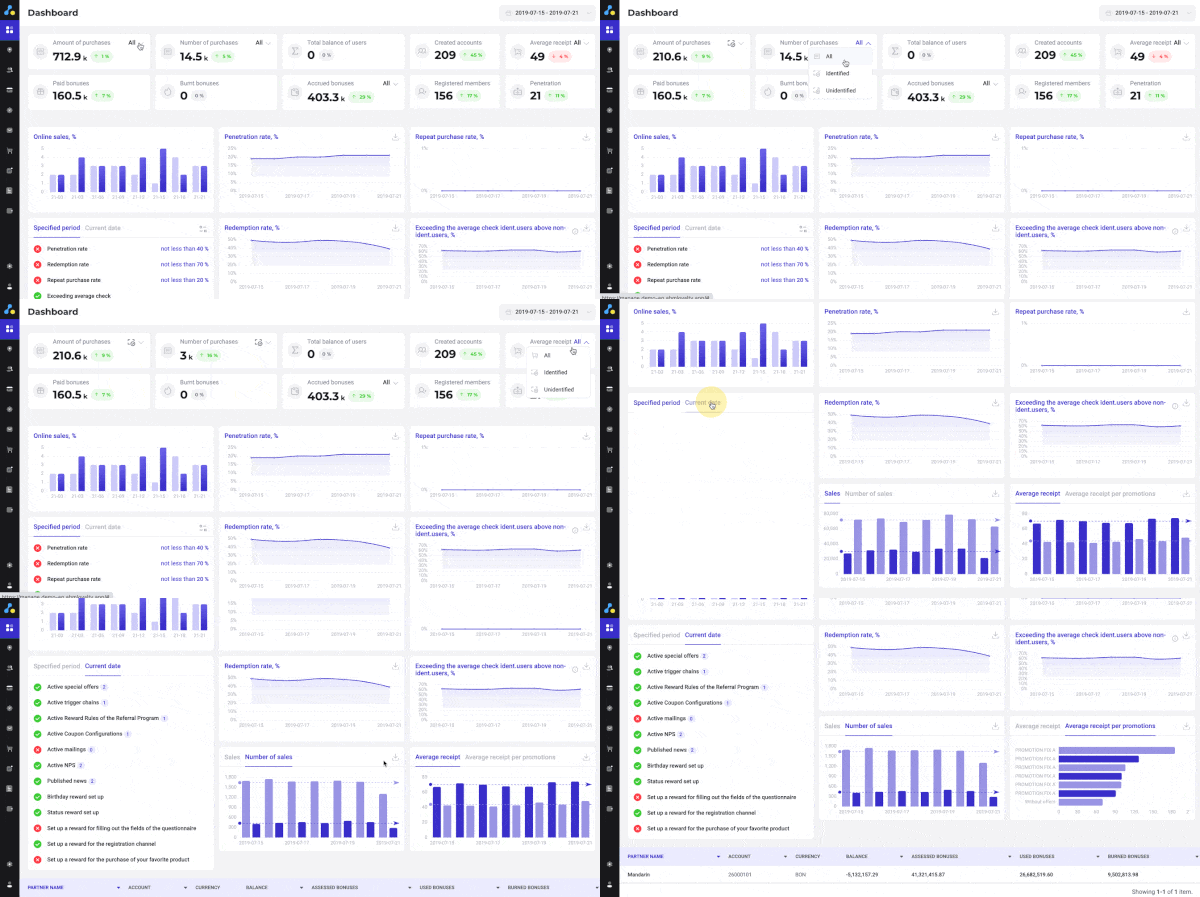
LEAFIO AI is a retail planning platform, the LEAFIO AI Retail Platform, and fresh is one algorithm inside it. The same platform runs center-store replenishment, DC allocation, promotions, assortment and planograms on one forecast and one data model. The company reports 250+ retailers and 30,000+ stores in 40+ countries.
Unlike a standalone fresh ordering tool, LEAFIO AI connects perishable inventory decisions with broader replenishment, assortment and shelf planning. Fresh stops being a separate planning workflow. LEAFIO AI helps multi-store grocers keep fresh and center store in sync through one platform, with no second vendor to reconcile.
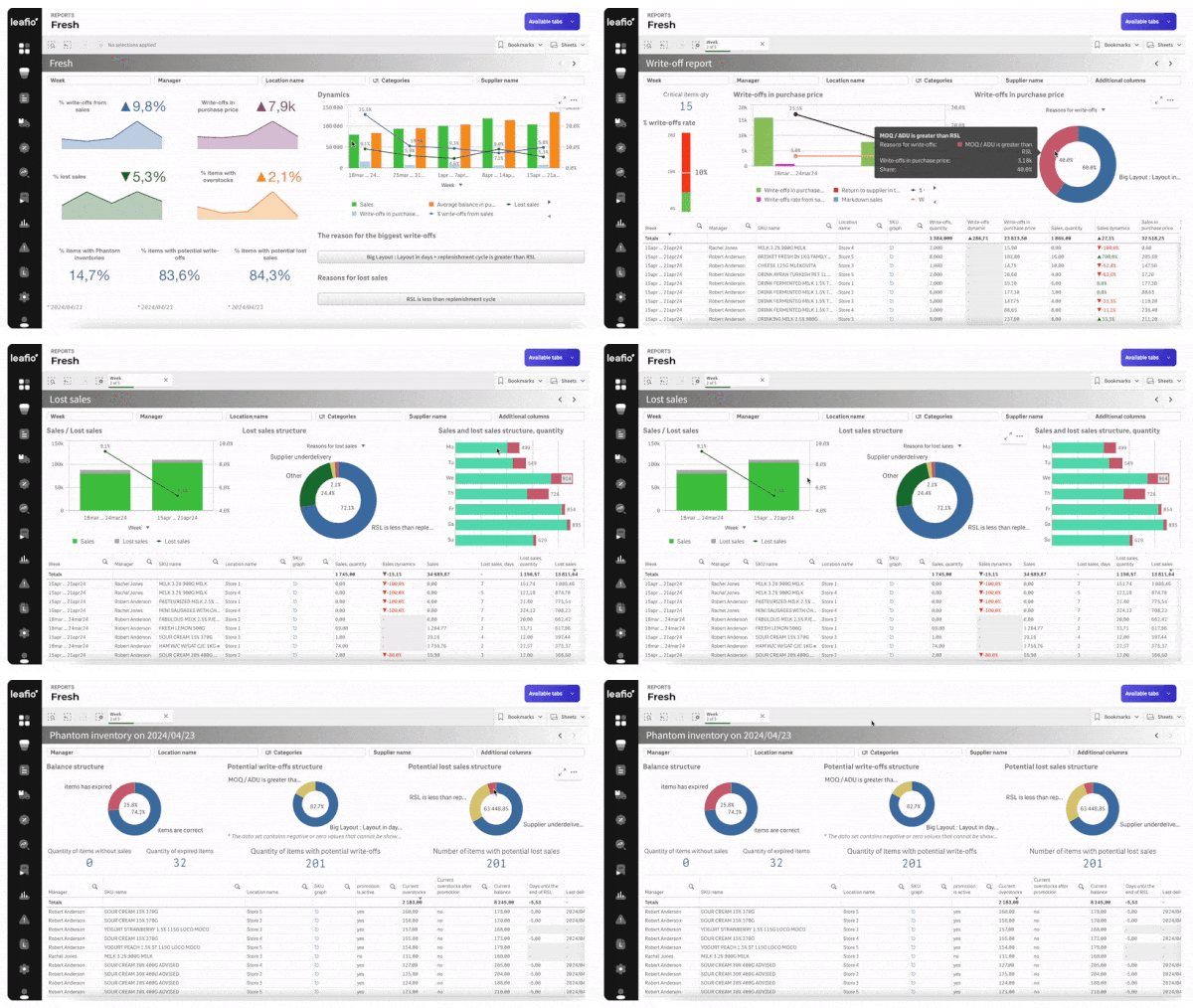
What stood out to me is the FRESH algorithm inside LEAFIO Inventory Optimization. Each item gets a target service level based on its remaining shelf life. Short-life items default to a lower level to limit write-offs, while longer-life items lean toward availability. You can tune that balance per category. Loose and weighed items get a virtual stock position, recalculated daily from each delivery batch, so staff recount only the items on tomorrow's order. Batch accounting runs on FIFO or LIFO, set per category.
Key features:
- FRESH algorithm with shelf-life-based service levels and weekday demand coefficients
- Delivery slot schedules per supplier and store, used directly in order calculation
- Center-store auto-replenishment, multi-echelon DC allocation andplanograms and space management on the same data model
Pros and cons:
| Pros | Cons |
|---|---|
| One product for fresh, center store, assortment and planograms | Fewer enterprise bakery-production references than RELEX |
| G2 5.0/5 from 33 reviews | No built-in labor scheduling, unlike Logile |
| 30,000+ stores across 40+ countries | Lighter on e-commerce fulfilment than Upshop |
Company-reported results: on fresh categories, LEAFIO reports up to 15% fewer write-offs, up to 10% less surplus inventory and up to 10% better availability. Daily, a 227-store chain in Georgia, grew sales by 23% and improved inventory turnover from 30 to 24 days. It now sends 99.5% of orders automatically. Local Discounter, an 82-store supermarket chain, grew sales by 28.3% and cut staff ordering workload by 80%.
Pricing: Custom pricing based on chain size and module selection. A free demo is available on request.
Best for: grocery chains with 50 to 1,000 stores that want every category, fresh included, planned in one place.
Bottom line: LEAFIO AI, RELEX and Blue Yonder are the three vendors here that cover fresh ordering, center-store replenishment and planograms in one platform. For a mid-size chain that wants that scope without an enterprise-scale project, LEAFIO AI is the one I'd shortlist first. See how LEAFIO fresh item management software works.
Reviews: LEAFIO AI on G2: 5.0/5 from 33 reviews.
Ready to see LEAFIO AI in action? Bring one fresh category and a month of sales and waste data. We'll show you how the FRESH algorithm would have ordered it, item by item. Book a free demo →
2. RELEX Solutions: Best for Enterprise Fresh Planning
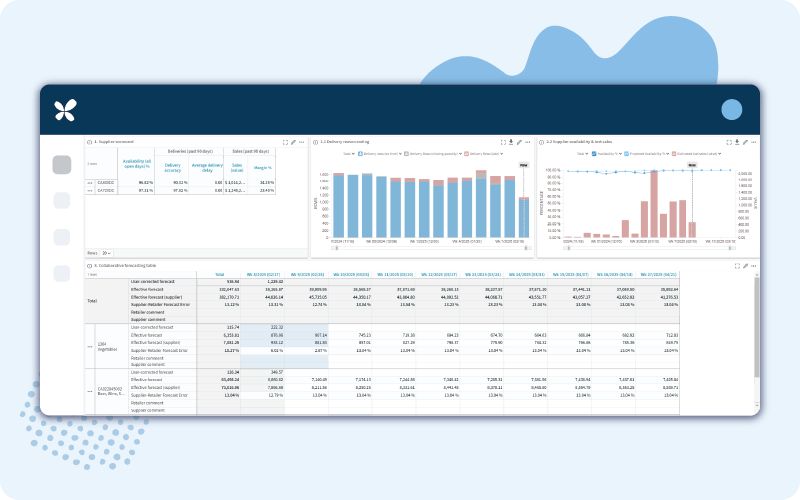
RELEX Solutions is a Helsinki-based planning platform for large grocery, convenience and specialty chains. Fresh is one of its most developed areas, with dedicated logic for in-store kitchens and bakeries. In my view, it's the benchmark for enterprise fresh planning. The price tag and timeline match.
Key fresh features:
- AI forecasting by item, store and day
- Ordering that accounts for the remaining shelf life of stock on hand
- Bakery and in-store kitchen replenishment based on recipes (BOM) and intraday forecasts
Its order logic weighs waste risk against lost margin, which is the trade-off fresh buyers otherwise make by hand.
| Pros | Cons |
|---|---|
| Deep forecasting, praised on G2 | Long, multi-month rollouts |
| Scales to very large networks | Learning curve flagged in some G2 reviews |
| Covers space planning and replenishment in one platform | Enterprise pricing |
Company-reported results: M&S Food and ADUSA are among RELEX customers. The vendor reports up to 40% less food waste and up to 85% fewer stock-outs.
Pricing: Enterprise, quote-based. Contact RELEX for a demo.
Best for: chains with 300+ stores, their own bakery or deli, and a team for a long implementation.
Bottom line: the deepest enterprise fresh stack on this list. See our RELEX alternatives guide and LEAFIO vs RELEX breakdown.
Reviews: RELEX on G2: 4.6/5 from 21 reviews.
3. Afresh: Best Fresh-First Specialist for US Grocery
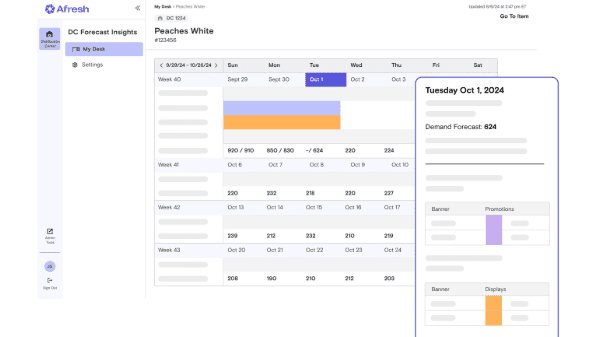
Afresh is one of the best-known fresh specialists in US grocery. It built its name on store ordering, production planning and DC buying for fresh departments. In 2026 it expanded into center store, frozen and general merchandise. The company raised $34 million in April 2026 and now runs in more than 12,500 departments across 40 states.
Key fresh features:
- AI store ordering for produce, meat, seafood and bakery
- Production planning for fresh departments
- DC buying recommendations for fresh
It sits on top of your existing ordering system instead of replacing it. That makes it a low-disruption way to test AI fresh ordering without touching your ERP.
| Pros | Cons |
|---|---|
| Deep fresh specialization | Shelf and space planning not in its documented offering |
| Strong US grocery brand, 12,500+ departments | US market only |
| Now orders center store, frozen and GM too | No public pricing |
Company-reported results: Afresh reports up to 25% less shrink, 3% higher sales and 7% better inventory turns.
Pricing: Not published. Quote on request.
Best for: US chains with 100+ stores that want a fresh-first AI layer. You'll still need another tool for the shelf.
Reviews: none on G2 or Capterra yet.
4. Upshop (incl. Invafresh): Best for Store Operations in North America
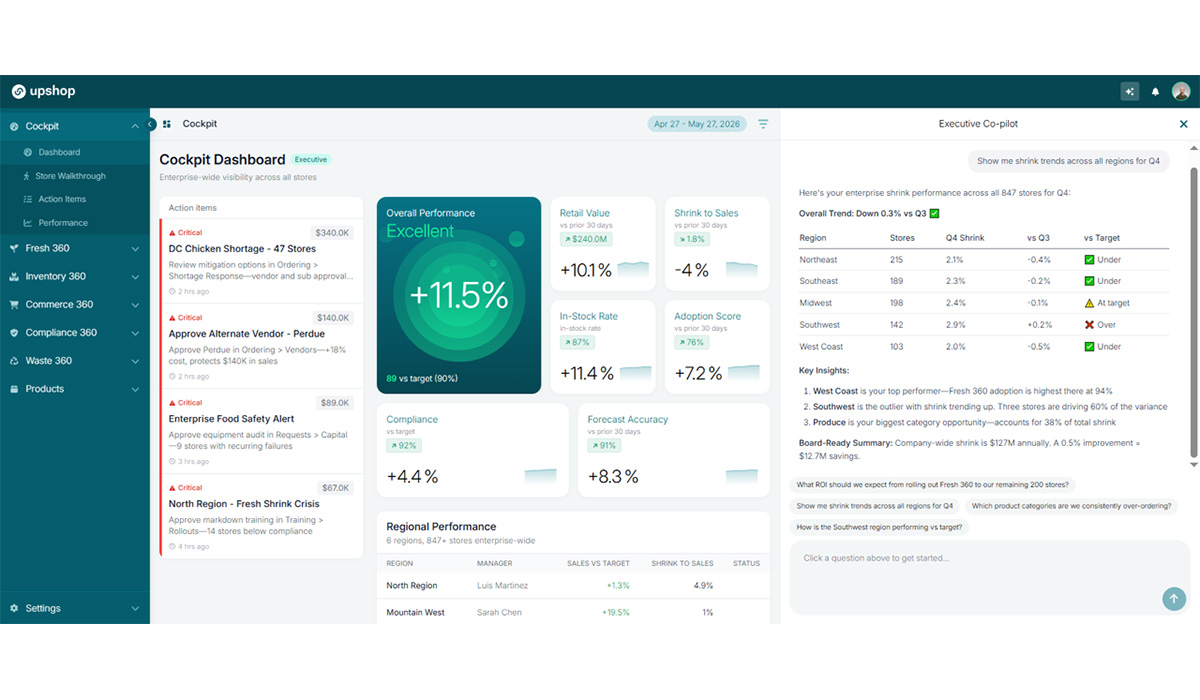
Invafresh is now part of Upshop. The merger closed on June 21, 2024, and the combined company reported 400+ retailers in 35 countries and more than 50,000 stores. The Invafresh brand was folded into Upshop. If you run Invafresh today, ask how the two products are being combined.
Key fresh features:
- Fresh production planning and AI forecasting, inherited from Invafresh
- Ordering for fresh, center store and direct store delivery (DSD)
- Waste tracking and sustainability reporting, built on Whywaste
Food safety workflows and e-commerce picking round out the suite. Worth a look if store labor and online picking cause as much waste as forecasting does.
| Pros | Cons |
|---|---|
| Broad store execution coverage | Planograms and assortment analytics not in its documented offering |
| E-commerce fulfilment built in | Two product heritages under one brand; check the roadmap |
| Large North American customer base | No public pricing |
Company-reported results: I found no published fresh-specific results I could verify. Ask for references in your format.
Pricing: Not published. Quote on request.
Best for: North American grocers that want one system for in-store operations, from fresh production to online orders.
Reviews: none on G2 or Capterra yet.
5. Logile: Best for Fresh Planning Tied to Labor and Compliance
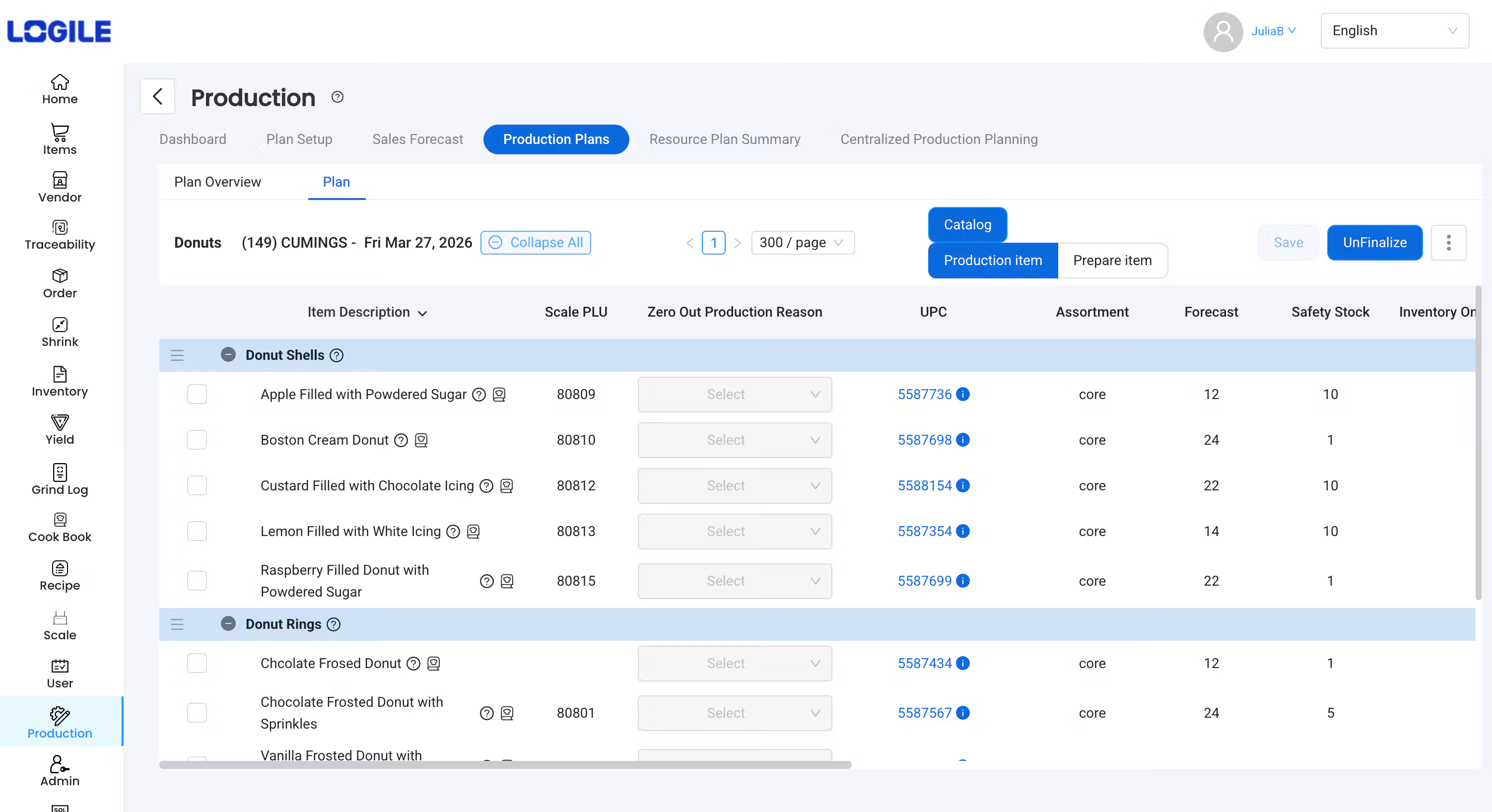
Logile combines fresh item management, production planning and workforce management in one US-focused product. It suits grocers with heavy in-store production in deli, bakery and meat. Its compliance features for FDA nutrition labeling and USDA grind logs are the most detailed I saw.
Key fresh features:
- AI and machine-learning forecasting for fresh departments
- Production planning with digital recipes and nutrition data for FDA labeling
- Grind logs, cutting tests and yield management
What sets Logile apart is the link to labor scheduling. Production plans turn into staffing plans without a handoff.
| Pros | Cons |
|---|---|
| Fresh planning tied to labor | Store-level focus; DC replenishment not in its documented fresh offering |
| Strong FDA and USDA compliance | Planograms not in its documented offering |
| Proven with large US grocers | US-focused |
Company-reported results: Schnucks rolled Logile out to 114 stores in September 2025, with no results published yet. Logile reports forecast accuracy of up to 97% and 20–40% less waste.
Pricing: Not published. Quote on request.
Best for: US chains where labor and food safety drive fresh decisions.
Reviews: none on G2 or Capterra yet. Logile Workforce Management is listed on Gartner Peer Insights without reviews so far.
6. Freshflow: Best Lightweight Fresh Ordering for European Stores
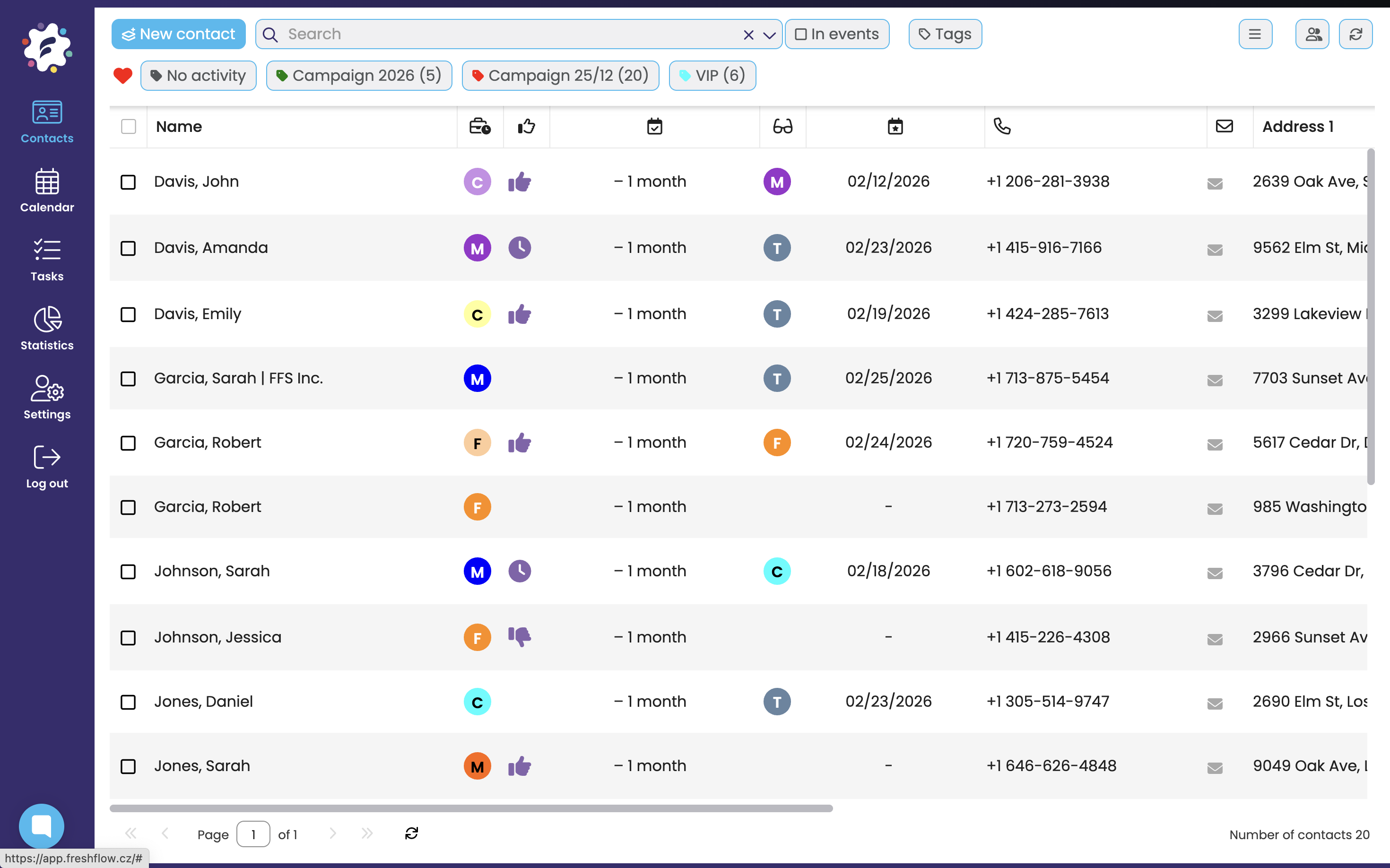
Freshflow is a Berlin-based AI startup focused on store-level fresh ordering in Germany and France. It raised a $10 million Series A in June 2026, led by Reimann Investors. Today it covers fresh produce, with meat, bakery and in-store production planned for late 2026.
Key fresh features:
- AI order recommendations for fresh at store level
- Forecasts that account for shelf life and spoilage risk
- Mobile interface for store staff
The number I'd watch is the 93% acceptance rate for its recommendations, against an industry norm of 50–60% by the company's own count. In fresh, a forecast that department heads override every morning is worth very little.
| Pros | Cons |
|---|---|
| Narrow, focused product | Early-stage company |
| References in Germany and France | Produce only for now, two countries |
| High staff acceptance of recommendations | No public pricing |
Company-reported results: Freshflow runs at nine retailers, including independent merchants within EDEKA, Carrefour, Intermarché and Stroetmann. It reports up to 30% less spoilage per store and 2–4% more revenue.
Pricing: Not published. Quote on request.
Best for: European grocers, often EDEKA or Carrefour franchisees, who want a simple fresh ordering tool.
Reviews: none on G2 or Capterra yet.
7. Slimstock (Slim4): Best for Fresh Planning at the DC
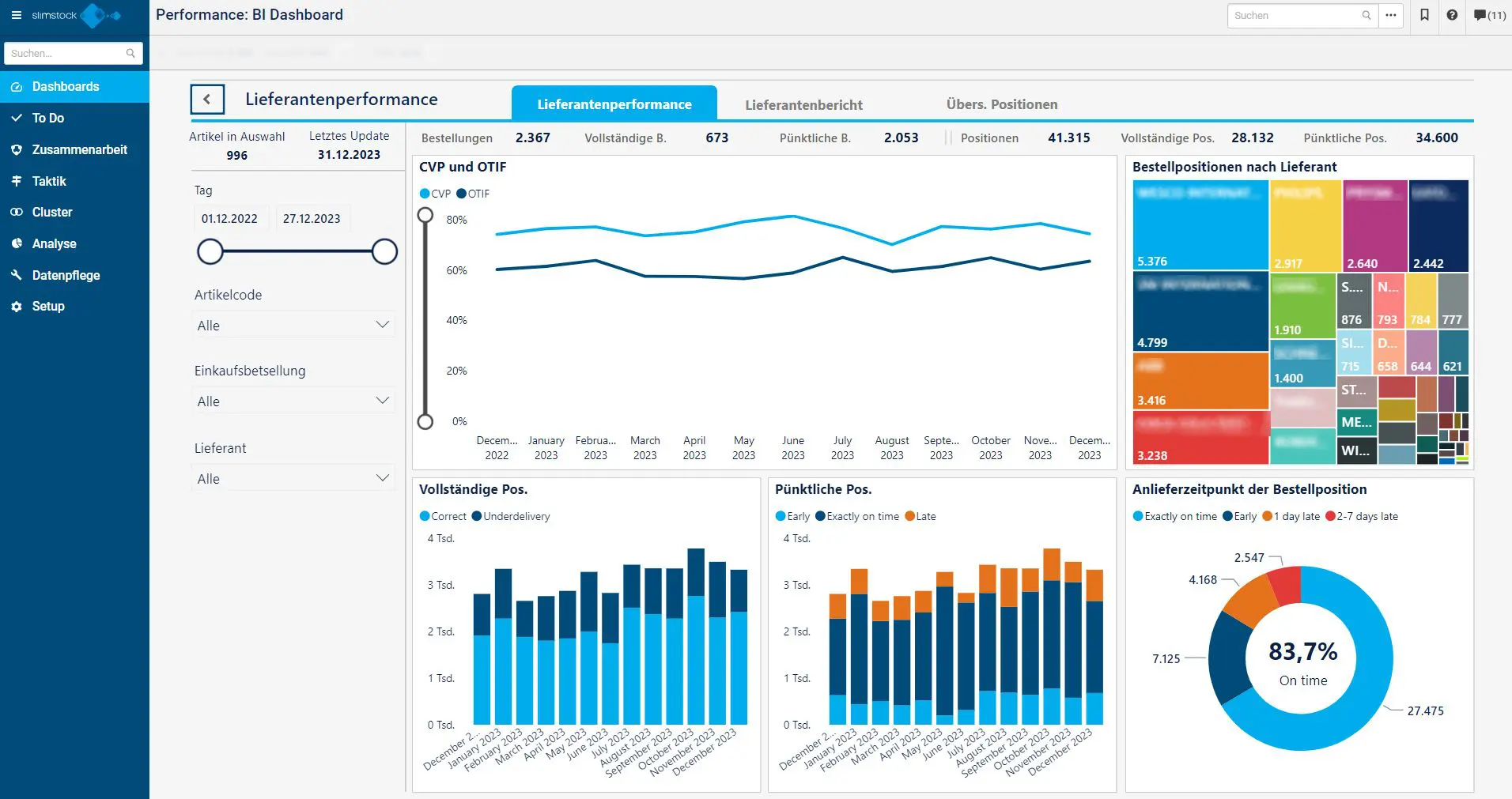
Slimstock is a Dutch inventory optimization vendor serving distribution, wholesale, retail and foodservice. Slim4 sits on top of an ERP rather than replacing it, and adds shelf-life and FEFO logic, mainly at warehouse and DC level.
Key fresh features:
- Forecasts that account for shelf life
- FEFO stock optimization
- Alerts on approaching expiry, with audit-ready records of stock movements
If your waste starts before goods reach the store (overbuying at the DC on long supplier lead times, say), Slim4 works on the right layer.
| Pros | Cons |
|---|---|
| Shelf-life and FEFO logic built in | Less store-level detail than retail-focused tools |
| Works alongside your existing ERP | Planograms and in-store production not in its documented offering |
| Strong at DC level | No public pricing |
Company-reported results: Slimstock reports that Bidfood UK cut stock value by £6 million and stock write-offs by 60%.
Pricing: Not published. Quote on request.
Best for: distributors and DC-heavy retailers whose main fresh problem sits in the warehouse.
Bottom line: solid upstream, less suited to the store shelf. See our Slimstock alternatives and LEAFIO vs Slimstock pages.
Reviews: Slimstock on G2.
8. Blue Yonder: Best for Global Chains Already on Blue Yonder
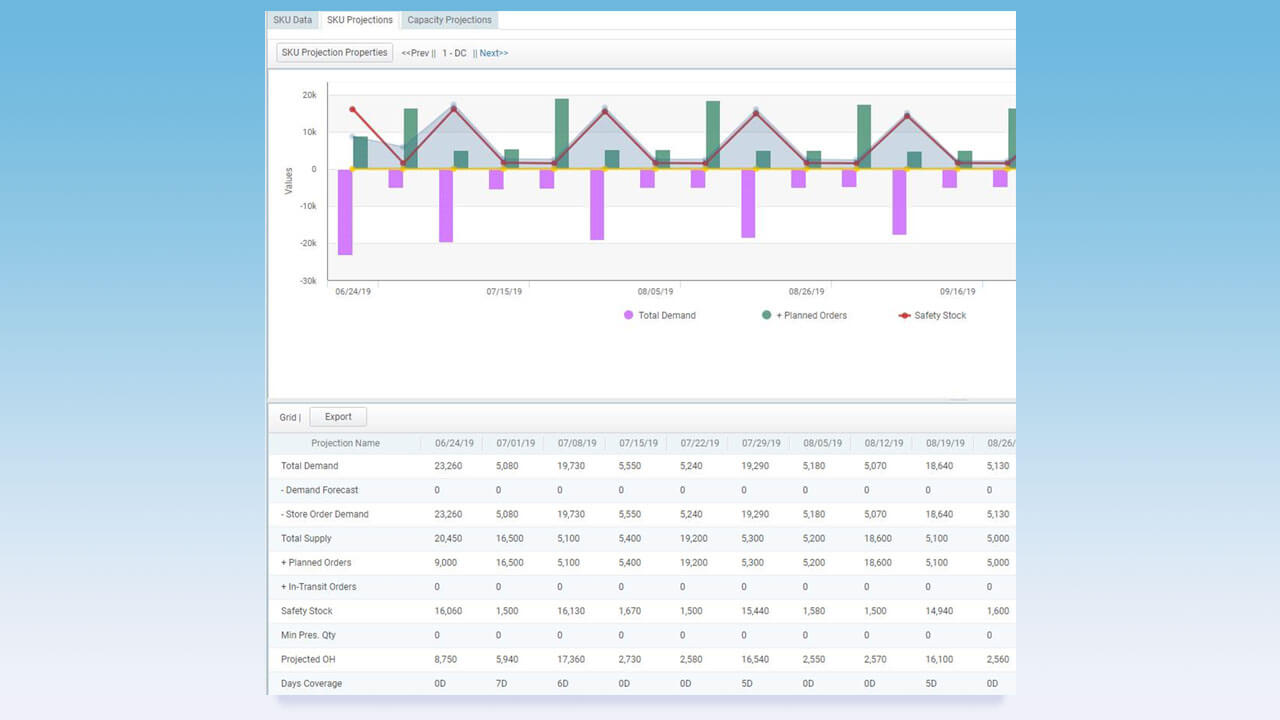
Blue Yonder, owned by Panasonic, is an end-to-end supply chain suite with fresh capabilities for demand planning, replenishment and markdowns. It's built for global chains with thousands of stores.
Key fresh features:
- Fresh demand forecasting and replenishment
- Pricing Real Time for AI-driven fresh markdowns
- Integration with Blue Yonder WMS and TMS
These modules make the most sense when forecasting, warehousing and transport already run on Blue Yonder. For a 100-store chain, buying the suite just for fresh is hard to justify.
| Pros | Cons |
|---|---|
| End-to-end supply chain coverage | Enterprise pricing |
| Mature fresh markdown engine | Long implementation |
| Global scale | Complex for mid-market chains |
Company-reported results: at Morrisons, AI markdowns cut fresh clearance from three manual markdown rounds a day to one.
Pricing: Not published. Quote on request.
Best for: global chains already running Blue Yonder.
Bottom line: a logical add-on inside the Blue Yonder ecosystem. Read our Blue Yonder alternatives and LEAFIO vs Blue Yonder guides.
Reviews: no separate G2 rating for the fresh modules.
Fresh Specialists vs. Full Platforms: Which Do You Need?
Most shortlists come down to this choice. A fresh specialist gives you a quick win in fresh, at the cost of a second system for everything else. In practice that means two forecasts for overlapping categories (think fresh-cut fruit next to packaged salads), two data feeds and two contracts.
A full platform puts fresh, center store and the shelf on one data model, so one forecast drives every order and every facing decision. The line is blurring (Afresh now orders center store too), but none of the specialists here document shelf planning. If center store is also on your list, see our replenishment software comparison.
How to Choose the Right Fresh Item Management Software
Before you book demos, write down your answers to these seven questions. In my experience they cut most shortlists in half.
- Does the forecast use the remaining shelf life of each batch? Most vendors say yes. Ask them to show what happens to tomorrow's order when stock on hand has two days left versus five. If the number doesn't move, the logic isn't there.
- Does it support weighted items and virtual stock? Loose produce rarely matches the system. Ask how the tool estimates on-hand without a full recount. LEAFIO AI, for example, recalculates a virtual stock position daily from delivery batches.
- Can it plan in-store production? Bakery and deli need recipes, yields and two or three runs a day. If production is a big share of your fresh sales, RELEX and Logile go deepest here.
- Does it treat waste as its own metric? You want write-offs reported apart from shrink, and markdowns triggered before expiry rather than after.
- Does the same tool cover center store and planograms? Answer this one first, because it decides between a specialist and a platform.
- How long will implementation take for a chain your size? Ask for references in your country, not just your segment. Every month of rollout is another month of fresh waste at today's rate.
- Is there independent proof? Check G2 or Capterra and ask for published customer results. Half the vendors here have no independent reviews at all. That doesn't make them bad, but it puts the burden of proof on the demo.
One more test I'd run: ask each vendor for a reference customer whose fresh share of sales looks like yours. Then call them without the sales rep on the line.
How AI Enhances Fresh Item Management Software
AI pays off fastest in fresh, because a bad guess turns into waste within days. Three things change. Forecasts move from weekly averages to item, store and day, with weekday swings built in. Service levels stop being one number for the whole store and start following each item's remaining shelf life. Markdowns shift from a clerk's judgment call to a rule that fires before expiry.
Most legacy replenishment tools still run on fixed reorder points with manual overrides on top. Often the "AI" label means a dashboard, not the order logic. LEAFIO AI helps grocery retailers reduce fresh waste without losing availability through AI demand planning that sets service levels by remaining shelf life and drives center-store orders from the same engine.
How to Launch a Fresh Item Management Solution That Scales
Fresh projects usually stall on data, not software. Here's the sequence a typical LEAFIO AI rollout follows:
- Collect sales and write-off history for fresh categories, ideally a full seasonal cycle.
- Clean master data: shelf life per item, weighed vs. unit items, batch rules.
- Load delivery slots and supplier constraints such as minimum order quantities.
- Connect POS, ERP and warehouse stock, then check on-hand against the shelf.
- Pilot one or two fresh categories in a few stores against control stores.
- Scale store by store once waste and availability move the right way.
After six to twelve months, you should see write-offs and out-of-stocks falling together. If only one of them moves, the configuration needs work.
Implementation doesn't have to take a year. A typical LEAFIO AI rollout starts with a pilot on one fresh category, then expands store by store. Talk to our team →
FAQ
What is fresh item management software?
It plans ordering and production for perishables such as produce, meat, bakery and deli, factoring in shelf life, weighted items and markdowns.
How do grocery stores reduce fresh food waste with software?
They use forecasts that account for shelf life, mark items down before expiry and track write-offs as a separate metric. Vendors on this list report waste reductions of 15% to 40%, depending on category and starting point.
What's the difference between FIFO and FEFO for perishables?
FIFO (first in, first out) sells the oldest delivery first. FEFO (first expired, first out) sells the batch with the nearest expiry date first. For perishables, FEFO usually reflects reality better, because deliveries can arrive with different remaining shelf life.
Can replenishment software handle products with short shelf life?
Many standard replenishment tools aren't built for it, because they apply one service level regardless of shelf life. Short-life products work better with a fresh-specific algorithm that adjusts service levels to remaining shelf life. LEAFIO AI's FRESH algorithm does this inside its inventory optimization module.
What is the best inventory software for a grocery store?
It depends on scale and scope. Chains that want one system for fresh, center store and planograms usually look at full platforms such as LEAFIO AI or RELEX. Chains that only need help with fresh can add a specialist instead. See LEAFIO's grocery store inventory management software.
How is fresh item management different from standard replenishment?
Standard replenishment typically works mainly from sales history and a stock number. Fresh item management also tracks days left per batch, estimates stock for loose items and plans in-store production. See how LEAFIO's fresh inventory software handles it.
What happened to Invafresh?
Invafresh merged with Upshop in a deal that closed on June 21, 2024. Its fresh production and forecasting tools now sit inside the Upshop store operations platform, under the Upshop brand.


Have a question?

Jack Larson
Retail Optimization Expert