

This comparison is published by LEAFIO AI. We include our own product and aim to describe every tool fairly, with competitor ratings linked to G2 and Capterra.
The system shows 14 units on hand. The shelf is empty. Somewhere between receiving, a customer return, and a miscounted case, the record drifted, and the next order went out wrong. A study by the Auburn University RFID Lab and GS1 US found that barcode-based processes left retail inventory records only about 63% accurate. Closing that gap is the job of retail inventory management software.
To find the best retail inventory management software for 2026, we compared 10 tools, from enterprise platforms that run large grocery chains to POS apps that run a single boutique. We looked at store-level stock accuracy, ordering automation, multi-store visibility, pricing, and what users report on G2 and Capterra. Every tool is matched to the store count it fits best. A 3-store gift shop and a 300-store grocer should not buy the same system.
For chains with 20 or more stores, LEAFIO AI is our top pick. LEAFIO AI generates daily orders for every store and links inventory with shelf and assortment decisions on one platform.
See LEAFIO AI on your own store data Get a walkthrough of automated store ordering, fresh replenishment, and store-level dashboards. Request a demo →
Retail Inventory Management Software Compared at a Glance
Some of these tools keep an accurate stock record. Others also decide what each store should order. The table sorts all 10 by the store count they fit, enterprise platforms first.
| Tool | Best For | Inventory Approach | Starting Price | Store-Level Strength |
|---|---|---|---|---|
| LEAFIO AI | Chains with 20+ stores (grocery, convenience, pharmacy, DIY) | Automated store ordering | Custom pricing · Request a demo → | Daily automated store orders with a dedicated fresh algorithm |
| RELEX Solutions | Large grocery and specialty chains | Automated store ordering | Contact for pricing | Store replenishment and fresh store ordering |
| Blue Yonder | Global enterprise retailers | Enterprise planning and execution suite | Contact for pricing | Store, DC, and channel inventory on one enterprise platform |
| SymphonyAI Retail CPG | Large grocers and CPG-heavy retailers | Automated replenishment and allocation | Contact for pricing | Store-by-SKU replenishment and allocation |
| Manhattan Active Omni | Omnichannel chains using RFID | RFID counts and store fulfillment | Contact for pricing | RFID counts, receiving, and transfers in one store app |
| Oracle NetSuite | Growing chains that want inventory inside an ERP | Inventory inside an ERP | Contact for pricing | Multi-location stock tied to financials |
| Lightspeed Retail | Independent stores and chains up to about 20 locations | POS-based tracking | From $69/month | POS and inventory in one retail app |
| Shopify POS | Omnichannel retailers with 1 to 10 stores | POS-based tracking with online sync | POS Pro $89/location/month plus a Shopify plan | Real-time stock sync between stores and online |
| Cin7 Core | Brands selling through stores, wholesale, and online | Multichannel inventory and orders | From $349/month | One stock record across retail and wholesale orders |
| Zoho Inventory | Single stores and small chains on a tight budget | Basic multi-location tracking | Free plan; paid from $29/month | Low-cost multi-location tracking |
Prices checked in October 2026; confirm them before you budget.
How We Evaluated Retail Inventory Management Tools
We selected and organized the tools by retail segment, using public product documentation and ratings on review platforms rather than hands-on testing of every system. Brand recognition counted, but only tools that manage store inventory made the final cut. Here is what we checked:
- Store-level stock accuracy. Does the tool keep an up-to-date count per SKU and per store, including returns, write-offs, and transfers?
- Ordering automation. Can it create automated purchase orders from reorder points or forecasts, so stores avoid both stockouts and overstock?
- Multi-store visibility. Can head office see stock, surplus, and lost sales across multiple locations and sales channels on one screen?
- POS and accounting integrations. Sales and stock should flow in from your POS systems and accounting software without manual entry, which is where manual errors start.
- Fresh and short shelf-life handling. For grocery and convenience chains, fresh is where write-offs pile up, so we checked who handles it natively.
- Fit by store count. We sorted tools into three bands: 1 to 5 stores, 6 to 50 stores, and 50+ stores.
- Deployment model. Most modern tools are cloud-based inventory management software, but setup effort still ranges from a weekend to a year.
- Total cost and reviews. We looked past the starting price to total cost and checked ratings on G2, Capterra, and Gartner Peer Insights.
10 Best Retail Inventory Management Software: Reviews
1. LEAFIO AI: Retail Inventory Management Built for Store Chains
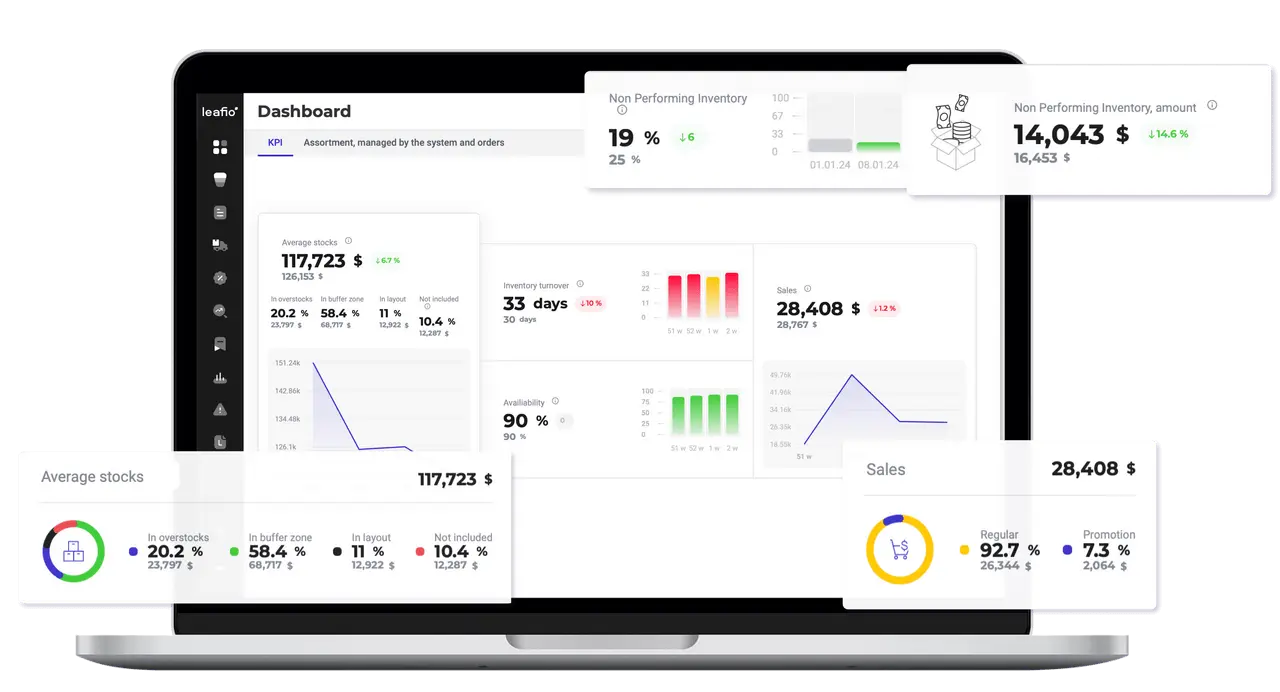
LEAFIO AI Retail Platform was built for store chains, not adapted from warehouse or manufacturing software. LEAFIO AI counts 250+ projects in 45+ countries and 30,000 stores in the system, and the platform holds a 5.0 rating on G2 from 33 reviews. LEAFIO AI lets you run Inventory Optimization as a standalone retail inventory optimization system, or connect it with Shelf Efficiency and Assortment Performance on one shared data layer.
At store level, LEAFIO AI removes most of the daily ordering routine. LEAFIO AI calculates demand and generates automated store replenishment orders for every store before managers start their shift. Head office tracks surplus, availability, lost sales, and turnover per store on an inventory management dashboard.
Fresh is where generic reorder rules break down. LEAFIO AI runs a dedicated FRESH algorithm that accounts for remaining shelf life, demand by day of the week, delivery slots, and FIFO or LIFO batch logic per category. For loose and weighed items, LEAFIO AI recalculates a virtual stock position every day, so staff recount only the items due for tomorrow's order.
Baltic Petroleum, an 86-store convenience chain in Lithuania, shows the effect. LEAFIO AI moved ordering from 84 store managers to 4 head-office specialists. Overstock fell 50%, lost sales dropped 9%, and the project paid back in one month. In grocery, Daily, a 227-store chain in Georgia, grew sales by 23% and cut inventory turnover from 30 to 24 days. Its fresh write-offs fell from 11% to under 2% within two months, and 99.5% of its orders now run without manual input.
How the modules work together. LEAFIO AI connects store ordering with assortment, shelf, and promotion decisions instead of treating them as separate tools. When retailers use Assortment Performance with Inventory Optimization, a delisting decision stops supplier orders and sells out remaining stock through the chain. When planogram data exchange is switched on, facings and shelf capacity from published planograms feed the replenishment model. Promotion Intelligence runs on Inventory Optimization, so promo forecasts go straight into store orders.
Key features:
- Three ordering algorithms instead of one reorder point: CDA for standard SKUs, FRESH for perishables, and DFO for DC-to-store flows
- Multi-echelon replenishment that plans stock from the central warehouse down to each store
- Supplier selection that ranks alternative suppliers by the retailer's own criteria
- New SKUs get a forecast from similar products and can get a first order automatically once activated in assortment
- Promotion Intelligence adds automatic promo forecasts and lets teams compare discount scenarios before launch
- 40+ analytics reports, including phantom inventory and supplier reliability
| ✅ Pros | ❌ Cons |
|---|---|
| Connected platform: store orders follow assortment decisions from Assortment Performance and, where switched on, shelf capacity from Shelf Efficiency | Not a POS or accounting system, so it needs a data feed from your existing systems |
| SuperApp limits recounts to the items that need them and feeds counts into the next order | Built for chains; a single store would use a fraction of it |
| Start with one module and add others later by extending the same integration | Not designed for apparel and fashion retail |
Pricing: Custom, based on store count and modules. After data integration, a standard Inventory Optimization pilot runs for about a month.
Best for: Grocery, convenience, pharmacy, and DIY chains with 20+ stores that want store ordering automated.
Automate store ordering across your chain See how LEAFIO AI builds daily store orders, including fresh, from your own sales and stock data. 250+ implementations · 45+ countries · 30,000 stores Request a free demo →
2. RELEX Solutions: Store Replenishment for Large Grocery Chains
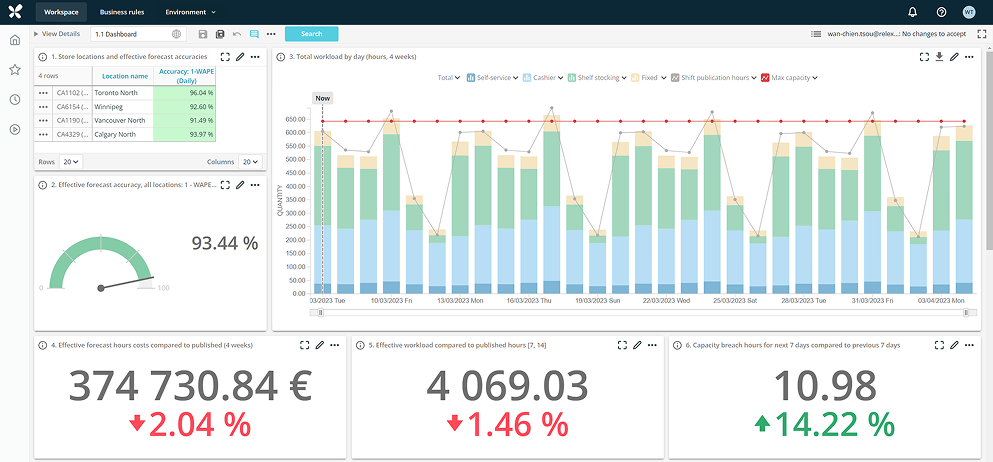
RELEX is a regular on large grocers' shortlists. Its strength for store operations is automated store replenishment with business rules per store and product. RELEX also acquired Ida, a French company focused on store ordering for loose fresh products such as produce, bakery, and meat. RELEX averages 4.7 across 104 reviews on Gartner Peer Insights. For a head-to-head view, see LEAFIO AI vs. RELEX.
Key features:
- Store-SKU forecasting that accounts for promotions and seasonality
- Automated store orders with business rules and exceptions per store and product
- Fresh and ultra-fresh store ordering, strengthened by the Ida acquisition
- Allocation and store replenishment for specialty retail
| ✅ Pros | ❌ Cons |
|---|---|
| Deep grocery and fresh experience | Enterprise scope and cost can exceed what a mid-size chain needs |
| Store logic is configurable per format and category | Projects lean heavily on clean master data and internal IT time |
| Named a Leader in the 2025 Gartner Magic Quadrant for Supply Chain Planning |
Pricing: Contact for pricing.
Best for: Large grocery and specialty chains with a dedicated planning team.
3. Blue Yonder: Store and DC Inventory on One Enterprise Platform
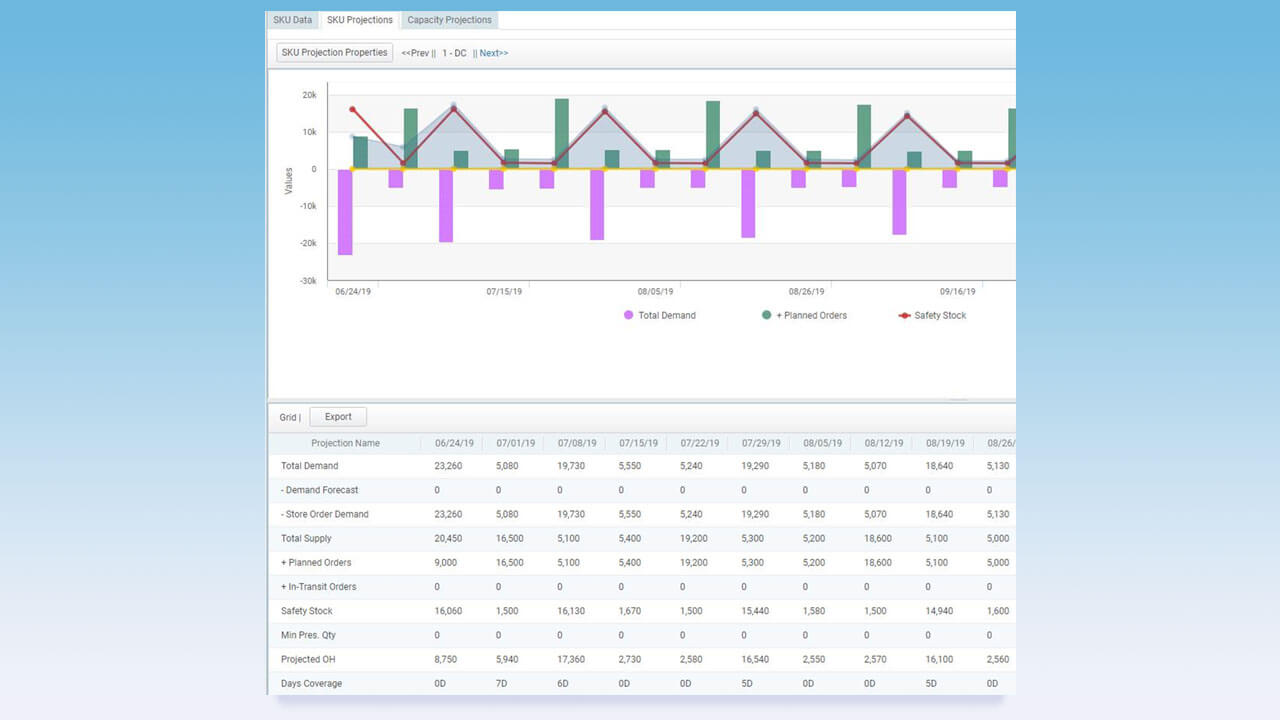
Blue Yonder sells planning, merchandising, and execution software to many of the world's largest retailers, delivered through its Luminate cloud platform. For store inventory, the value is one view of stock across stores, distribution centers, and online channels. It is a serious choice for global networks. It is a heavy one for a regional chain.
Key features:
- Inventory visibility across stores, distribution centers, and online channels
- Store-cluster planning for localized ranges
- Warehouse management and transport execution in the same suite
- AI demand sensing on the Luminate cloud platform
| ✅ Pros | ❌ Cons |
|---|---|
| Covers almost every supply chain process a global retailer runs | Pricing is custom, and partner implementation services add first-year cost |
| Long track record with tier-one retailers | Configuration takes real effort when store formats vary |
Pricing: Contact for pricing.
Best for: Global retailers with complex store, DC, and e-commerce networks. Comparing options? See our list of Blue Yonder alternatives.
4. SymphonyAI Retail CPG: Store-by-SKU Control for Large Grocers
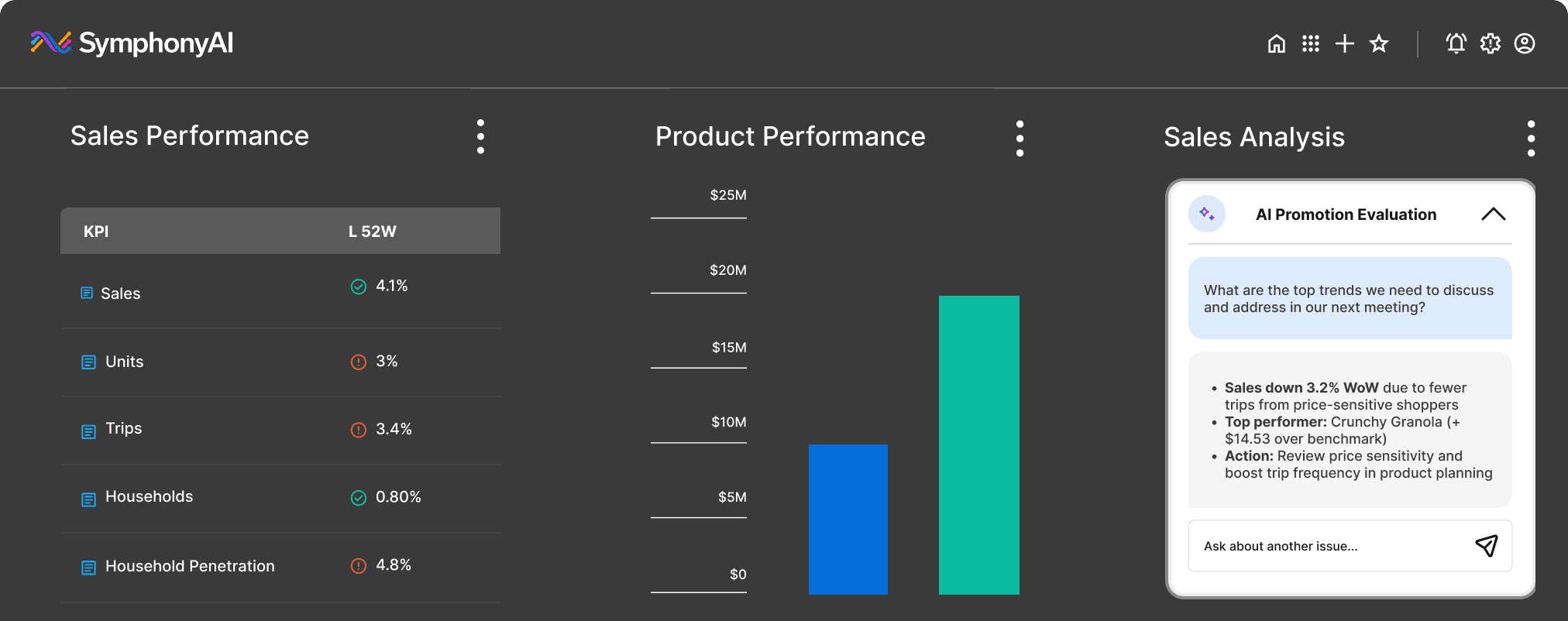
SymphonyAI Retail CPG combines forecasting, replenishment, allocation, planogram, and pricing tools for retailers and CPG suppliers. Intermarché runs replenishment for all 39 of its distribution centers on SymphonyAI. The platform targets store-by-store and SKU-by-SKU decisions for merchants, store operations, and supply chain leaders.
Key features:
- Automated replenishment and allocation
- Store intelligence for labor efficiency and merchandising consistency
- Planogram and shelf planning
- Pricing, margin, and promotion tools
| ✅ Pros | ❌ Cons |
|---|---|
| Broad retail scope in one vendor | SymphonyAI also sells into finance and industry, so retail is one division among several |
| Proven at grocery scale, including Intermarché's distribution network | Few public reviews and no public pricing |
Pricing: Contact for pricing.
Best for: Large grocers and CPG-heavy retailers buying several modules from one vendor. See how the two compare in LEAFIO AI vs. SymphonyAI.
5. Manhattan Active Omni: RFID-Ready Store Inventory for Omnichannel Chains
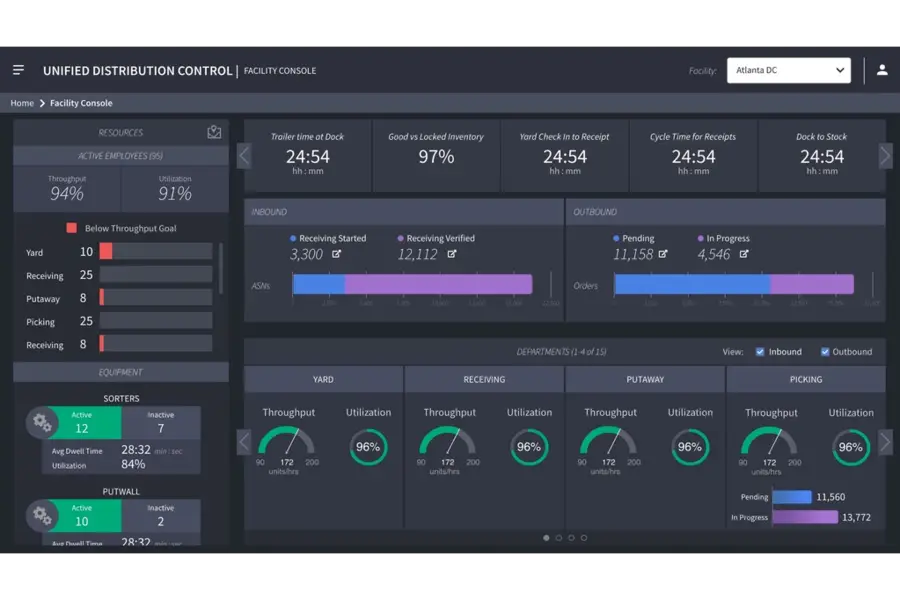
Manhattan comes at store inventory from the fulfillment side. Manhattan Active Omni puts counting, receiving, transfers, and order picking in one store app. With item-level RFID, Manhattan says store accuracy can rise from 70% to nearly 100%. That matters if you ship online orders from stores.
Key features:
- RFID counting, plus a find mode that guides staff to tagged items
- Receiving and transfers with blind receipts and wrong-store handling
- Ship-from-store, curbside pickup, and same-day delivery
- Inventory lookup across stores, DCs, and stock in transit
| ✅ Pros | ❌ Cons |
|---|---|
| Strong accuracy gains for tagged apparel and general merchandise | Focused on order fulfillment, not on calculating replenishment orders |
| One app for associates instead of several | RFID tags and readers add hardware cost |
| Named a Leader in the 2025 Forrester Wave for order management systems |
Pricing: Contact for pricing.
Best for: Apparel and general merchandise chains that fulfill online orders from stores.
6. Oracle NetSuite: Store Inventory Inside an ERP
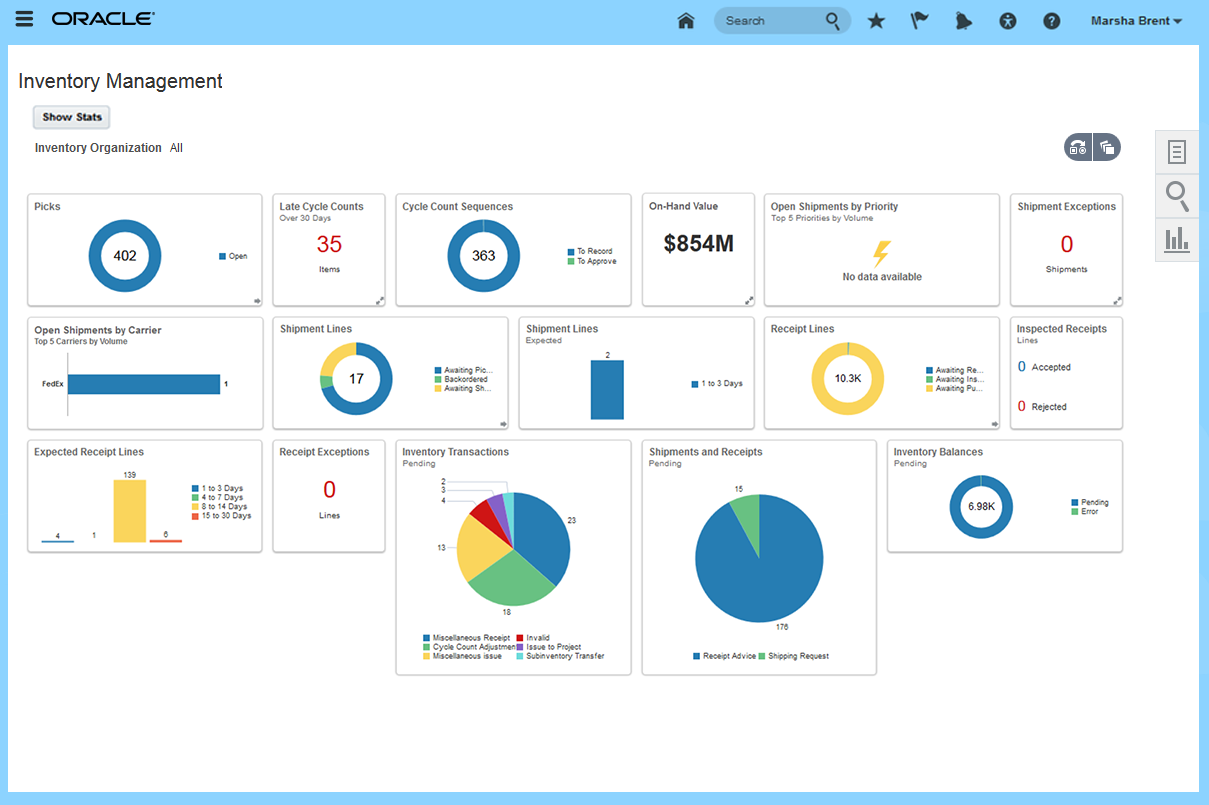
NetSuite is a cloud ERP, and inventory is one module among finance, purchasing, and order management. For a growing chain, the pull is simple: every stock movement posts straight to the books. The tradeoff is depth. Store replenishment logic is basic compared with specialist tools.
Key features:
- Multi-location stock records
- Purchasing and transfer orders
- Lot and serial number tracking for traceability
- Financials and inventory in the same system
| ✅ Pros | ❌ Cons |
|---|---|
| One system for stock and accounting | Capterra reviewers mention a steep learning curve |
| Familiar to finance teams and auditors | Implementation usually runs through a partner |
| Rated 4.2 on Capterra across more than 2,000 reviews |
Pricing: Annual license; contact for pricing.
Best for: Growing chains that need ERP and inventory under one roof.
7. Lightspeed Retail: POS and Inventory for Independent Stores
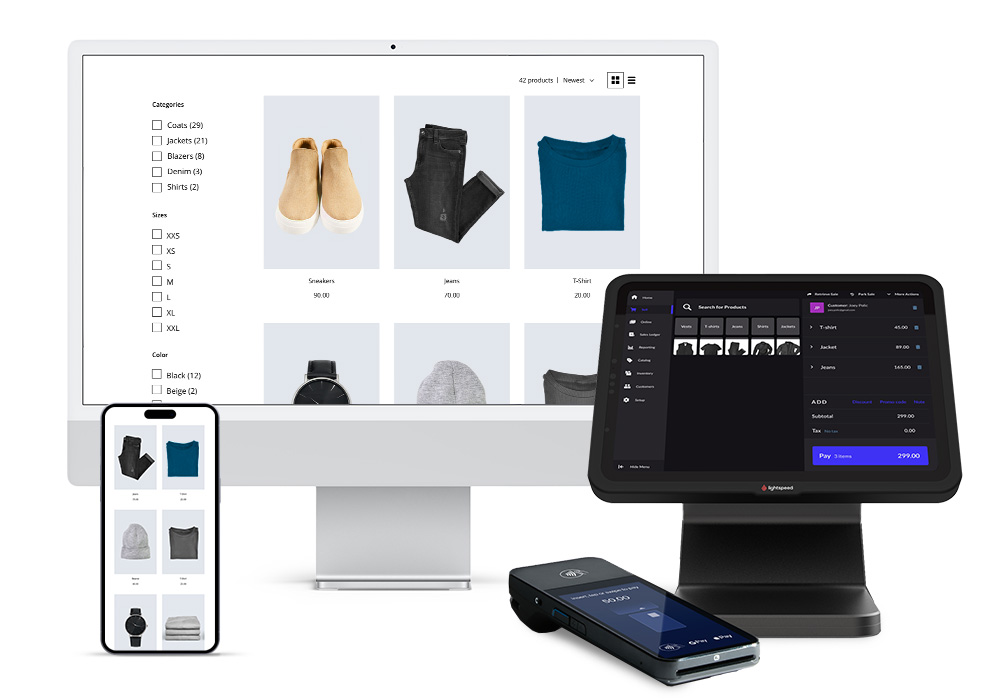
Lightspeed Retail appears on nearly every retail inventory shortlist we reviewed. It holds one inventory record for in-store and online sales, with purchase orders and stock counts built in. About 83% of its G2 reviewers are small businesses, and it scores 4.0 out of 5 from 294 reviews.
Key features:
- Catalog and variant management
- Purchase orders and stock counts
- Multi-location stock
- E-commerce sync
| ✅ Pros | ❌ Cons |
|---|---|
| Quick to learn for store staff | Reviews are mixed, and G2 users find setup harder than Shopify POS |
| Plans start at $69 per month | Fewer chain-level ordering tools than enterprise platforms |
Pricing: From $69/month.
Best for: Independent retailers and chains up to about 20 stores.
8. Shopify POS: Store Inventory for Online-First Retailers
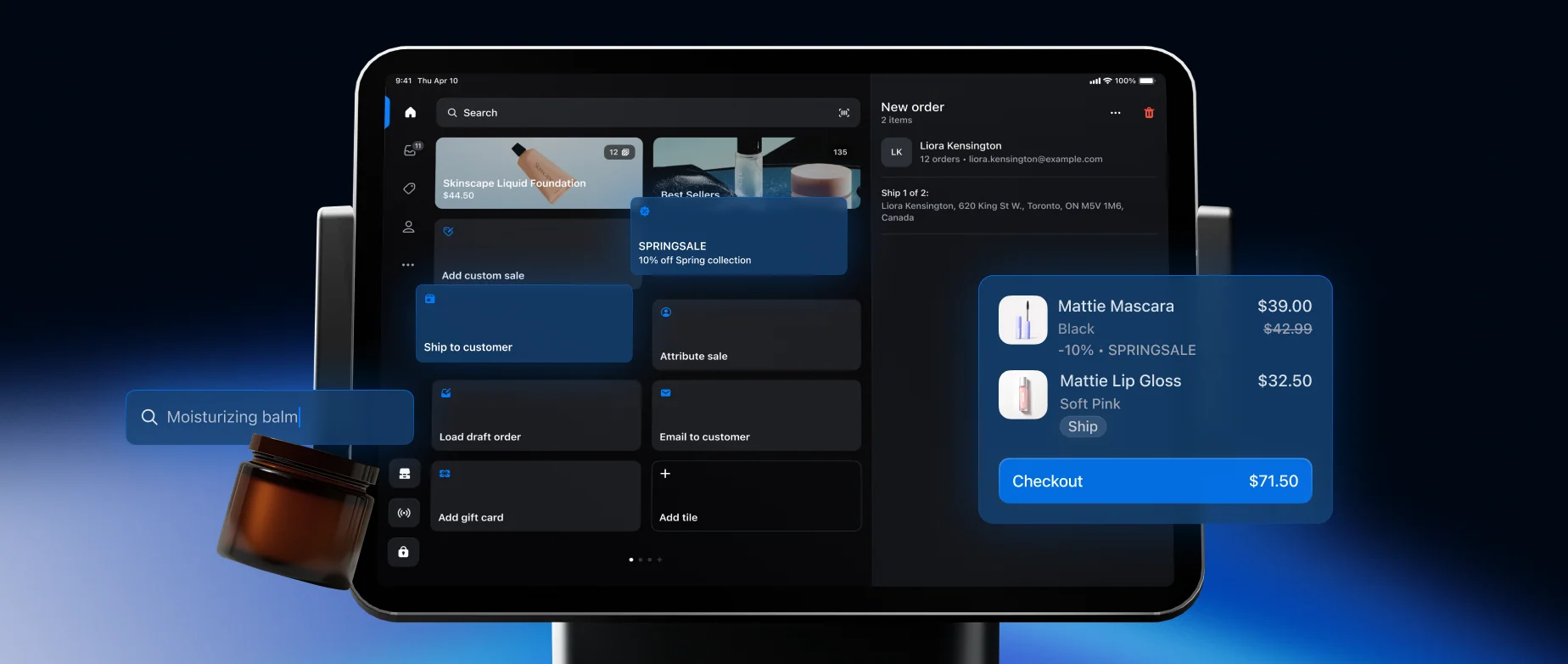
If your business started online, Shopify POS is the obvious next step into stores. Stock levels update in real time across every location and your online store, which prevents overselling. It rates 4.4 on G2 from 366 reviews and 4.6 on Capterra from 241.
Key features:
- Real-time stock sync across stores and the online store
- Buy online, pick up in store
- Returns at any location (POS Pro)
- Staff permissions and performance tracking (POS Pro)
| ✅ Pros | ❌ Cons |
|---|---|
| One catalog for stores and e-commerce | POS Pro costs $89 per location per month on top of your Shopify plan |
| Familiar admin for Shopify merchants | Deeper reporting often needs paid apps |
Pricing: POS Lite comes with any Shopify plan; POS Pro is $89/location/month.
Best for: Online-first brands running 1 to 10 stores.
9. Cin7 Core: One Stock Record for Retail and Wholesale
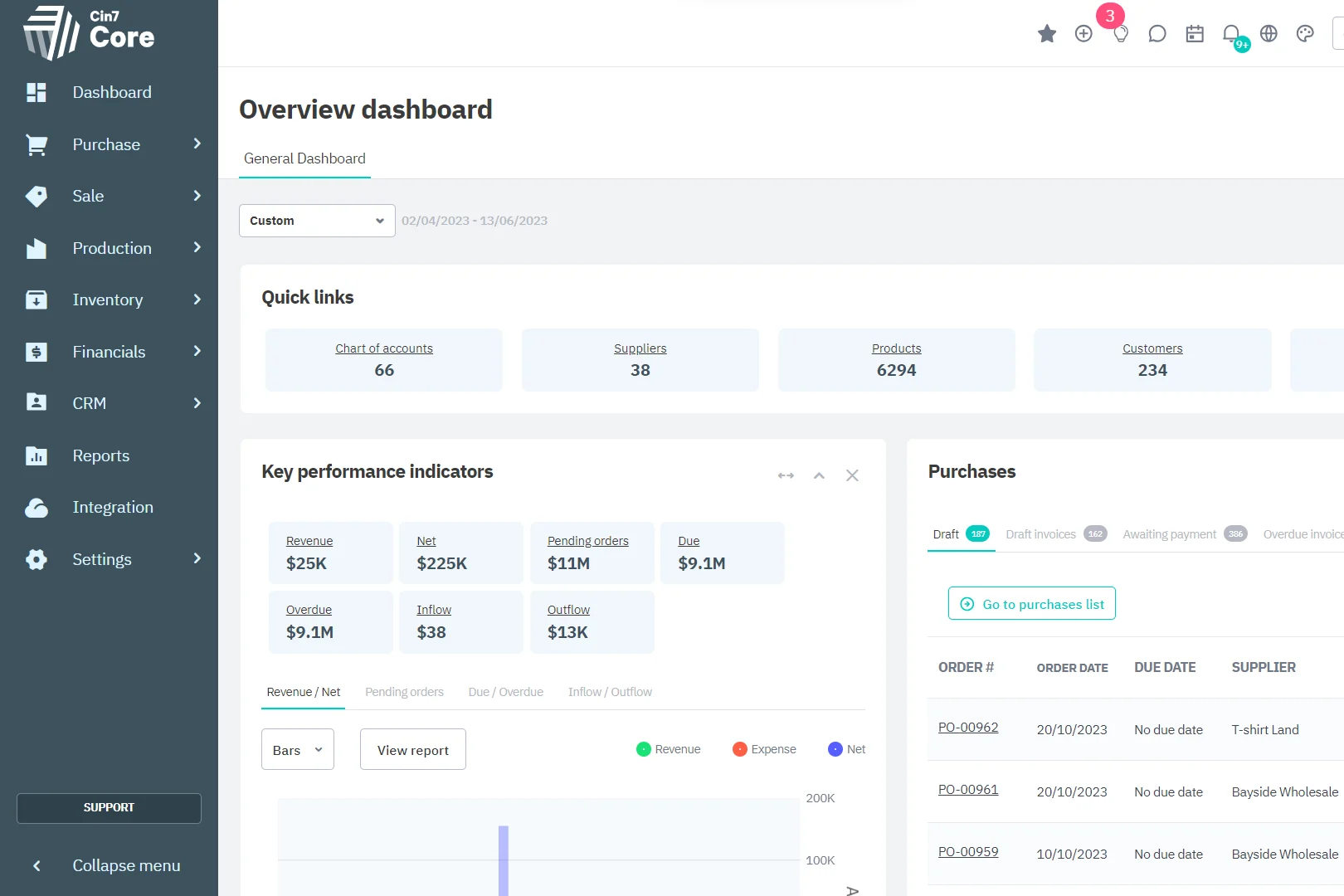
Cin7 Core suits brands that sell through multiple sales channels at once: their own stores, wholesale accounts, and online. It keeps one stock record across all of them. On G2 it scores 4.2 from 341 reviews, and 88.6% of reviewers are small businesses.
Key features:
- Multichannel order management
- Purchasing and assembly
- Warehouse picking
- POS and e-commerce connectors
| ✅ Pros | ❌ Cons |
|---|---|
| Handles retail and wholesale in one place | G2 reviewers flag missing features and integration issues |
| Reviewers praise its stock management | Pricing starts at $349 per month for 5 users |
| Rated 4.3 on Capterra across more than 700 reviews |
Pricing: From $349/month.
Best for: Brands that run stores alongside wholesale.
10. Zoho Inventory: Low-Cost Tracking for Small Retailers
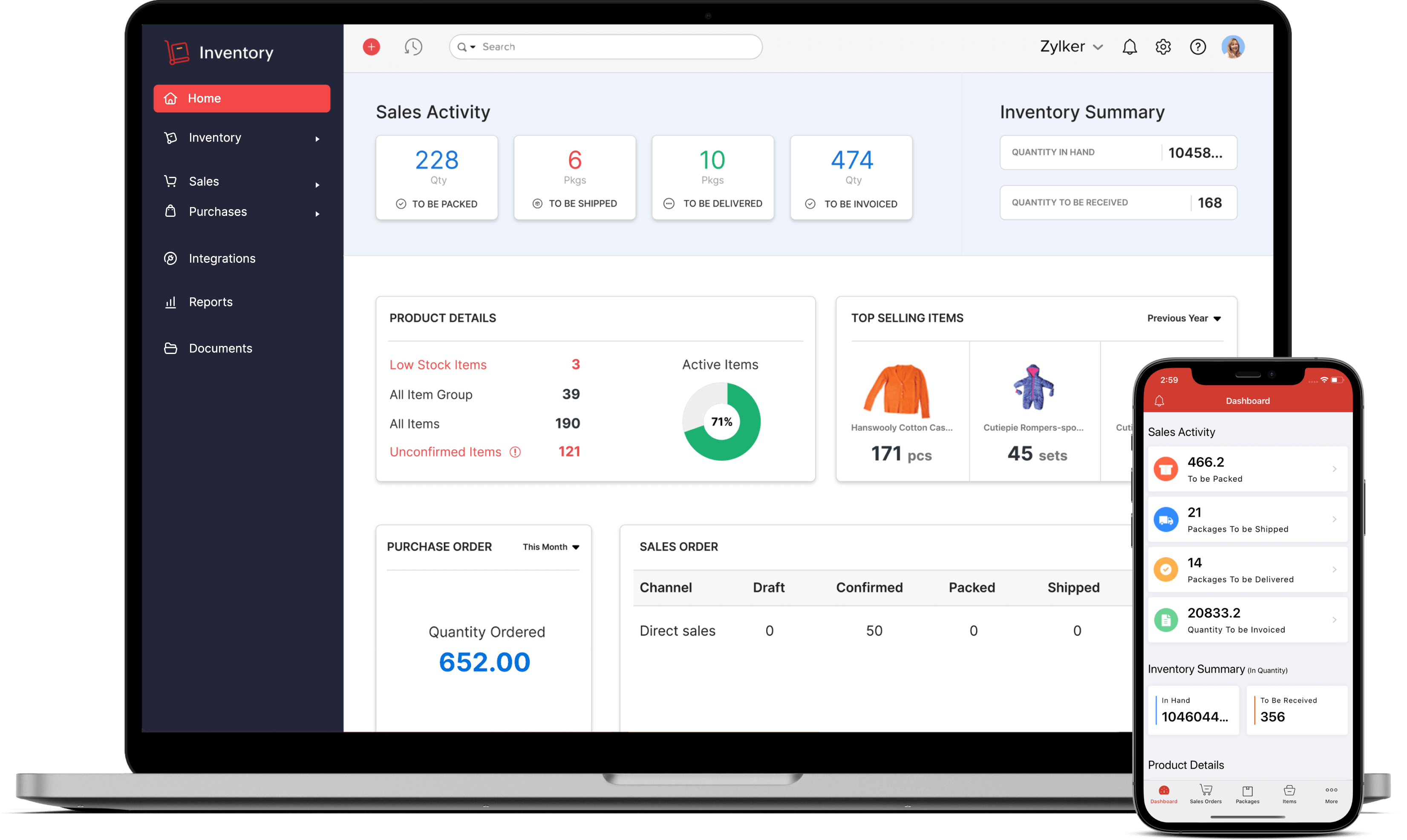
Zoho Inventory is the cheapest serious way to stop running stock in a spreadsheet. A free plan covers basic tracking, and paid plans add more locations and order volume. It rates 4.4 on G2 from 90 reviews.
Key features:
- Multi-location tracking
- Purchase and sales orders
- Barcode scanning
- Links to other Zoho apps
| ✅ Pros | ❌ Cons |
|---|---|
| Free plan and low entry price | Built for small businesses, not store-level replenishment |
| Simple interface | Needs a separate POS for most physical stores |
| 14-day free trial on paid plans |
Pricing: Free plan; paid plans from $29/month billed annually.
Best for: Single stores and small chains on a tight budget.
Also worth a look: Sortly and inFlow Inventory for simple, barcode-based tracking in small shops. Square for Retail and KORONA POS for low-cost POS inventory across a few locations. Odoo for a free inventory app inside an open-source ERP.
What Is Retail Inventory Management Software?
Retail inventory management software tracks stock levels in each store, where stock moves, and when to reorder it. It combines POS sales, deliveries, transfers between stores, returns, and write-offs into one stock record per SKU and location. Advanced systems for chains also use stock records, demand forecasts, and replenishment rules to generate store orders automatically. You may also see these tools called inventory management systems, stock control software, or a store inventory management system.
Why Store-Level Inventory Accuracy Matters
Accuracy is the part buyers underestimate most. Every automated order starts from the stock record. If that record is wrong, the forecast can be perfect and the shelf will still be empty. IHL Group puts the global cost of out-of-stocks and overstocks at $1.73 trillion a year, and fewer than one in four retailers has rolled out AI where that loss is largest. IHL also reports that 70% of retailers struggle with inventory accuracy because of their own return processes.
Which Retail Inventory Management Software Fits Your Store Count?
Store count is the fastest filter we know for choosing the best inventory management software for retail. It decides who places orders, how much stock moves between locations, and how much a wrong count costs you.
1 to 5 stores. The owner or a store manager still orders by hand, and that is fine at this size. Inventory management software for retail stores this size needs a reliable stock count, barcode scanning, and low stock alerts. It also needs purchase orders and a POS that updates inventory at checkout. Zoho Inventory, Lightspeed Retail, or Shopify POS will cover it. Spending more buys features you will not use.
6 to 50 stores. Here manual ordering starts to break. Each manager orders differently, transfers multiply, and head office loses sight of surplus. Multi-store inventory management software should give you central ordering rules, store-to-store transfers, and stock health across multiple locations on one screen. A POS alone usually stops being enough somewhere past 10 to 15 stores. For chains with around 20 stores or more, especially with complex assortments or fresh categories, platforms such as LEAFIO AI are worth evaluating. Below that, NetSuite or Cin7 can cover central purchasing.
50+ stores. Inventory management software for retail chains this size has to order without people typing it. You need automated store replenishment, fresh logic if you sell perishables, and DC-to-store coordination. LEAFIO AI, RELEX, Blue Yonder, and SymphonyAI play in this band. The real question is how much of the platform your team will use in year one.
Two more checks apply at any size. Map your POS and ERP before you sign anything, and ask for a pilot on one region or category.
Features Worth Paying For (Short Version)
At chain level, three inventory management features pay back fastest. They are automated store orders built on demand forecasting, fresh handling for perishables, and accurate stock tracking per store. For a detailed breakdown, see our guide to the features to look for in inventory management software.
When Your POS Stops Being Enough for Chain Inventory
A standard POS knows what sold. It rarely works out what each store should order tomorrow. That gap stays small at three stores and gets expensive at thirty.
You have probably outgrown POS inventory if these sound familiar:
- Store managers spend an hour or more a day building orders.
- Head office learns about overstock from the monthly stock report, not the week it happens.
- Stores run out of fast sellers while the DC still holds plenty.
- Promotions run from a spreadsheet that never reaches the ordering screen.
At that point, keep the POS for checkout and add a layer that calculates orders centrally. Systems with automated store ordering draft each order before the shift starts, so managers review exceptions instead of typing lines. They also flag stock that looks wrong, such as an item with stock on record and zero sales for days. Many POS and ERP tools still order from fixed min/max levels that someone set months ago.
LEAFIO AI helps convenience and grocery chains cut overstock through centralized, automated store ordering. At Baltic Petroleum, each store manager spent about 2 hours per ordering cycle before LEAFIO AI took over. Order calculation is also where inventory management starts to overlap with optimization. If buffers, forecasting, and DC-to-store planning matter most to you, our comparison of inventory optimization software for retail covers that side in depth.
Questions to Ask Before You Sign
Vendor demos run on clean data. Your stores do not. These questions show how a tool behaves on real store data:
- How does the system correct stock it thinks is there but is not (phantom inventory)?
- Can it calculate orders for loose and weighed fresh items without a daily full count?
- Who sets order parameters per store: my team, your consultants, or the algorithm?
- What happens to orders when a delivery arrives short or late?
- Can we pilot on one region or category, with KPIs agreed upfront?
- What is the total cost of ownership over three years, including implementation and any modules we add later?
If a vendor cannot answer question 1 clearly, expect your team to keep correcting stock by hand.
Rolling Out Inventory Management Across a Store Network
Whichever vendor you pick, a chain-wide rollout is easier to manage when you phase it by region and category. A typical sequence:
- Connect sales, stock, and supplier data from your current systems.
- Clean master data: SKU hierarchy, store formats, lead times, and delivery schedules.
- Run a pilot on a group of stores or one category, with KPIs agreed upfront.
- Move ordering from store managers to a central team, starting with the pilot stores.
- Add fresh categories once regular SKUs run without manual fixes.
- Scale to the full network, then add Shelf Efficiency or Assortment Performance if you need them.
Once the rollout settles, store managers spend their time on the sales floor instead of order screens, and head office reviews exceptions rather than every order.
FAQ: Retail Inventory Management Software
What is the best retail inventory management software for multi-store chains?
For chains with 20 or more stores, LEAFIO AI, RELEX Solutions, and Blue Yonder are the strongest options. LEAFIO AI fits mid-size and large chains that want automated store orders and fresh handling without an enterprise-scale project. RELEX and Blue Yonder suit very large grocers and global retailers with dedicated planning teams.
Can a POS system handle inventory management for multiple stores?
POS systems can track stock across a few stores, but they rarely calculate what each store should order. In our experience, chains outgrow POS-only inventory somewhere past 10 to 15 stores. At that point, they keep the POS for checkout and add central ordering software.
How accurate is store inventory data?
Less accurate than most retailers assume. A study by the Auburn University RFID Lab and GS1 US found barcode-based inventory records were about 63% accurate. Software improves accuracy by flagging phantom stock, logging write-offs and transfers as they happen, and targeting cycle counts where errors are likely.
How much does retail inventory management software cost?
POS-based tools start around $29 to $89 per month or per location. Shopify POS Pro costs $89 per location per month on top of a Shopify plan. Chain-level platforms such as RELEX, Blue Yonder, and LEAFIO AI use custom pricing based on store count and modules.
Is there free inventory management software for retail stores?
Yes, but only for very small operations. Zoho Inventory has a free plan, and Shopify includes POS Lite with every Shopify plan. Free tiers work as basic retail inventory tracking software, not automated store ordering.
How does retail inventory management software handle transfers between stores?
It records each transfer as stock leaving one location and arriving at another, so both counts stay correct. Better tools also suggest transfers when one store holds surplus and another is running short. Without that record, transferred stock often shows up as phantom inventory.
What is the difference between retail inventory management software and a WMS?
A WMS manages stock inside a warehouse: bins, picking, and packing. Retail inventory management software manages stock across stores: what each one holds, sells, and needs to order. Large chains usually run both and connect them for DC-to-store replenishment.
How do retail chains manage inventory for fresh products?
They use ordering logic built for short shelf life rather than standard reorder points. LEAFIO AI, for example, runs fresh inventory software with a dedicated FRESH algorithm that weighs remaining shelf life, weekday demand, and delivery slots. The goal is the right balance between availability and write-offs per category.
How long does it take to roll out inventory management software across a store chain?
It depends on data quality and network size. POS-based tools can go live in days. For chain-level platforms, integration time depends on the retailer's systems and data. Once it is complete, a standard LEAFIO AI pilot of one module on selected stores or categories runs for about a month, followed by rollout to the rest of the network.
Plan your rollout with the LEAFIO AI team See what a pilot on your stores or categories would look like, from data connection to the first automated orders. Book a LEAFIO AI demo →


Have a question?

Andrew Ivarsen
Logistics Optimization Expert