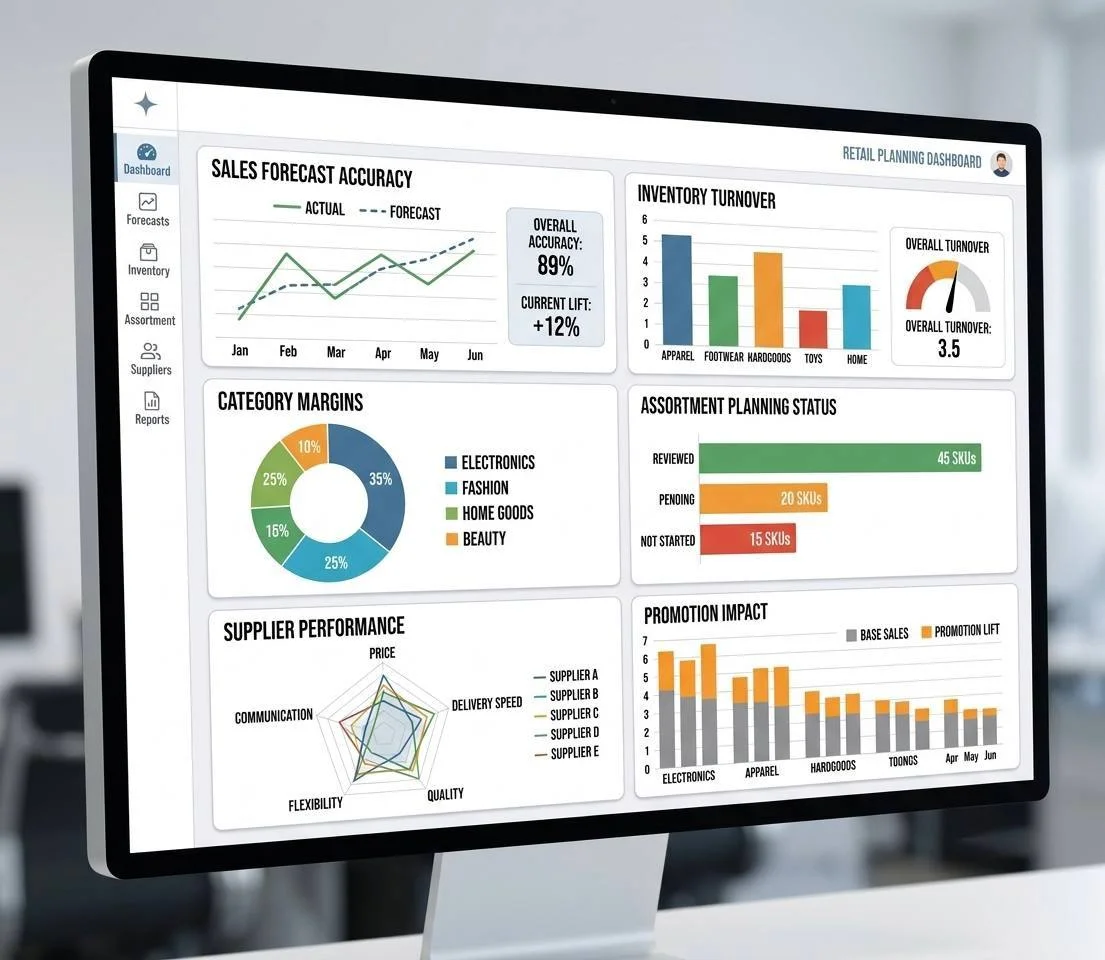


Publisher disclosure: This comparison is published by LEAFIO AI, a vendor included in the comparison. Confirm current capabilities, pricing and implementation scope with each vendor. Most retail operations don't lose margin because planning is impossible. They lose it because the planning tools don't talk to each other. Demand forecasts live in one system, merchandise financial plans in another, and shelf execution happens wherever store managers decide. When those layers are disconnected, the result is predictable: overstock in the wrong categories, stockouts in the fast movers, and assortment decisions made on last quarter's data. Retail planning software is built to close that gap, but the category spans everything from demand forecasting and merchandise financial planning to shelf optimization and in-store compliance. Not every tool covers all of it. Commercial and review check: 22 October 2026. Compare quotes for the same modules, locations, integration, onboarding, subscription and support scope; agree pilot and rollout milestones. See current LEAFIO AI Retail Platform reviews on G2 and LEAFIO’s implementation overview. Individual customer results are not guarantees.
We reviewed 10 retail planning platforms to help you find the right fit. The list covers tools built for different scales and use cases, from large enterprise suites managing global supply chains to mid-market platforms that balance planning depth with faster deployment. We evaluated each tool on planning breadth, AI maturity, integration capability, and how well it handles the full cycle from demand signal to shelf.
One tool worth calling out early: LEAFIO AI is the only platform on this list that covers demand planning, inventory optimization, shelf planning, and in-store execution compliance in a single system. If the gap between what gets planned at HQ and what actually lands on the shelf is your core problem, it is worth looking at closely.
What Is Retail Planning Software?
Retail planning software is a category of tools that help retailers coordinate decisions across demand forecasting, merchandise financial planning, assortment strategy, inventory management, and shelf execution. It connects the commercial plan to the operational plan, so buying, allocation, replenishment, and store teams work from the same data. Modern platforms go further, using AI and machine learning to support Sales & Operations Planning (S&OP), automatically generating plans, adapting them to store-level demand, and connecting planning decisions with inventory and shelf execution in real time.
Why Retail Planning Software Matters
The cost of poor retail planning is not abstract. According to IHL Group's 2025 research, the global retail industry loses $1.73 trillion annually to inventory distortion, which includes both stockouts and overstock combined. That figure represents 6.5% of all global retail sales. McKinsey's supply chain research found that AI-driven planning can reduce inventory holding costs by 35% and cut forecast error by 20 to 50%, translating to 65% fewer stockouts in well-implemented deployments.
Without dedicated retail planning software, most chains run into the same set of problems:
- Demand forecasts are calculated in spreadsheets and updated monthly, not as conditions change
- Merchandise financial plans are disconnected from replenishment and allocation logic
- Assortment decisions are made on category-level averages, ignoring store-cluster demand patterns
- Inventory accumulates in slow movers while fast movers stock out in the same category
- Store execution happens independently of what was planned at HQ, with compliance gaps nobody tracks
- Planners spend 20 to 30% of their week manually correcting system recommendations instead of running strategies.
How We Picked the Best Retail Planning Software
Evaluating retail planning platforms is harder than it looks. The vocabulary is standardized across vendors, with "AI-powered," "end-to-end," and "unified" appearing in nearly every product description regardless of what the tool actually does. My evaluation started from a single question: when demand shifts unexpectedly, does the platform adapt its recommendations automatically, or does a planner have to intervene?
I reviewed product documentation, ran through demos where available, and pulled user feedback from G2 and Capterra. Here is what separated the stronger tools:
- Planning breadth. Does the tool cover demand, inventory, assortment, and shelf? Or is it specialized in one layer? I noted where tools are strong and where they require a complementary system.
- AI maturity. Tools that built machine learning into the forecasting engine behave differently from those that wrapped rule-based logic in AI branding. I tried to be specific about which is which.
- Store-level adaptation. Chain-wide averages are a planning baseline, not a planning output. I prioritized tools that adapt plans to store-cluster demand without manual overrides for every location.
- Integration with ERP and POS. Planning software that can't pull live data from your ERP stays static and loses value fast. I checked SAP, Oracle, and Microsoft Dynamics compatibility for each tool.
- Execution tracking. A plan that exists only in a PDF is easy to ignore. I noted which platforms push updates to store teams and track whether execution matches the plan.
- Scalability and implementation timeline. Enterprise platforms are powerful. They are also expensive and slow to deploy. Mid-market tools that get used are worth more than enterprise platforms that take 18 months to implement.
Quick Comparison: Best Retail Planning Software at a Glance
Here is a snapshot of all 10 tools before the in-depth reviews.
| Tool | Best For | Price Range | Free Trial? | Key Feature |
|---|---|---|---|---|
| LEAFIO AI Request demo |
Mid-to-large retail chains | Custom pricing | Yes (demo) | Unified: demand, inventory, shelf + in-store execution, assortment planning |
| RELEX Solutions | Enterprise grocery & FMCG | Contact for pricing | Demo only | AI demand forecasting + space + workforce in one platform |
| Blue Yonder | Global enterprise retail | Contact for pricing | Demo only | AI demand sensing across multi-tier supply networks |
| o9 Solutions | Large enterprise, global ops | Contact for pricing | Demo only | Digital Brain for connected demand, supply & finance planning |
| Oracle Retail | Enterprise MFP and allocation | Contact for pricing | Demo only | Merchandise financial planning + allocation + replenishment |
| SAP IBP | SAP-ecosystem retailers | Contact for pricing | Demo only | Integrated demand + supply + financial planning in SAP |
| Anaplan | Cross-functional planning teams | Contact for pricing | Demo only | Connected MFP, assortment & finance in a flexible model |
| ToolsGroup | Service-level-driven replenishment | Contact for pricing | Demo only | Probabilistic forecasting + multi-echelon optimization |
| Board | Fashion & specialty retail | Contact for pricing | Demo only | Unified MFP + assortment + financial alignment |
| Slimstock | Mid-market supply chain teams | Contact for pricing | Demo only | Demand-driven replenishment with accessible implementation |
10 Best Retail Planning Software: In-Depth Reviews
1. LEAFIO AI: Best Retail Planning Software for Mid-to-Large Chains
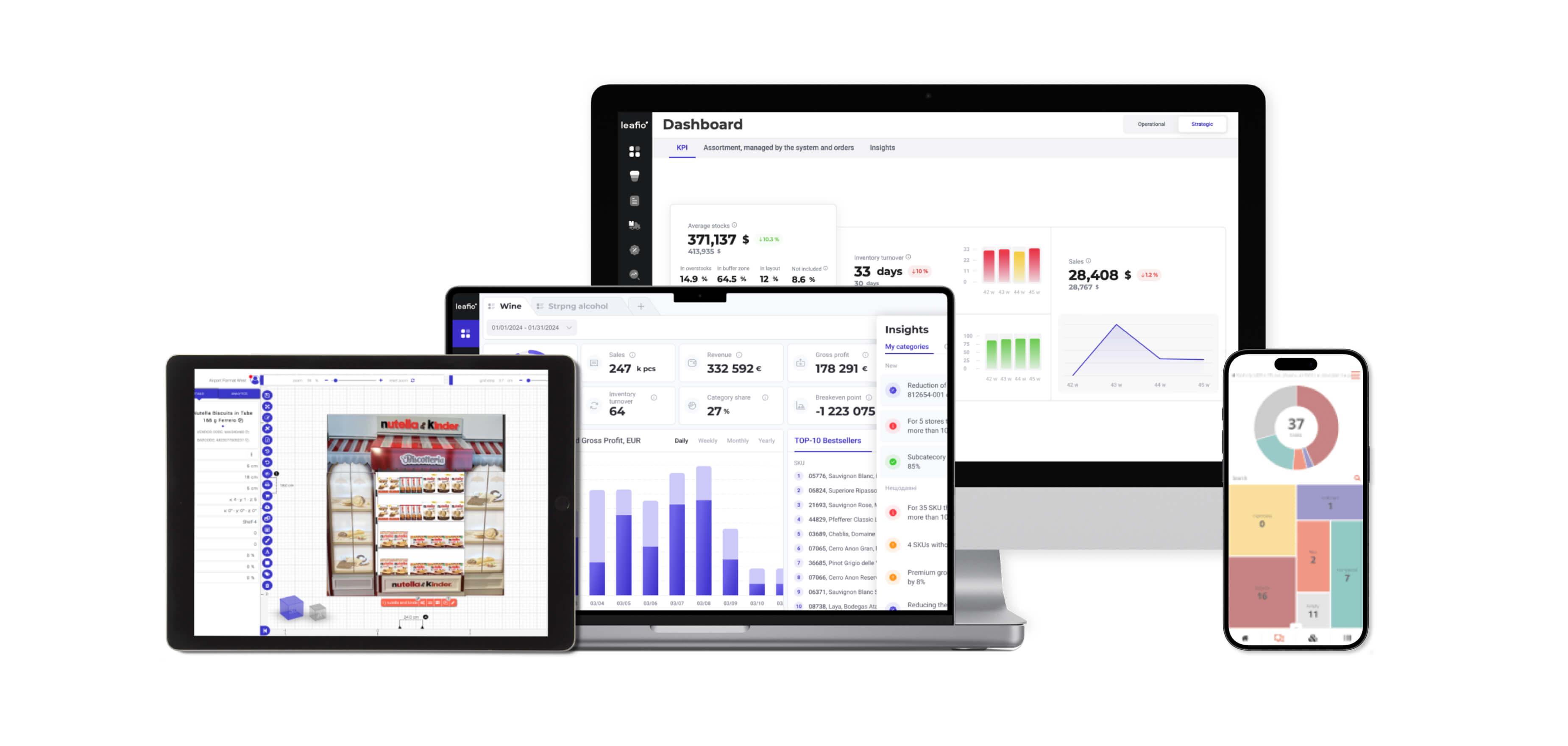
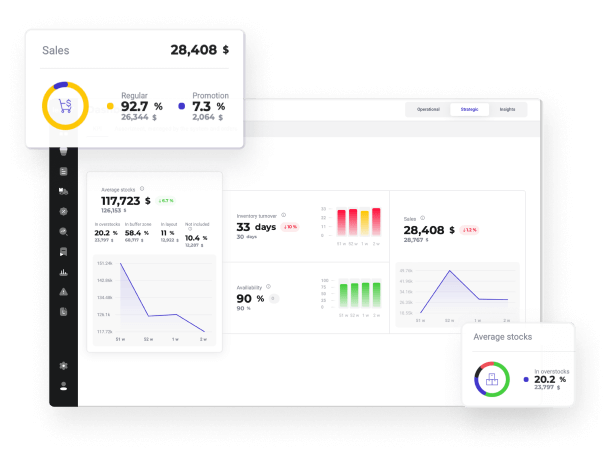
LEAFIO AI is the only platform on this list that covers the full retail planning cycle in a single system. Most tools specialize in one layer, whether that is demand forecasting, merchandise financial planning, or shelf management. LEAFIO AI connects all of them. Its demand planning software, inventory optimization software, assortment planning, and planogram software share the same data layer, so a decision in one area updates the others automatically. For mid-to-large chains, that integration removes the manual reconciliation work that consumes most planning teams.
The AI in LEAFIO is not a reporting dashboard bolted onto rule-based automation. Demand forecasts update from point-of-sale data continuously, and the replenishment engine recalculates buffer zones per SKU based on actual average daily usage, supplier lead times, and configured service-level targets. When demand shifts during a promotion or seasonal peak, the system adjusts before the next order cycle, not after the first stockout confirms the forecast was wrong.
What separates LEAFIO AI from enterprise competitors is the execution layer. Most retail planning platforms stop at the approved plan. LEAFIO's merchandise planning software pushes planograms to store teams through a mobile app, and AI image recognition checks shelf photos against the approved layout. HQ gets real-time compliance visibility across every location. The gap between what gets planned at headquarters and what actually lands on the shelf is where most retail margin goes. LEAFIO closes it.
Grupo Camilo de Alimentos implemented LEAFIO Inventory Optimization and LEAFIO Shelf Efficiency on a unified platform, connecting forecasting, replenishment, and shelf execution. The retailer reduced lost sales by 67%, cut overstocks by 41%, improved product availability, and lowered idle inventory capital from 43.8% to 15.9%, highlighting the value of end-to-end retail planning within a single ecosystem.
Key Features:
- AI demand forecasting. Machine learning models per SKU and store, updating continuously from POS data. Handles seasonal curves, promotional uplift, and new product introductions without manual parameter tuning.
- Inventory optimization and replenishment. Demand-driven buffer system with green/yellow/red zones per SKU. The Direct Supplier PUSH module allocates stock across the store network algorithmically, removing manual store ordering for direct-supplier products.
- Assortment performance. Category-level analysis covering sales per meter, ABC classification, and facing efficiency. Assortment changes update planograms automatically without a manual rebuild.
- Planogram generation and floor planning. Automated planogram creation from sales, stock, and rule-based configuration. Autofacing calculates required facing counts based on product velocity at the store level. Dedicated space planning software efficiently manages the store's physical space.
- In-store compliance verification. Store teams submit shelf photos via mobile app. AI image recognition checks against the approved planogram and flags discrepancies for HQ review.
- ERP integration. Connects to SAP, Oracle, and major retail ERP systems for real-time master data, sales figures, and inventory levels.
| ✅ Pros | ❌ Cons |
|---|---|
| End-to-end coverage from demand and inventory to shelf planning and in-store compliance in one system | Pricing available only through direct contact; no public tiers |
| AI is embedded in the planning engine, not just the reporting dashboard | Full rollout requires data preparation, integration, configuration, pilot validation and staff adoption |
| Store-specific planogram generation scales to hundreds of diverse store formats | Store teams need to adopt the mobile compliance workflow, which requires change management |
| A mobile compliance app gives HQ real-time execution visibility across all locations | |
| Integrates natively with assortment, replenishment, and inventory modules, eliminating data silos |
Pricing: Custom pricing based on chain size and module selection. Request a free demo to discuss your specific requirements.
Best for: Mid-to-large retail chains that need automated planning from demand to shelf, with in-store compliance verification, in a single platform.
Want to see how unified retail planning works in practice? Request a personalized LEAFIO AI demo →
2. RELEX Solutions: Best for Unified Supply Chain and Space Planning at Enterprise Scale
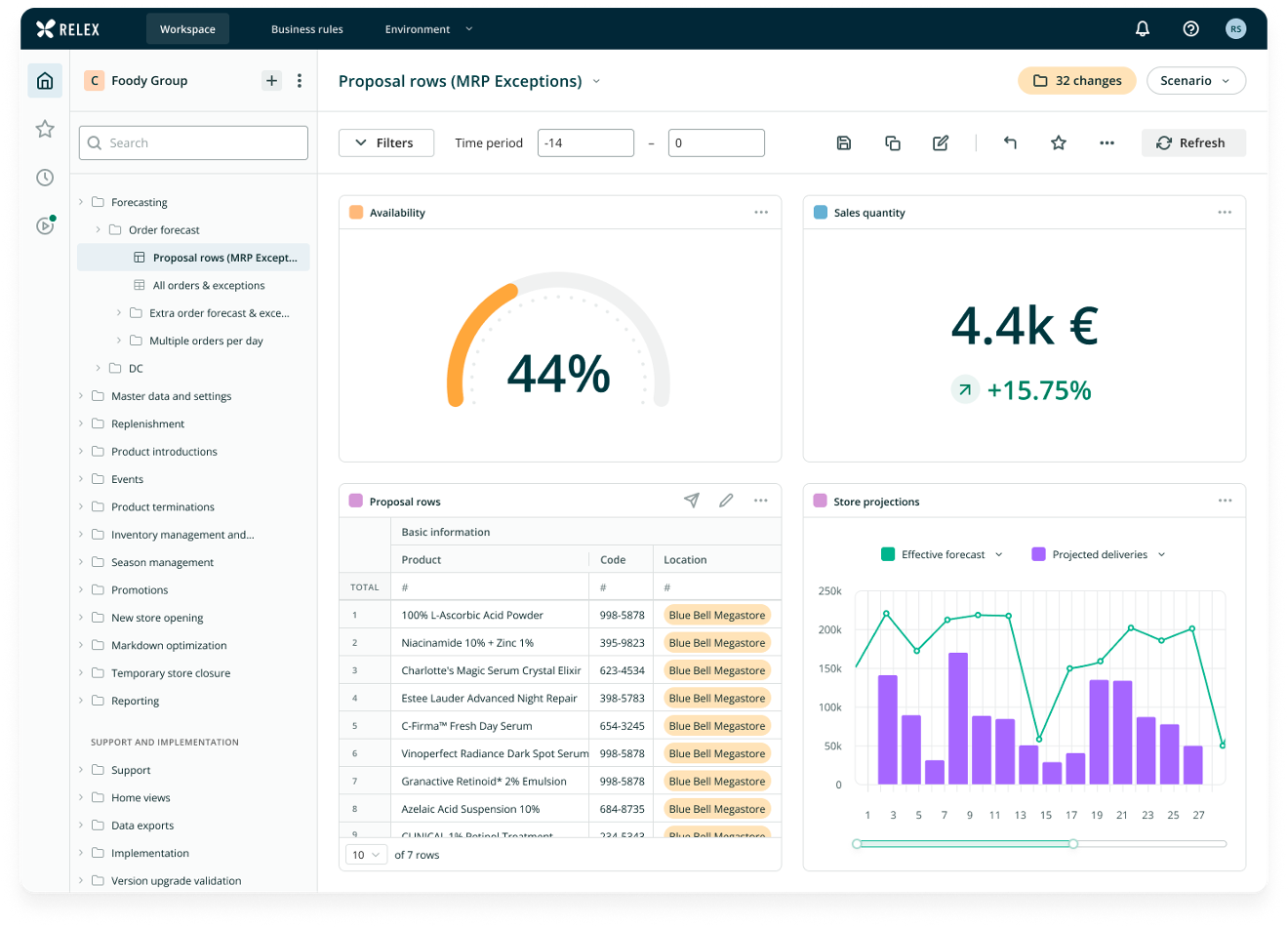
RELEX Solutions is the benchmark for enterprise grocery and FMCG retailers that need demand forecasting, replenishment, space management, and workforce planning to run on a shared data layer. Its forecast models update from POS data continuously, not on weekly batch cycles, which matters most in high-turnover categories where a three-day lag in demand sensing generates stockouts. RELEX is one of the few platforms where the space planning module talks directly to the replenishment module, so shelf layouts reflect actual stock positions rather than theoretical facings.
Key Features:
- AI-powered demand forecasting with continuous model updates from POS and supply chain signals
- Automated, locally optimized planograms generated for thousands of stores based on store-level demand patterns
- RELEX Planogram Delivery pushes updates to store associates via mobile
- Integrated supply chain, inventory, space, and workforce planning in one platform
- Strong promotion planning with pre-built uplift models wired into replenishment logic
| ✅ Pros | ❌ Cons |
|---|---|
| AI-native replenishment engine with strong track record in grocery and FMCG | RELEX does not publicly disclose standard pricing for its solutions. |
| Unified platform across supply chain, space, and workforce | Implementation is a multi-month project |
| Locally optimized planograms adapt to store-level demand at scale | Space planning module is not available standalone |
Pricing: Pricing is typically provided on request and may vary depending on the modules, scope of deployment, number of locations, and other implementation requirements.
Best for: Large retailers running thousands of stores who need locally differentiated planograms, AI-driven replenishment, and unified supply chain visibility.
Enterprise retailers that value RELEX’s unified planning model but want a different balance of cost, modularity, or implementation speed can also compare RELEX competitors.
3. Blue Yonder: Best for Global Enterprise Supply Chain Complexity
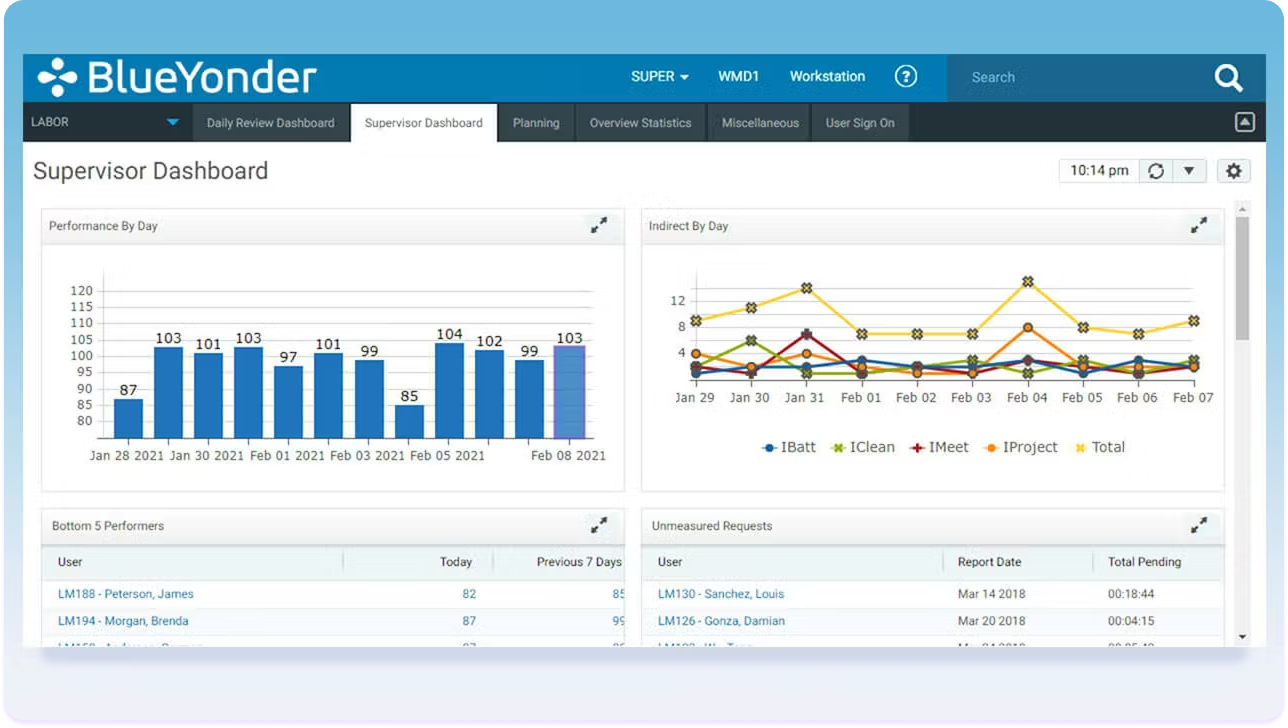
Blue Yonder (formerly JDA) is the retail industry's longest-standing reference for AI-driven demand sensing at scale. The platform covers demand forecasting, replenishment, space management, warehouse management, and transportation in a single ecosystem. For retailers already embedded in the Blue Yonder supply chain suite, the space planning and retail planning modules are a natural extension. Over the 2025 Thanksgiving weekend, the platform estimated delivery dates for 1.2 billion SKUs in under 12 milliseconds each, which gives a sense of the infrastructure scale involved.
Key Features:
- AI demand sensing with real-time updates from POS systems and supply chain events
- Automated replenishment across stores, DCs, and multi-tier distribution networks
- Macro and micro space management with integrated floor planning
- Store clustering and localized replenishment planning across diverse formats
| ✅ Pros | ❌ Cons |
|---|---|
| Handles retail planning at a global enterprise scale | Cost and complexity rule it out below enterprise scale |
| Deep integration across WMS, transportation, and supply chain | Full value requires investment across the broader Blue Yonder ecosystem |
| AI demand sensing updates forecasts in real time | Implementation timelines are measured in months |
Pricing: Contact for pricing. No public tiers listed.
Best for: Global enterprise retailers with complex multi-format networks where deep integration with an existing Blue Yonder supply chain environment is the priority.
Retailers that need comparable enterprise planning capabilities but want to assess differences in cost, implementation effort, and retail specialization should also review Blue Yonder competitors.
4. o9 Solutions: Best for Enterprise Digital Planning Transformation
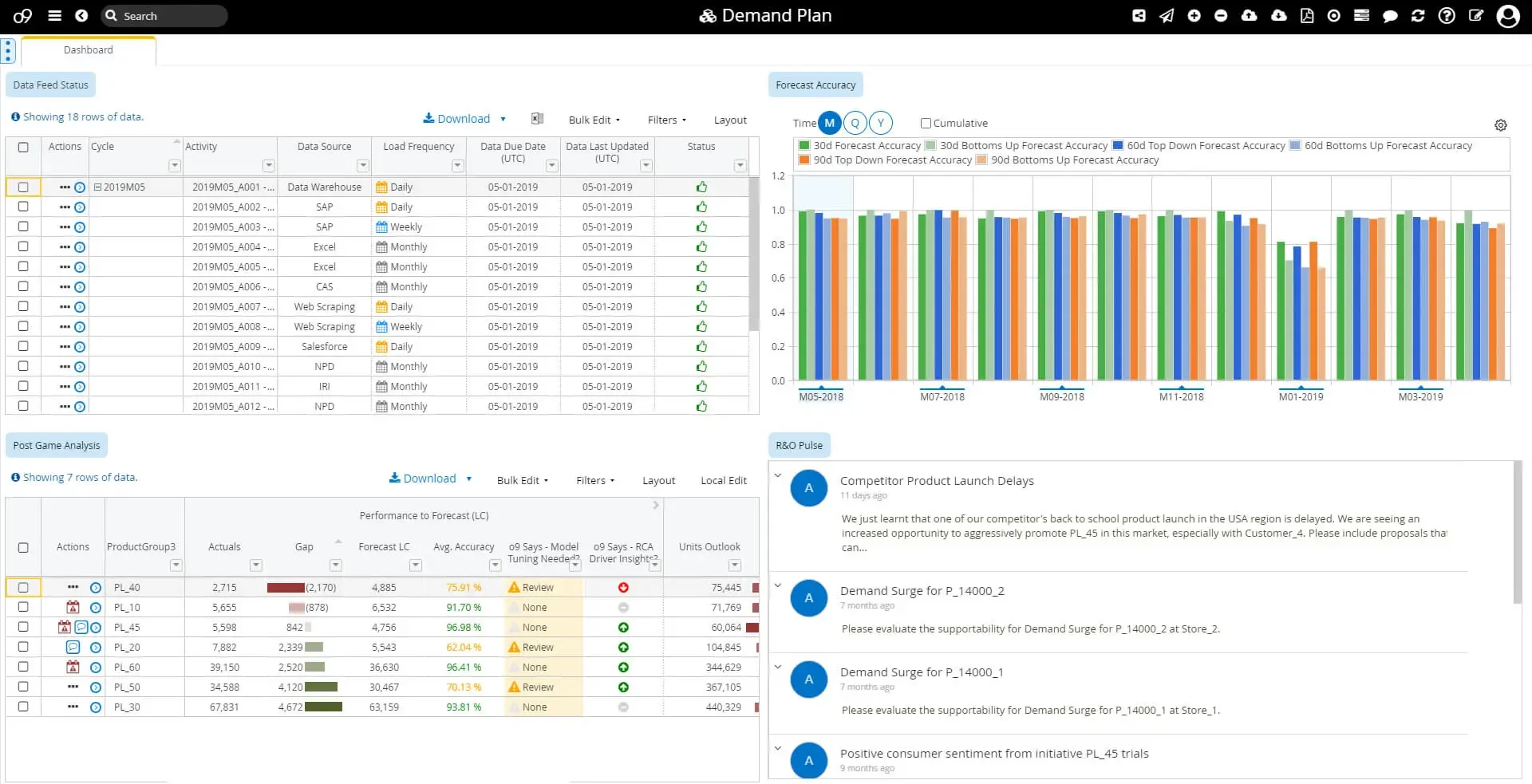
o9 Solutions calls its core product the Digital Brain, which describes the architecture accurately. The platform connects demand sensing, supply planning, financial planning, and scenario simulation in a unified graph-based data model. Every planning decision across commercial, supply chain, and finance teams runs through the same system. For large enterprises that are running planning across departments from spreadsheets and disconnected tools, o9 offers something genuinely different: a single model where changing one input propagates across all related plans.
Key Features:
- The knowledge graph data model connects demand, supply, and financial plans in a single environment
- AI-based demand sensing with real-time scenario simulation across the supply network
- Integrated business planning (IBP) covering retail demand, supply, inventory, and finance
- Scenario planning tools for modeling trade-offs across margin, inventory, and service levels
| ✅ Pros | ❌ Cons |
|---|---|
| Strongest connected planning architecture for large enterprises | Designed for large enterprises; less suited to retailers under 200 stores |
| Handles complex global operations across commercial, supply, and finance | Not suitable for those not undergoing a broad planning transformation |
| Scenario simulation runs in real time across all planning functions | Pricing and implementation timelines are in enterprise territory |
Pricing: Contact for pricing. No public tiers.
Best for: Large enterprise retailers and CPG companies undertaking a broad digital planning transformation that requires connected demand, supply, and financial planning in a single model.
For large enterprises considering connected planning, o9 Solutions' alternatives are also worth comparing on implementation complexity, retail execution depth, and time to value.
5. Oracle Retail: Best for Enterprise Merchandise Financial Planning and Allocation
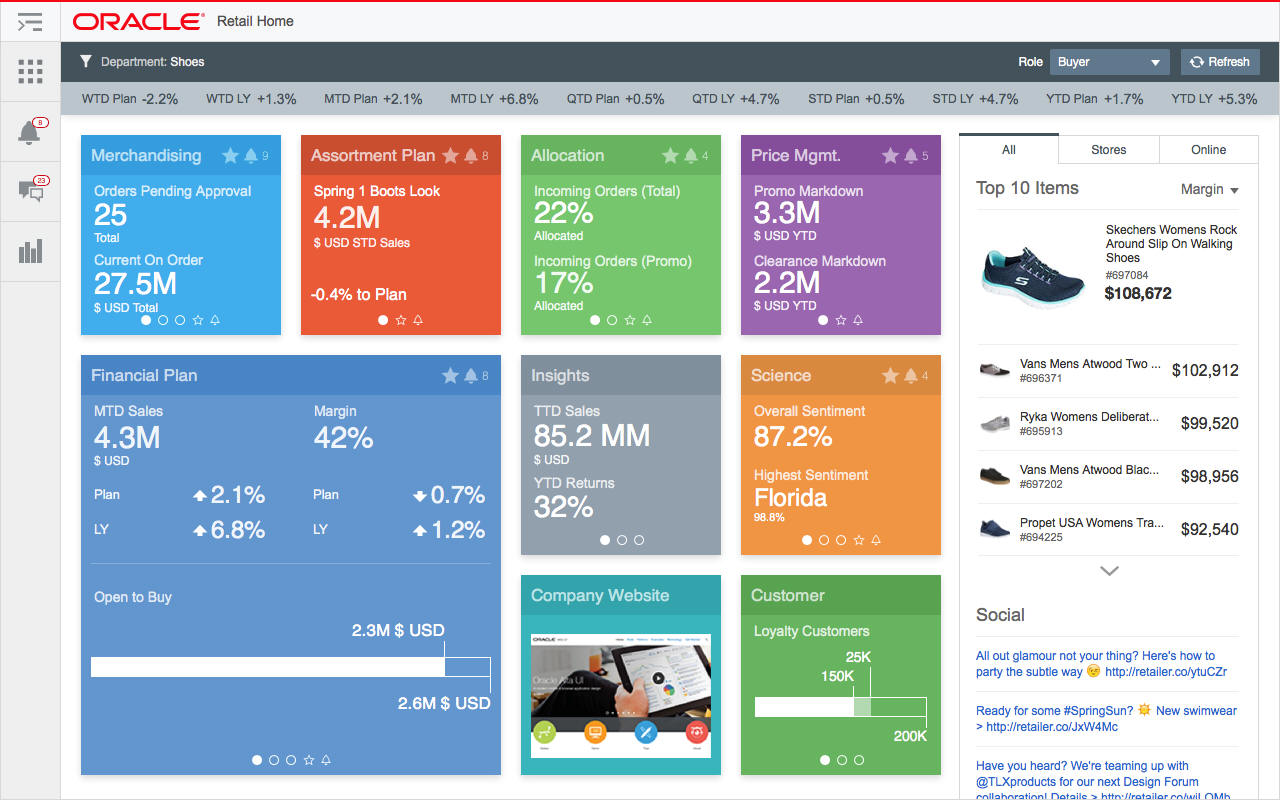
Oracle Retail is the standard reference for merchandise financial planning and allocation in large-format retail. Its planning suite covers merchandise financial planning (MFP), assortment planning, item planning, and allocation, all connected to Oracle's broader supply chain and ERP ecosystem. Retailers already on Oracle's infrastructure often find the planning modules are the most natural fit, given the shared data layer across finance, supply chain, and buying teams.
Key Features:
- Merchandise financial planning with top-down and bottom-up planning reconciliation
- Allocation and replenishment optimization integrated with financial plans
- Assortment and item planning connected to sales history and space data
- Native integration with Oracle ERP and supply chain management suite
| ✅ Pros | ❌ Cons |
|---|---|
| Industry standard for MFP in large-format retail | Practical value is limited if not already on Oracle's broader platform |
| Strong allocation logic | Implementation is expensive and complex |
| Native integration with Oracle ERP and supply chain | Supply chain depth does not match Blue Yonder or RELEX for demand-driven replenishment |
Pricing: Contact for pricing. Enterprise-tier only.
Best for: Large retailers already on Oracle's platform that need best-in-class merchandise financial planning and allocation as part of a unified Oracle ecosystem.
6. SAP Integrated Business Planning: Best for SAP-Ecosystem Retailers
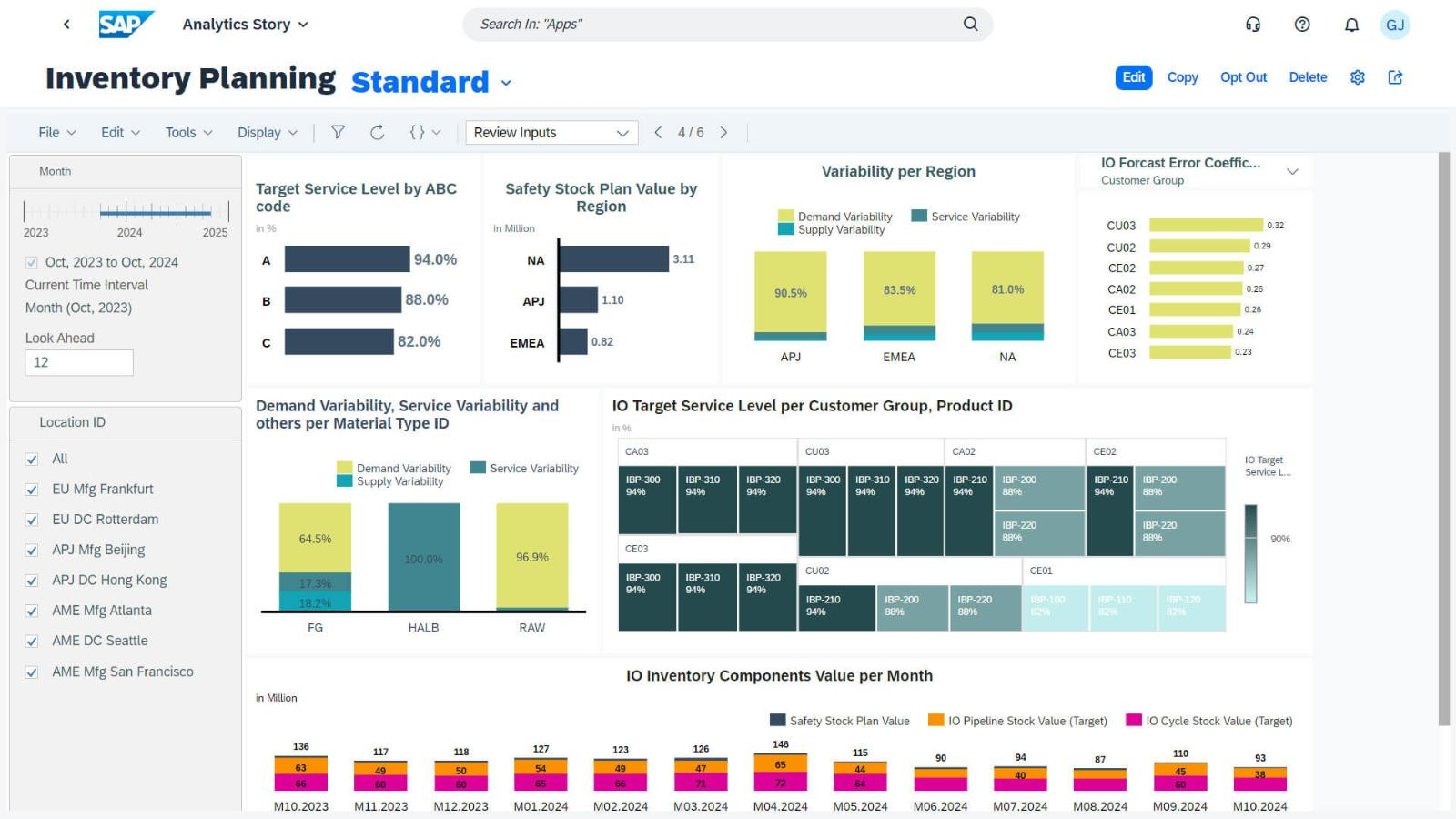
SAP Integrated Business Planning (IBP) connects demand sensing, supply chain planning, inventory optimization, and sales and operations planning within the SAP ecosystem. For retailers running SAP ERP or SAP S/4HANA, IBP is the natural planning layer because it shares master data and transactional records directly without a separate integration project. The platform's demand sensing module updates forecasts using machine learning algorithms, and its supply planning tools generate purchase orders and distribution recommendations that feed back into SAP's ERP processing.
Key Features:
- Demand sensing and statistical forecasting with ML-based model updates
- Supply chain planning covering inventory optimization and distribution network decisions
- Sales and operations planning with scenario simulation and collaborative consensus workflows
- Native integration with SAP ERP and S/4HANA for shared master data and order management
| ✅ Pros | ❌ Cons |
|---|---|
| Native SAP integration eliminates data reconciliation for SAP ecosystem retailers | Value is largely limited to SAP-ecosystem customers |
| Demand sensing uses genuine machine learning | Complex to deploy; licensing and implementation costs are significant |
| Covers end-to-end supply chain from demand to distribution | Less suited to retailers outside the SAP stack |
Pricing: Contact SAP for pricing. Enterprise licensing only.
Best for: Large retailers running SAP ERP who need integrated demand, supply, and financial planning within the SAP ecosystem.
7. Anaplan: Best for Connected Financial and Merchandise Planning
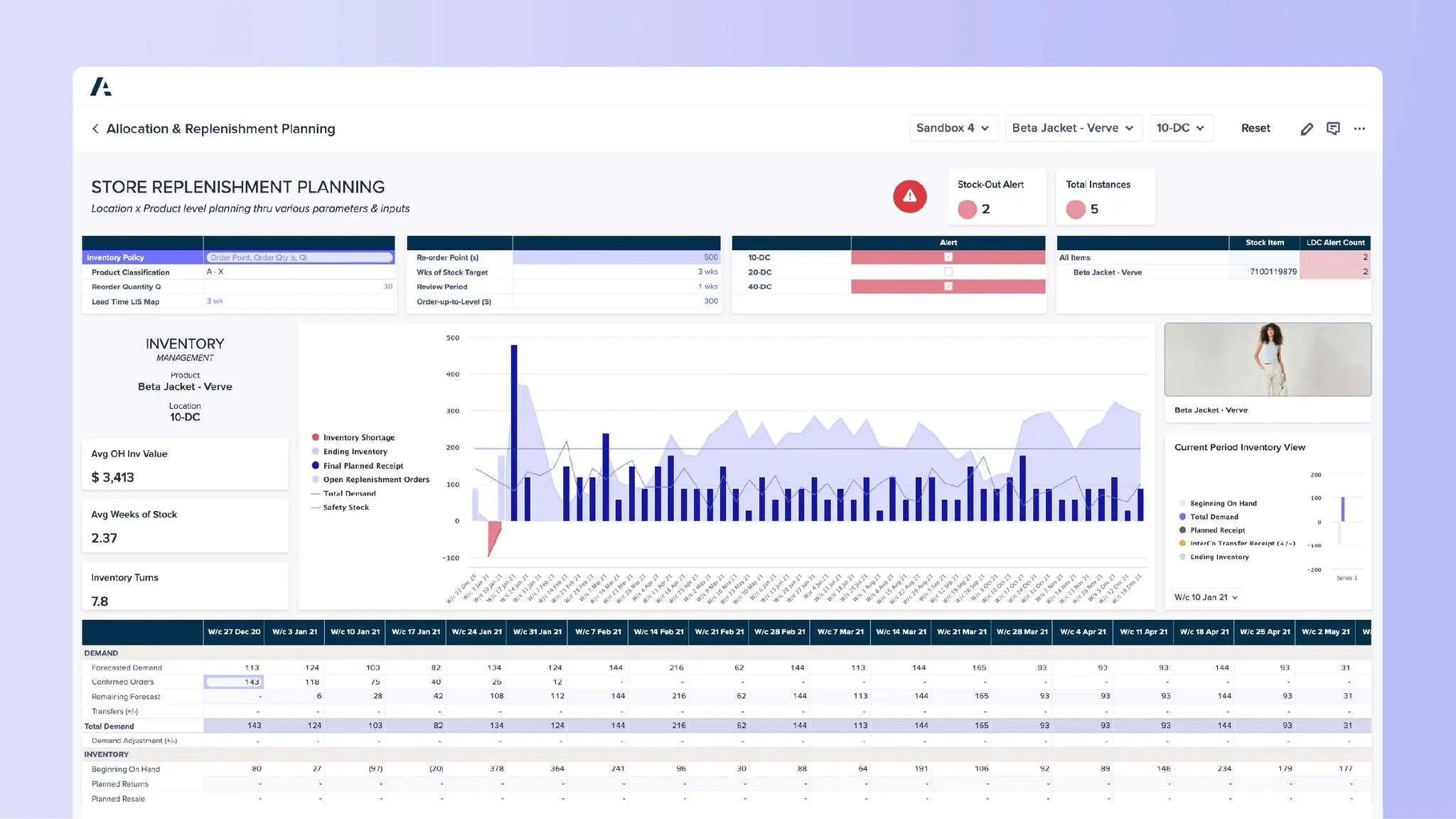
Anaplan is a cloud-native connected planning platform that earns high marks for cross-functional flexibility. In retail, it is most commonly used for merchandise financial planning, trade promotion optimization, and connecting finance targets with category-level assortment decisions. Its Hyperblock calculation engine handles multidimensional modeling across finance, sales, and supply planning, so commercial and supply teams work from the same numbers. Anaplan earned the highest overall rating in the ISG 2025 Buyer's Guide for Supply Chain Planning.
Key Features:
- Merchandise financial planning with top-down and bottom-up reconciliation
- Trade promotion optimization with scenario modeling and budget tracking
- Connected planning across finance, assortment, and supply chain in a shared data model
- Highly configurable Hyperblock calculation engine for multidimensional retail modeling
| ✅ Pros | ❌ Cons |
|---|---|
| Most horizontally flexible planning platform | Not a retail operations tool; lacks replenishment, store-level planning, and execution capabilities |
| Strong FP&A and merchandise financial planning | Heavy model-building requirement means implementation requires skilled Anaplan architects |
| Connects finance and supply planning without a data handoff | Enterprise licensing based on users and planning scope |
Pricing: Contact for pricing. Enterprise licensing based on users and planning scope.
Best for: Retailers that need connected financial and merchandise planning with strong FP&A alignment, without requiring deep supply chain or store-level execution functionality.
8. ToolsGroup: Best for Service-Level-Driven Replenishment and Multi-Echelon Optimization
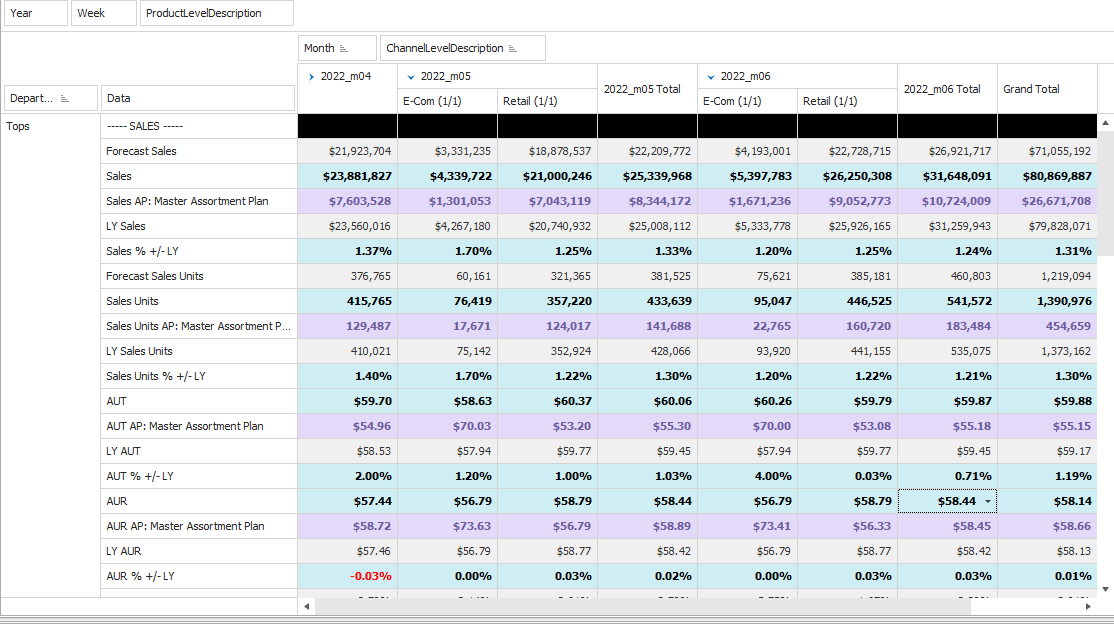
ToolsGroup takes a probabilistic approach to inventory planning and replenishment. Rather than setting fixed reorder points, the platform models demand as a probability distribution and calculates inventory targets based on the configured service level per product category. That approach is more accurate for handling demand uncertainty than deterministic models, especially for retailers with long or unpredictable supplier lead times. Its multi-echelon optimization calculates inventory positions simultaneously across DCs and stores, rather than treating each tier as an independent planning problem.
Key Features:
- Probabilistic demand forecasting with service-level-driven inventory targets per SKU
- Multi-echelon inventory optimization calculating positions across DCs and store networks simultaneously
- Automated replenishment order generation and supplier collaboration tools
- Integration with SAP, Oracle, and other major ERP platforms
| ✅ Pros | ❌ Cons |
|---|---|
| Probabilistic approach handles demand uncertainty more accurately than fixed reorder points | Enterprise pricing and implementation timeline |
| Multi-echelon optimization is a genuine differentiator | Probabilistic planning requires supply chain analytics capability on the buyer side |
| Strong enterprise track record in retail and distribution | Less retail-execution focus than LEAFIO AI |
Pricing: Custom pricing. Contact ToolsGroup for a demo and quote.
Best for: Enterprise retailers and distributors with high demand variability that need service-level-driven replenishment optimization across multi-echelon networks.
9. Board: Best for Fashion and Specialty Retail Merchandise Planning
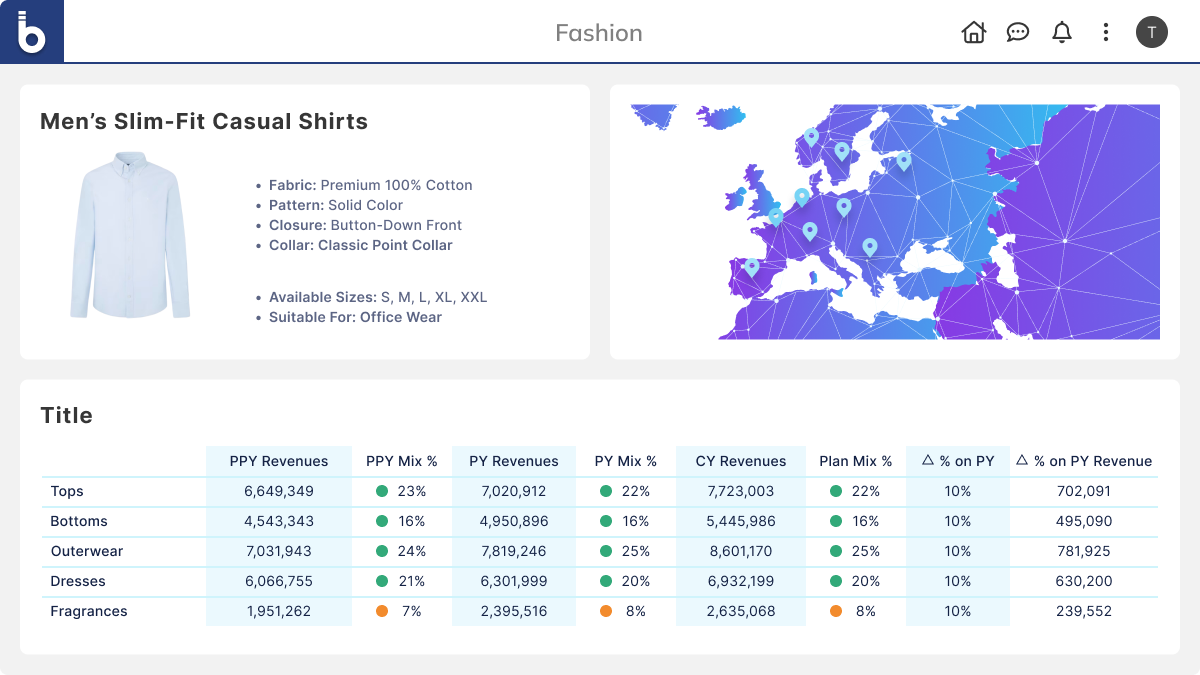
Board is a planning platform used by fashion, apparel, and specialty retailers that need merchandise financial planning, assortment planning, and financial alignment in one environment. Its strength is connecting top-down financial targets with bottom-up category plans, so buying and finance teams work from agreed numbers rather than reconciling separate spreadsheets at month-end. Board supports multi-market reporting and is used by specialty retailers operating across multiple countries and currencies.
Key Features:
- Merchandise financial planning with top-down and bottom-up reconciliation across buying and finance
- Assortment planning with scenario modeling across categories, channels, and markets
- Financial alignment connecting merchandise plans with P&L targets
- Multi-market reporting for retailers operating across geographies and currencies
| ✅ Pros | ❌ Cons |
|---|---|
| Strong fit for fashion and specialty retail with complex financial and assortment planning requirements | Less suited to grocery or FMCG retail with high-velocity replenishment needs |
| Handles multi-market operations across geographies and currencies | Supply chain execution capabilities are limited compared to RELEX or LEAFIO AI |
| Connects merchandising, finance, and supply decisions in one platform | Pricing requires a direct conversation |
Pricing: Contact for pricing. See board.com for details.
Best for: Fashion, apparel, and specialty retailers where financial and merchandise planning alignment is the core planning challenge.
10. Slimstock: Best for Mid-Market Supply Chain and Replenishment Planning
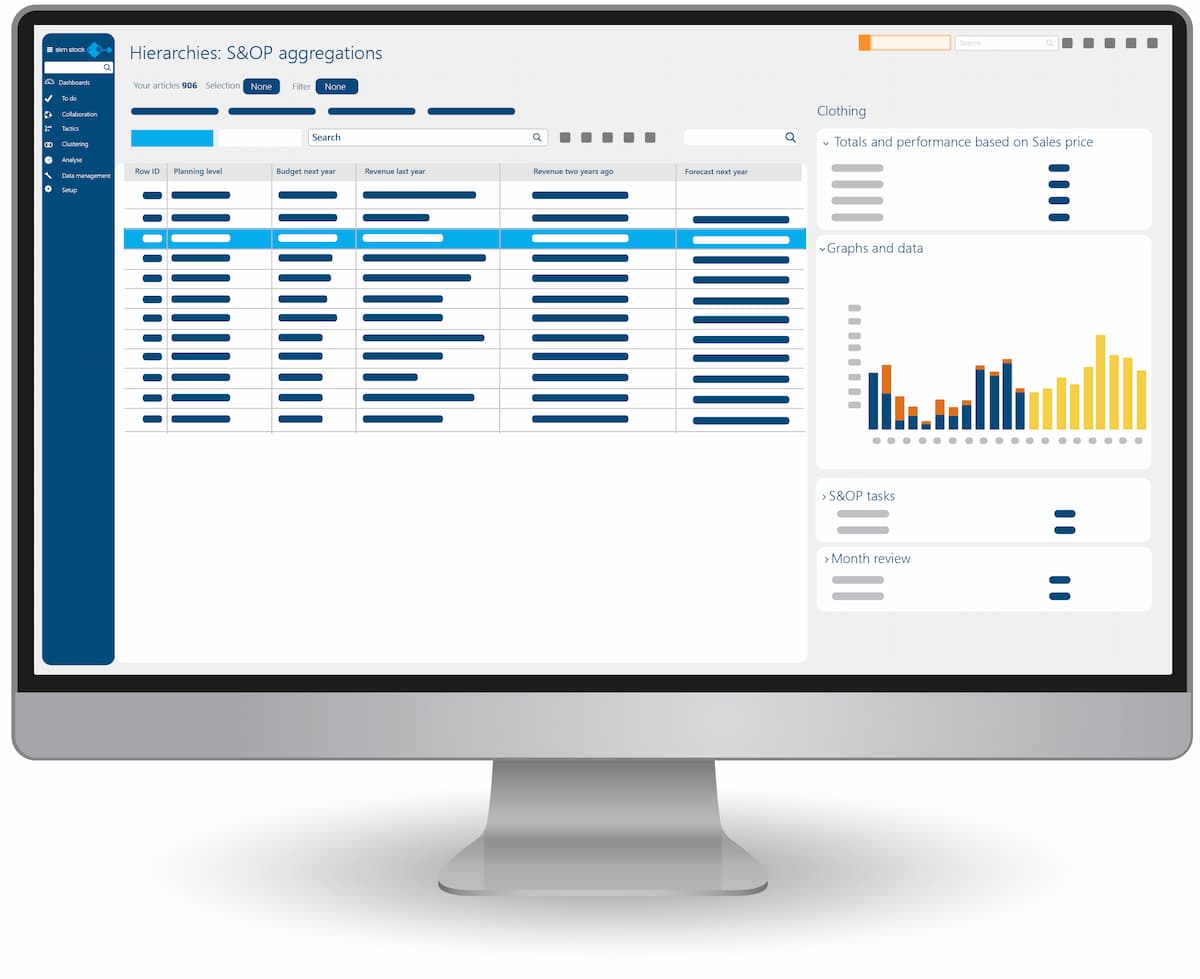
Slimstock fills a gap in most retail planning comparisons: a tool genuinely suited to mid-market retailers who have outgrown spreadsheet replenishment but are not ready for a 12-month enterprise implementation. Its Slim4 platform covers demand forecasting, inventory optimization, replenishment, and S&OP planning with a learning curve that mid-market supply chain teams can manage without dedicated implementation consultants on retainer. It connects to most major ERP systems and has a track record across European retail, distribution, and wholesale.
Key Features:
- Demand forecasting with statistical and machine learning models per SKU
- Inventory optimization with safety stock calculations based on demand variability and service-level targets
- S&OP planning with demand/supply balancing and scenario simulation
- ERP integration with SAP, Oracle, Microsoft Dynamics, and other platforms
| ✅ Pros | ❌ Cons |
|---|---|
| Accessible for mid-market teams without a large implementation budget | Less suitable for retailers managing more than 500 stores with complex multi-echelon distribution |
| Faster to deploy than enterprise platforms | Space planning and in-store execution capabilities are not part of the platform |
| Solid ERP integration covering most major systems | Primarily European customer base; less common in North American deployments |
Pricing: Contact for pricing. See slimstock.com for details.
Best for: Mid-market retailers and distributors that need demand-driven replenishment and inventory planning at a manageable implementation cost.
Mid-market teams that like Slimstock’s demand-driven approach but need a different mix of retail-specific functionality or implementation support can also evaluate Slimstock competitors.
AI Features Comparison: Which Retail Planning Tools Are Actually AI-Native
"AI-powered" appears in every vendor's product description regardless of what the AI actually does. The practical distinction is where in the product the AI sits. A tool where machine learning drives the forecasting engine and updates recommendations as data changes behaves differently from a tool where AI generates a dashboard insight that a planner then acts on manually. Knowing the difference matters when you are evaluating tools side by side.
AI embedded in the planning engine (genuine ML-based recommendations):
- LEAFIO AI: demand forecasting and buffer replenishment both update from live POS data; image recognition drives in-store compliance checking
- RELEX Solutions: continuous model updates from point-of-sale data; AI-driven space optimization adapts planograms to store-level demand
- Blue Yonder: AI demand sensing updates inventory positioning decisions in real time from POS and supply chain signals
- o9 Solutions: Knowledge Graph-based AI connects demand, supply, and financial planning with real-time scenario propagation
AI in the reporting or recommendations layer (rule-based automation with AI-assisted insights):
- Oracle Retail: strong MFP and allocation, but AI features are more supplementary than foundational to the planning engine
- Anaplan: powerful connected planning model, but AI is applied at the analytics layer rather than in automated plan generation
- SAP IBP: demand sensing uses ML, but the broader planning framework is structured around human-configured scenarios
Most legacy tools that predate 2018 fall into the second category. They can produce the right output given the right inputs, but they do not adapt when conditions change unless a planner adjusts the parameters. If handling demand volatility, promotional uplift, and seasonal shifts automatically is important to your operation, build AI maturity into your evaluation criteria before scheduling demos.
How to Choose the Right Retail Planning Software for Your Business
The right platform depends less on feature lists and more on where your operation actually breaks down. A few honest questions before you start evaluating tools will save you from a 12-month implementation that solves the wrong problem.
1. How many stores and SKUs are you managing?
A retailer with 20 locations has different needs than a grocery chain running 500 formats. Once you cross roughly 50 stores, manual or semi-automated planning creates bottlenecks that compound quickly. Platforms like LEAFIO AI and RELEX are built for this kind of scale. Slimstock covers the mid-market more accessibly. Enterprise tools like Blue Yonder, o9, and Oracle require both the budget and the internal capacity to run them.
2. Where does your planning actually break?
Stockouts during promotions point to a forecasting gap. Chronic overstock on slow movers usually means safety stock calculations ignore demand variability. Execution gaps at store level mean your planning tool has no compliance layer. Those are different problems that point toward different tools. Buying a platform that optimizes demand forecasting will not fix execution compliance.
3. Do you need the full cycle or one layer?
Some teams already have a demand planning tool and need inventory optimization as a separate layer. Others need everything, from demand signal to shelf. A unified platform like LEAFIO AI avoids the overhead of stitching systems together but only makes sense if you actually need each module.
4. What does your ERP environment look like?
Planning software without a live ERP connection stays static and loses its value quickly. Before evaluating tools on features, confirm which version of your ERP each vendor supports and what the actual data sync frequency is. Most enterprise platforms handle SAP and Oracle well. Smaller tools typically rely on flat file imports or API connectors with variable sync frequency.
5. How honest are you about your implementation capacity?
Enterprise platforms are powerful. They are also slow to deploy and require dedicated internal resources for 6 to 18 months. A mid-market tool your team actually uses consistently is worth more than an enterprise platform still in configuration two years after purchase. Consider the best inventory replenishment software and best demand forecasting software for retail options relative to your team's capacity, not just your ideal-state requirements.
Questions to Ask Retail Planning Vendors Before You Sign
Most vendor demos show the product working well. These questions surface what matters after you have signed.
- Can the system generate store-specific plans automatically, or does someone need to manually adapt each template per location?
- How does the platform handle assortment changes? If a SKU is added or discontinued, how quickly does that update flow through to replenishment and shelf plans?
- What does AI mean in your product specifically? Is the machine learning embedded in the forecasting engine, or does it surface insights that a planner then acts on?
- Which version of our ERP do you support, and what is the actual data sync frequency: real-time, daily batch, or weekly?
- How long does a typical implementation take for a chain of our size, and who owns the onboarding process on your side?
- What does pricing look like as we scale? Are there per-user charges, per-store charges, or both?
- What does in-store execution verification look like, and how does the system surface compliance gaps to HQ?
How AI Enhances Retail Planning Software
AI changes retail planning in three concrete ways. First, generation speed: plans that take a category manager half a day to build manually can be automated in minutes when the system draws on live sales, inventory, and supplier data. Second, store-level accuracy: AI-native platforms adapt plans to store-specific demand patterns without manual overrides for every location. Third, execution compliance: image recognition detects gaps between what was planned and what actually ended up on the shelf, replacing self-reported confirmation with objective verification.
Most legacy retail planning tools still rely on fixed rules and static reorder points. The 'AI' label in their marketing often describes a set of sorting algorithms or a reporting dashboard, not a forecasting engine that updates when conditions change. Platforms built around machine learning from the ground up, such as LEAFIO AI, RELEX Solutions, and Blue Yonder, behave differently at scale because the system adapts rather than waiting for a planner to catch what the rules missed.
How to Launch a Retail Planning Solution That Scales
Switching from spreadsheets or disconnected tools to a unified planning platform is manageable when the rollout is sequenced correctly. The technology setup, which includes ERP integration, data validation, and rule configuration, is the part with a clear checklist. The harder part is the planner who has been manually adjusting reorder points for seven years and does not yet trust the system. Both problems need solving. For chains moving to LEAFIO AI, the typical process looks like this:
- Connect ERP data feeds. Sales, inventory, and master data are the foundation. This step usually takes one to two weeks with the integration team.
- Build equipment and product libraries. Fixture templates and product dimensions are entered once and reused across all future planograms and replenishment profiles.
- Configure category rules and buffer profiles. Sorting logic, facing minimums, ABC classification thresholds, and service-level targets are set per category.
- Generate plans for a pilot cluster. Start with five to ten representative stores before rolling out chain-wide.
- Deploy via the mobile execution app. Store staff receive tasks on their devices and complete them against the visual planogram guide.
- Review analytics post-rollout. Shelf performance and on-shelf availability metrics are compared before and after, and configuration is refined based on outcomes.
After 90 days, most teams see planning creation volume increase while time per plan drops. The bandwidth freed up tends to go toward category strategy rather than layout maintenance and manual corrections.
Frequently Asked Questions
What is the best retail planning software in 2026?
For mid-to-large retail chains that need demand, inventory, shelf, and in-store execution in one system, LEAFIO AI is the strongest option in this comparison. For enterprise retailers with unified supply chain requirements across thousands of stores, RELEX Solutions and Blue Yonder are the benchmarks. Oracle Retail leads in merchandise financial planning for Oracle-ecosystem retailers. If you are a mid-market chain that needs faster deployment and accessible pricing, Slimstock is a practical starting point.
What is retail planning software, and what does it cover?
Retail planning software covers the tools retailers use to coordinate decisions across demand forecasting, merchandise financial planning, assortment strategy, inventory management, and shelf execution. Depending on the platform, it may cover one of these layers or all of them. Modern platforms integrate multiple layers in a single data environment so that a change in one plan, such as an assortment update, propagates automatically through replenishment and shelf planning without a manual handoff.
What features should I look for in retail planning software?
The core features to evaluate are demand forecasting depth (does the model update automatically when conditions change?), inventory and replenishment automation, assortment and merchandise financial planning tools, store-level customization, mobile execution support for in-store compliance, built-in analytics, and ERP integration with your specific system version. Teams managing large store networks should also evaluate floor planning, cluster management, and whether execution verification is part of the platform or a separate tool.
How much does retail planning software cost?
Slimstock is generally accessible for mid-market budgets. RELEX does not publicly disclose standard pricing for its solutions. Blue Yonder, Oracle Retail, SAP IBP, o9 Solutions, Anaplan, ToolsGroup, Board, and LEAFIO AI all price on a custom basis by chain size and module selection. Enterprise platforms are typically scoped in a direct conversation with the vendor.
Is there retail planning software for small or mid-size retailers?
Yes. Slimstock and LEAFIO AI are practical options for mid-market chains that need planning depth without a 12-month enterprise implementation. Slimstock covers supply chain planning and replenishment with accessible onboarding. LEAFIO AI covers demand, inventory, shelf, and execution compliance, and its modular pricing means you can start with the modules most relevant to your immediate pain points.
How does retail planning software integrate with ERP systems?
Most enterprise platforms, including LEAFIO AI, RELEX, Blue Yonder, and SAP IBP, integrate with SAP and Oracle ERP via pre-built connectors that pull master data, sales figures, and inventory levels and push purchase orders or allocation recommendations back for processing. Before committing, confirm the vendor supports your specific ERP version, not just the product family, and verify the actual data sync frequency. Real-time integration and daily batch imports produce meaningfully different planning outputs.
What is the difference between retail planning software and supply chain planning software?
The terms overlap significantly. Supply chain planning software emphasizes demand sensing, inventory optimization, replenishment, and distribution network decisions. Retail planning software typically adds merchandise financial planning, assortment strategy, and store-level execution. Most modern enterprise platforms cover both. The practical question is whether the tool you are evaluating handles the retail-specific layers, such as MFP, planogram generation, and in-store compliance, or focuses only on the supply chain layer.
How does AI improve retail planning workflows?
AI primarily addresses three workflow problems in retail planning. Generation speed: automated plan creation from live sales and inventory data replaces manual spreadsheet work. Store-level accuracy: machine learning adapts plans to local demand patterns rather than applying chain-wide averages everywhere. Compliance detection: image recognition verifies in-store execution from shelf photos rather than relying on self-reported confirmation. Platforms where AI is embedded in the forecasting and planning engine, such as LEAFIO AI and RELEX, behave differently from tools that added an AI dashboard to rule-based automation.


Have a question?

Kristi Miller
Retail optimization expert


