


Take a buyer who signs off 400 automated order lines every Monday and changes 120 of them, mostly upward, just in case. A month later, nobody can say whether the system or the buyer was right, because nobody kept score.
Buyers start to trust automated orders once they can see how each quantity was built. They also need a sanctioned way to add what the system cannot know. The last piece is a habit: every override gets reviewed for what it did to availability and stock. Banning overrides does none of that (it only moves them into email and phone calls). In this guide, a buyer is the category manager or replenishment planner who signs off orders before they go to suppliers.
Buyers pad orders because an empty shelf costs them more than a full backroom
Most overrides in store replenishment start with a memory. The buyer remembers the empty shelf from last spring and pads the order. Blame in retail is lopsided, which makes padding feel safe. An empty shelf gets a call from the regional director, often before lunch. Three extra cases in the backroom get nobody a call.
The same objections come up in most rollouts. The first automated orders look like a black box, so the buyer cannot defend them to a store manager. An earlier tool may have forecast badly, and its reputation sticks to the new one. Some buyers also fear that if the system orders well, their job goes next. (Few of them say so in the kickoff meeting.)
Overrides can be costly in either direction. Padded orders sit in the backroom and tie up cash. For perishable items, that extra stock can end up as waste. Cuts hurt too. An order trimmed below demand empties the shelf, and the empty days hide real demand from the next forecast.
Research on forecasts points the same way. Fildes, Goodwin and De Baets studied judgmental adjustments in a 2025 paper in the International Journal of Forecasting. Adjustments improved accuracy for just over half of SKUs, and upward adjustments were more likely to make results worse. That study measured forecasts, not order lines. The lesson still holds for orders. A manual change is a bet, and nobody knows whether it paid off until someone checks.
How to get buyers to trust automated orders, step by step
The order of these steps matters more than any single one. Teams that write rules before anyone has measured usually spend months trading opinions.
Step 1: Measure the override rate before you argue about it
The override rate is the share of automated order lines that a person changed before sending. Track it for two weeks before you change anything else. Split it by direction (raised, cut, deleted), by size, by category and by buyer.
A baseline usually surprises people. Overrides tend to cluster. A few categories and a few buyers usually account for most of them. That turns a vague "people don't trust the system" into a short list of places to look.
Step 2: Route what the buyer knows into the plan, not into the order
Buyer knowledge belongs in the plan, because an edited order uses that knowledge once and then forgets it. A town festival, a store reopening after renovation or a supplier that always ships two days late are real inputs. Typed into one order, they help this week only.
Each kind of knowledge has its own place. The festival goes in as a planned event, so the forecast expects the extra demand. The reopening gets a one-time top-up on the next order. A day distorted by a road closure is kept out of the demand history, so it does not drag down future orders.
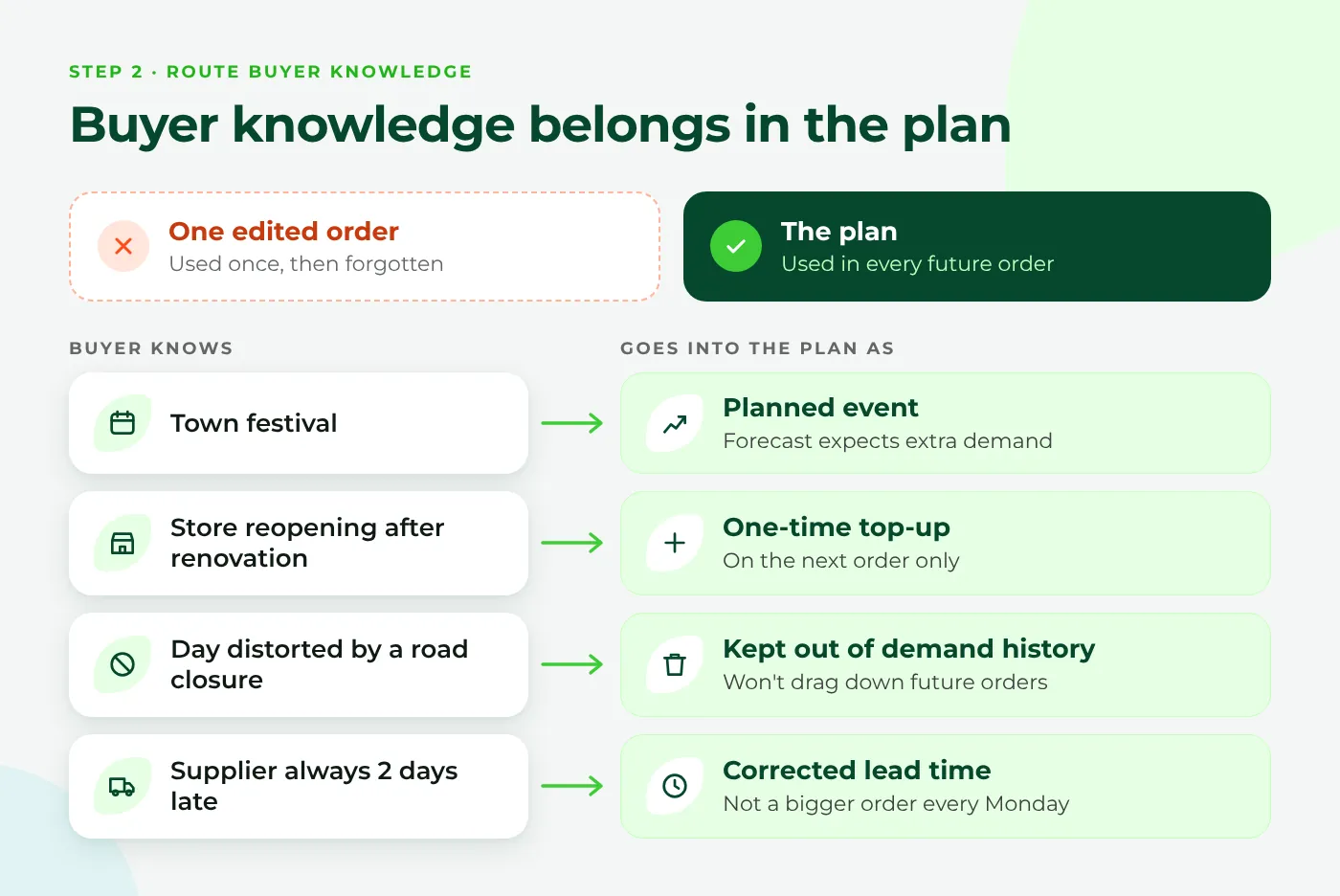
Repeat overrides tell you where to look. If a buyer raises the same SKU three Mondays in a row, check the forecast, the target stock level and the lead time. The late supplier needs a corrected lead time. A bigger order every Monday only hides the problem.
Step 3: Show the buyer how each order quantity was built
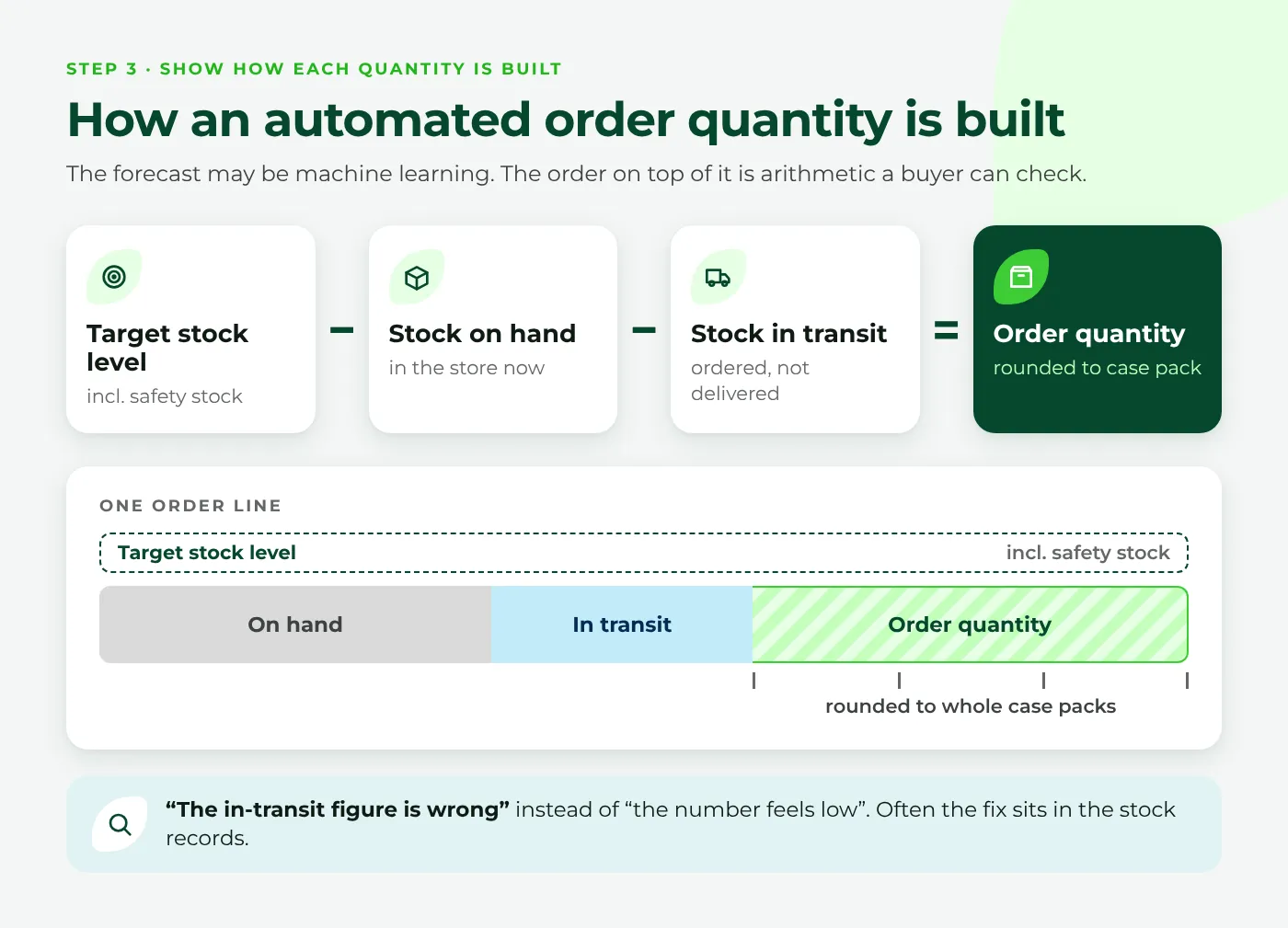
Even when machine learning produces the forecast, the order quantity on top of it is arithmetic, and buyers trust arithmetic they can check. A typical calculation starts from the target stock level, which already includes safety stock. It then subtracts stock on hand and stock in transit. The result is rounded to the supplier's case pack.
The forecast behind the order needs the same openness. Compare last month's forecast with actual sales for the SKUs buyers override most. Flag stockout periods separately, since sales during those periods can understate demand. Our guide to forecast accuracy in retail explains which error measures to show.
When the buyer sees each line, the argument changes. "The number feels low" becomes "the in-transit figure is wrong." Often that complaint is true, and the fix sits in the data. Stock records are the first place to look, as our guide to preventing replenishment failures caused by messy data explains.
Step 4: Write override rules with a reason code and a size threshold
Override rules work when they are short enough to remember. Three are usually enough:
- Every override gets a reason code, because every override is reviewed later.
- Small changes go through without extra review, for example anything within one case pack.
- Larger changes and deleted orders get a second look before the order goes out.
Keep the reason list to six or eight codes, written in the buyer's words: local event, supplier delay, shelf reset, quality issue. Cap the use of "other", or it becomes the most popular reason. Who approves what is the retailer's choice and usually follows existing roles.
Fix the blame imbalance at the same time. Measure buyers on availability and overstock together, so padding stops being the safe choice. A buyer judged only on empty shelves will keep rounding up, whatever the rules say.
Step 5: Run the pilot in one category with buyers as co-owners
A pilot convinces buyers only when buyers help run it. Pick one category with steady demand and clean stock records. Let the buyers who will live with the system choose it and own the weekly review.
Daily, a 227-store supermarket chain in Georgia, started its first automated orders in one category, tobacco products, before rolling out across the network. A narrow start keeps mistakes small and visible. It also gives skeptics a fair test they can watch week by week.
Step 6: Review what each override did to availability and stock
Judge each override against the original recommendation
A weekly review turns overrides from a matter of opinion into a record. After the next delivery cycle, compare the stock the store actually had available with what it would have had under the original recommendation. Start with stock on hand when the delivery arrived. Then check what was received, what sold and whether the item went out of stock before the next delivery. Sales alone can mislead. Once the shelf empties, the register only records what was left to sell.
Mark each override with one of four statuses, always judged against the original recommendation:
- Helped. An upward override let the store sell units it would have run out of. A cut reduced leftover stock while the item stayed available.
- Hurt. An upward override left more stock on hand at the next delivery without improving availability. A cut made the item run out sooner.
- No difference. Neither availability nor leftover stock changed meaningfully.
- Inconclusive. Records are too incomplete to tell, or a stockout leaves too much uncertainty about demand.
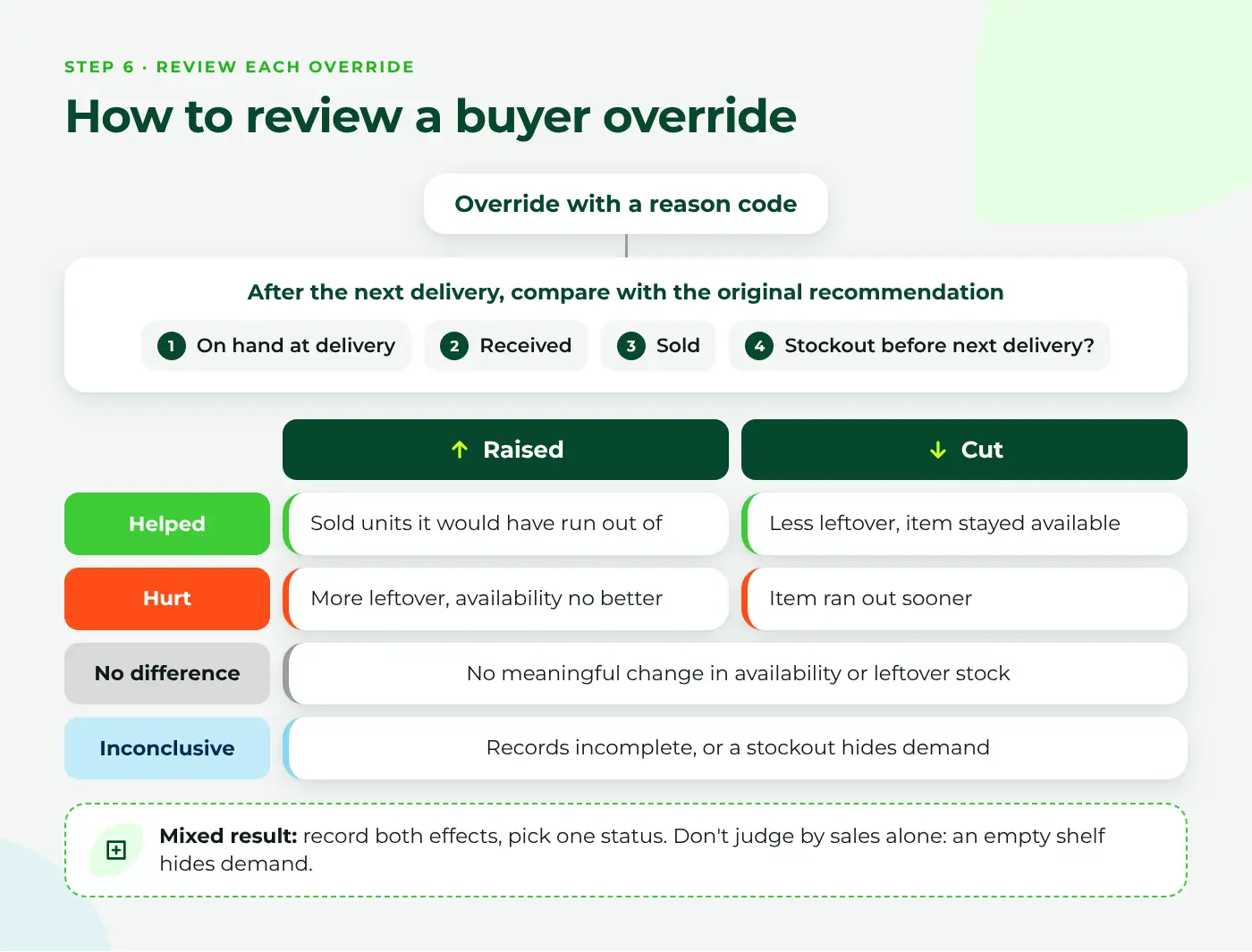
Example: one order line. When the delivery arrived, the store had 4 units on hand. The system recommended 12, the buyer raised the order to 18, and the supplier delivered all 18. The store sold 19 units before the next delivery, with no other stock movements. If the supplier had delivered all 12 units under the original recommendation, the store would have had 16 units available. So the override let the store sell at least 3 units it would otherwise have run out of. The other 3 extra units were still on hand at the next delivery.
When the result is mixed. Record both effects, then pick one status for the summary table: here, helped. If the supplier delivered a different quantity than ordered, estimate what it would have delivered under the original recommendation. When that cannot be established and the verdict depends on it, mark the override as inconclusive.
Turn the results into plan changes and the next pilot step
Group results by reason code. Buyers co-own the pilot, and a review that names people makes honest coding less likely. Reason codes that keep helping become planned inputs, as in Step 2. Codes that keep hurting go on the agenda of the next team meeting.
Widen the scope one category at a time. Move to the next category once availability in the pilot stays at or above the baseline and overstock does not grow for several delivery cycles. Repeat overrides for causes the plan already covers should also become rarer. The retailer can then let orders in that category go out without review, while buyers check the exceptions. Our article on switching from manual to automated replenishment covers the business case for each step.
Step 7: Give buyers back the hours, and give them new work
Fear of replacement is real, and the honest answer is a new job description. The hours that went into checking 400 order lines can go to supplier terms, late deliveries, assortment gaps and the exceptions that need a decision.
At Baltic Petroleum, an 86-store fuel and convenience chain in Lithuania, 84 station managers once placed orders by hand. Each spent about two hours per ordering cycle. With LEAFIO Inventory Optimization, four head-office specialists now handle ordering for the whole network.
In a November 2026 Capgemini report, 84% of surveyed executives said humans should hold final authority to check decisions AI produces. The buyer keeps the decision, and the system takes the arithmetic.
Reviewing 120 overrides shows which ones earn their place
Two versions of the same Monday show why the review matters more than any rule. In both, the buyer signs off 400 automated order lines and overrides 120 of them, an override rate of 30%. Of those, 90 raise the quantity and 30 cut it. The upward overrides add 6 units each on average, at a unit cost of $4.
Scenario A: no reason codes, no review. The 90 upward overrides add 540 units a week. Over four weeks, that is 2,160 extra units with a purchase value of $8,640. Some of it was needed, and some may still sit in the backroom. Nobody knows which part, so the override rate stays at 30% next month too.
Scenario B: reason codes and a review after each delivery cycle. Four weeks of reviews give this picture for a typical week:
| Override type | Count | Helped | Hurt | No difference | Inconclusive |
|---|---|---|---|---|---|
| Raised quantity | 90 | 38 | 30 | 14 | 8 |
| Cut quantity | 30 | 18 | 4 | 5 | 3 |
| Total | 120 | 56 | 34 | 19 | 11 |
So 56 of 120 overrides clearly helped, 34 hurt and 30 either made no difference or could not be judged. Say each of the 30 upward overrides that hurt added 8 units, and all 8 were still on hand at the next delivery. That is 240 units a week, or $960 of stock that sat through a full delivery cycle. In the 4 cuts that hurt, the item ran out sooner than it would have under the original recommendation.
The reason codes explain the split. Say most of the 38 useful upward overrides carry the codes "local event" or "supplier delay." The 30 that hurt sit mostly under "safety" and "other." Next month, the team can add known events to the forecast, correct lead times where delays recur, and review what buyers file under "other."
LEAFIO Inventory Optimization shows the buyer where each order came from
LEAFIO Inventory Optimization builds each automated order from a demand forecast and a target stock level that moves with demand. The forecast comes from machine learning models that read sales history, promotions, seasonality and external factors such as weather. Buyers can see the sales, stock and forecast behind every quantity, so they can defend an order to a store manager. When demand drops, orders shrink with it, so stock does not pile up in the backroom.
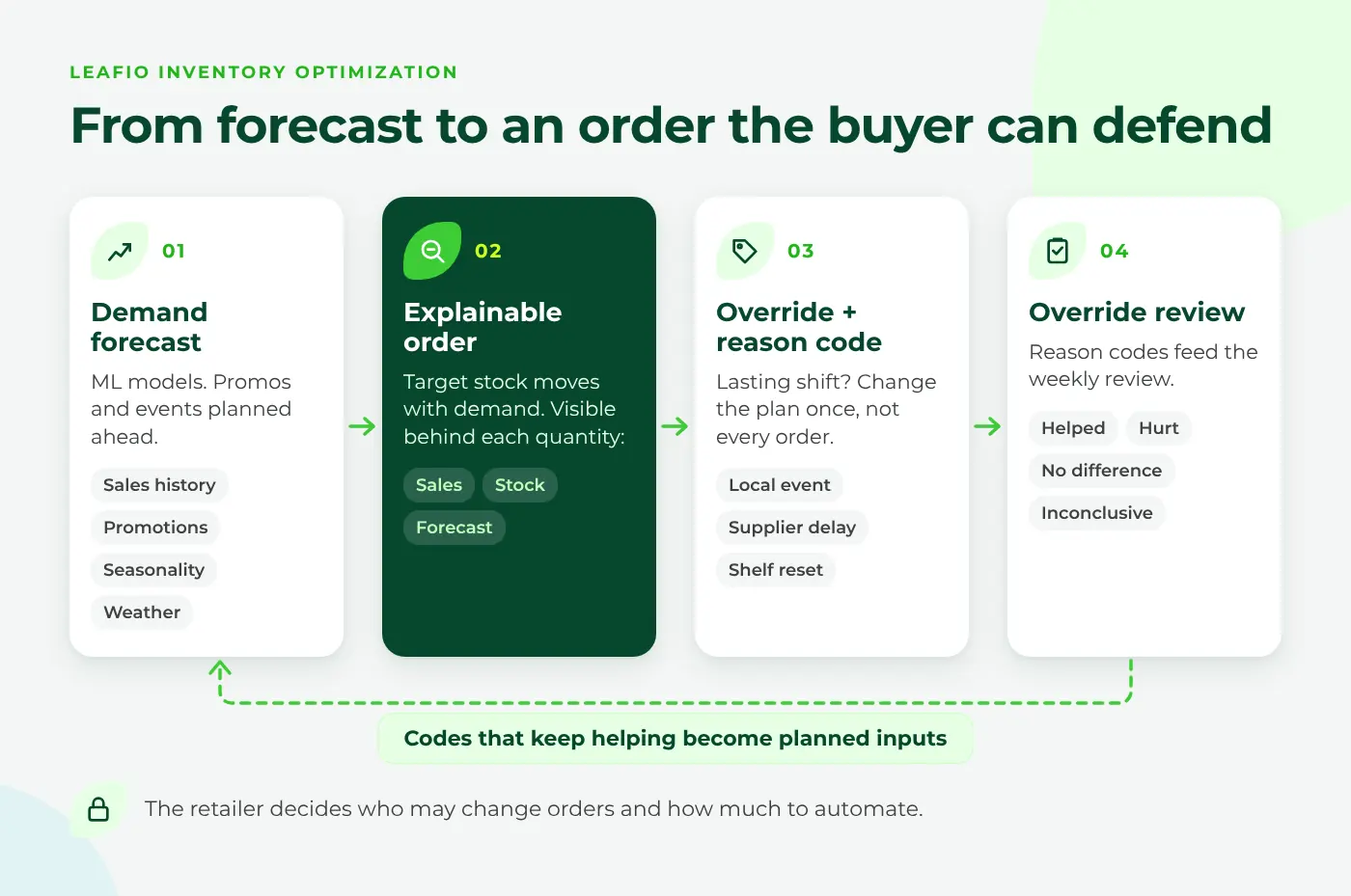
Overrides have their own path in the module. Buyers can attach a reason code to each change, giving managers a record for the weekly review. When a change reflects a lasting shift, the buyer changes the plan once instead of correcting every order. Promotions and local events are planned in advance, so the next order already accounts for them.
The retailer decides who may change orders and how much to hand over to the system.
Taken together, LEAFIO Inventory Optimization gives buyers explainable quantities for Step 3, recorded reason codes for Steps 4 and 6, and planned events for Step 2.
Daily shows where this can lead. Before LEAFIO, store managers adjusted every automated order from the ERP on their own judgment. Today, 99.5% of Daily's replenishment orders go out without a manager touching them. Treat Daily's 99.5% as a result after full rollout, not a target for the pilot month.
A typical LEAFIO AI implementation takes 4–6 months, but the timeline may vary with the number of platform modules and the specifics of the retail chain. The first measurable results are usually seen after a one-month pilot, which is part of the implementation.
Overrides are worth keeping when the buyer knows what the data does not
Some knowledge reaches the buyer long before it shows up in the data. A new competitor across the street, a local strike or a supplier problem announced by phone will not appear in sales history for weeks.
The method has limits. If stock records are wrong, no rule will build trust. The system will order from bad numbers, and the buyer will be right to override. Reviews need at least one full delivery cycle, and slow movers need longer. Two weeks of data on an SKU that sells once a week proves nothing. Tracking stockouts shows cuts that went wrong faster than padding that sits, so check overstock as a separate measure. And the goal is never zero overrides.
Banning overrides has never built anyone's trust. Buyers start trusting automated orders when every override carries a reason and gets a fair review. The manual work then shrinks on its own, one resolved cause at a time.
FAQ
Should buyers be allowed to override automated orders at all?
Yes. Buyers often know about events, supplier problems and local changes before the data does. The goal is to see every override and check what it did. Then useful knowledge moves into the plan, and habits that add stock without reason fade out.
What override rate should a retail chain aim for?
There is no universal benchmark, because the rate depends on data quality, category mix and how long the system has run. Track the trend and the reasons behind it. A falling rate, with fewer repeat overrides for causes the plan already covers, is the sign that trust is growing.
How long does it take for buyers to trust automated orders?
It depends on the chain, the data and the categories in scope. Trust usually starts in the pilot category, once buyers see the first review of their overrides.


Have a question?

Jack Larson
Retail Optimization Expert