
Key Takeaways
Merchandising analytics drives smarter display decisions that boost sales.
Helps measure shelf effectiveness.
Guides adjustments to planograms.
Tracks category & SKU contributions.
Identifies underperforming displays.
Supports data-driven visual strategies.
It is not a secret that quality merchandising analytics boost sales. That’s why merchandising analysis is a key component of analyzing sales data of a store. Making such analysis is much easier with the help of software.
This way we analyze not only numbers in terms of total sales or categories. The sales analysis in merchandising is conducted in relation to the concrete trade equipment, its area and dimensions. In other words, not only sales are analyzed but also the placement efficiency and the return from of every square centimeter of the shelf.
This article will discuss what you should keep in focus and how to make an analysis properly.
What Are Retail Merchandising Analytics
Retail analytics encompasses the methodologies and technologies used to collect, process, and interpret data generated across various retail touchpoints, both online and offline, through data analytics.
This data, derived from sources such as point-of-sale (POS) systems, e-commerce platforms, customer relationship management (CRM) databases, and even social media interactions, is analyzed to extract actionable insights.
By leveraging techniques like predictive modeling, data mining, and statistical analysis, retailers can gain a comprehensive understanding of customer behavior, purchasing patterns, inventory performance, and market trends.
These insights empower data-driven decision-making across critical business functions, including inventory management, pricing optimization, targeted marketing campaigns, and personalized customer experiences, ultimately driving revenue growth and enhancing profitability.
Planogram Analysis: Key Display Performance Indicators [Webinar]
1. Store plan analysis
Merchandising analysis is conducted through the prism of the store plan and the trade equipment located in it. A store plan is a scheme or a drawing of a store.
Aside from trade equipment, the plan contains auxiliary items that create a more accurate picture – cash desk, column, entrance and exit. It is important to take into consideration the following parameters when you analyze the store plan:
- The area of each SKU in centimeters.
- The number of faces in width and depth for each SKU.
This information is vital as when locating trade equipment, the real dimensions of products, as well as racks, are taken into account and then they are compared with the store dimensions.
Thus, on the store plan, we are able to see the real picture of the store with all the placed products, equipment (showcases, racks, pallets, refrigerators etc.) and how much area each product occupies in the store.
It is important that you track the customer traffic in retail stores when working with the store plan. Trade equipment should be placed in such a way that the products with high demand are accessible and visible on the shelf to the customer.
Firstly, it is important to assign categories on trade equipment. Which means to assign a specific category or a group of categories for each rack. On the store plan, you can determine or assign one or several categories for certain racks. It will speed up both visual and analytic analysis.
The rule, as well as commodity neighborhood rule, will help you determine the best placement for products and categories no matter the size of the store.
At the base of the “golden triangle” rule lies the movement of the customer in the store along the given trajectory: entrance – showcase – cash desk.
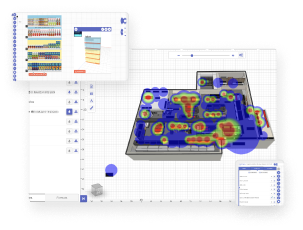
During merchandising analysis, it is important to evaluate cold and hot zones as well as define the racks with the best sales data. Such “promising” retail objects need to be placed in the zones of highest customer traffic.
During merchandising analysis, it is important to evaluate cold and hot zones as well as define the racks with the best sales data. Such “promising” retail objects need to be placed in the zones of highest customer traffic.
Nowadays all of this can be implemented instantly with the use of specialized systems. It is depicted below how, for example, Leafio conducts ABC store plan analysis in terms of sales for the period on practice.
In the software the period and indicator are chosen, in this case, it is ABC turnover. In the picture, you can see that racks are colored by categories.
- Green – category A;
- Yellow – category B;
- Red – category C.

So, on the basis of visual coloring of racks and table analytics in numbers, you have an opportunity to make decisions and analyze the efficiency of trade equipment location on the store plan.
It is also important to compare shares, sales in physical and monetary terms. This indicator will show the real full picture of sales throughout the store. During the full analysis of the trade point, all of the following factors must be taken into account:
- sales in physical and monetary units;
- shares and ABC analysis;
- heat map of customer traffic;
- contract terms and commodity neighborhood rules.
The aforementioned factors can change depending on regional specifics and the area of activity but the one important thing that remains unchanged in the analytics is the use of modern tools with the opportunity to compare different periods and trade equipment locations.
2. Planogram analysis
Planogram is a scheme with the location of the products. It can be made as a table with a list of vendor codes, places on the shelves, faces, or as a picture of products on the equipment.
The combination of table and visual image is important not only for merchandising analysis but also promotes quality work with the planogram on the trade point and analyzes its effectiveness.
Users of special merchandising software can display in-store analytics by characteristics on a visual planogram.
Depending on the set characteristics, you can color products and groups by analogy with diagrams.
Depending on the retail sector, as well as regional and cultural factors the list of characteristics on the planogram can vary.
The unchanged factors for most retail networks remain brands, suppliers, rest, expiration dates, turnover in days, margin, taste, country of origin, etc. (Figure 2. Coloring by brands).
Visual assessment of indicators is a convenient and easy way of determining strong and weak areas, assessing the integrity of the planogram and making a decision about a possible relocation of products.
Depending on the set characteristics, you can color products and groups by analogy with diagrams.
Depending on the retail sector, as well as regional and cultural factors the list of characteristics on the planogram can vary.
.png "2. Planogram analysis")
3. Analysis of return from shelf meter and inventory management
Quality work with planogram and store plan helps to make decisions about relocating trade equipment, brands, product groups and SKU which eventually will boost the sales and accessibility of products.
Effective merchandising analysis can significantly enhance customer satisfaction by ensuring that products are accessible and well-placed.
However, it is understanding of the full picture and the analysis of return from shelf meter in terms of the entire network or formats that helps to make complex decisions in category management and during the merchandising analysis in the store.
Such a picture can be obtained by calculating the return from shelf meter. This number can be calculated if the database of the following is available:
- trade equipment dimensions along all axes including width, height and depth of trade equipment;
- dimensions of products located on equipment;
- number of product units on equipment on all axes (in width, height and depth).
To get a return rate from the shelf meter you must define a total area of footage the product occupies and the sales of the product.
This rate is very important when you analyze assortment and the effectiveness of merchandising. The rate can help to change the matrix, increase or decrease the presence of products on the shelves. Moreover, it can reduce overstock or out-of-stock.
When you get a ratio for a certain category and expand the report to SKU, you can identify both outsiders and leaders in categories and product groups. It is difficult to make such a report without any special tools which accumulate all the data in one place.


The objective analysis of the use of each square meter of the store area helps to make strategical decisions regarding the business development.
In category management these are the presence rate of categories on the shelves, increase or decrease of categories and formats of trade groups, decisions in the assortment matrix.
In contractual companies, these are well-reasoned grounds for marketing budgets, changes in prices or adjustments to assortment matrix, withdrawal and returning of products depending on their return rate.
In-store merchandising analysis can improve the sales and turnover rates, helps to monitor the situation with products out of the matrix and deal with overstock and out-of-stock products.
Such evaluation of merchandising effectiveness directly affects the performance of layout tasks, compliance with suppliers and internal network rules about planogram making. It also makes the layout more understandable and accessible to the customer.
Analyzing Retail Merchandising Data
Analyzing retail merchandising data is a crucial step in developing effective merchandising strategies. Retailers can use various tools and techniques to analyze their data, including retail analytics software, data visualization tools, and statistical models.
By diving deep into their data, retailers can gain valuable insights into customer behavior, sales trends, and inventory levels. This information is instrumental in identifying areas for improvement, optimizing inventory management, and crafting targeted marketing campaigns.
Some common types of retail merchandising data that retailers analyze include:
- Sales data: This encompasses data on sales volume, revenue, and profit margins, providing a clear picture of what products are performing well and which ones are lagging.
- Customer data: This includes data on customer demographics, behavior, and preferences, helping retailers understand who their customers are and what they want.
- Inventory data: This involves data on inventory levels, stockouts, and overstocking, which is essential for efficient inventory management.
- Market data: This includes data on market trends, competitor activity, and customer demand, offering insights into the broader market landscape.
By analyzing these types of data, retailers can gain a deeper understanding of their business and make data-driven decisions to drive growth and profitability.
Retail analytics tools enable retailers to transform raw data into actionable insights, ensuring that every decision is backed by solid evidence.
Developing Effective Merchandising Strategies
Developing effective merchandising strategies is critical to driving sales growth and profitability in the retail industry. A well-designed merchandising strategy can help retailers optimize their product offerings, pricing, and inventory levels, creating a compelling shopping experience for their customers.
Some key elements of an effective merchandising strategy include:
- Understanding customer needs and preferences: Retailers need to have a deep understanding of their customers’ needs and preferences to develop a merchandising strategy that meets their expectations. This involves analyzing customer behavior and feedback to tailor product offerings accordingly.
- Analyzing market trends: Staying up-to-date with the latest market trends and competitor activity is essential for developing a competitive and relevant merchandising strategy. This ensures that retailers can anticipate changes in customer demand and adjust their strategies proactively.
- Optimizing product offerings: Retailers need to optimize their product offerings to ensure they meet customer demand and maximize sales. This involves regularly reviewing and adjusting the product mix based on sales data and market trends.
- Managing inventory levels: Effective inventory management is crucial to avoid overstocking or understocking. Retailers need to balance inventory levels to meet customer demand without tying up too much capital in unsold stock.
- Creating a compelling shopping experience: A compelling shopping experience can drive sales and build customer loyalty. This includes everything from store layout and product placement to customer service and promotional activities.
By developing an effective merchandising strategy, retailers can drive sales growth, improve profitability, and build customer loyalty. Retail merchandising analytics solutions provide the insights needed to refine these strategies and ensure they are data-driven and customer-focused.
Implementing Merchandising Analytics
Implementing merchandising analytics involves strategically applying data analysis to optimize product presentation and placement within retail environments, both physical and digital.
This process begins with defining key performance indicators (KPIs) aligned with merchandising objectives, such as sales per square foot, conversion rates, and average transaction value.
Data from various sources, including POS systems, planogram software, and shopper tracking technologies, is then integrated and analyzed to assess the effectiveness of current merchandising strategies.
This analysis can reveal insights into product adjacencies, optimal shelf placement, the impact of promotional displays, and the effectiveness of visual merchandising techniques.
By leveraging these insights, retailers can refine their merchandising strategies to maximize product visibility, enhance shopper engagement, and ultimately drive sales conversions.
This data-driven approach ensures that merchandising decisions are based on empirical evidence rather than intuition, leading to more effective and profitable outcomes.
Conclusion
Retail merchandising analytics is a critical component of any retail business. By analyzing retail merchandising data, developing effective merchandising strategies, and overcoming common challenges, retailers can drive sales growth, improve profitability, and build customer loyalty.
Retailers who invest in retail merchandising analytics solutions can gain valuable insights into customer behavior, sales trends, and inventory levels, and can use this information to make data-driven decisions to drive growth and profitability.
By leveraging retail merchandising analytics, retailers can stay ahead of the competition and achieve long-term success in the retail industry.
What are the Core Types of Retail Analytics?
Core types include customer analytics, sales analytics, inventory analytics, pricing analytics, and marketing analytics.
How do Analytics and Merchandising Tie Together?
Analytics informs merchandising decisions by providing insights into product performance, customer preferences, and the effectiveness of merchandising strategies.
Why are Retail Merchandising Analytics Important?
Merchandising analytics optimizes product placement, enhances customer experience, and drives sales growth by providing data-driven insights.
How Analytics is Transforming the Retail Merchandising Industry
Answer 4: Analytics enables personalized experiences, predictive demand forecasting, and data-driven optimization of the entire merchandising process.


Have a question?

Jack Larson
Retail Optimization Expert