
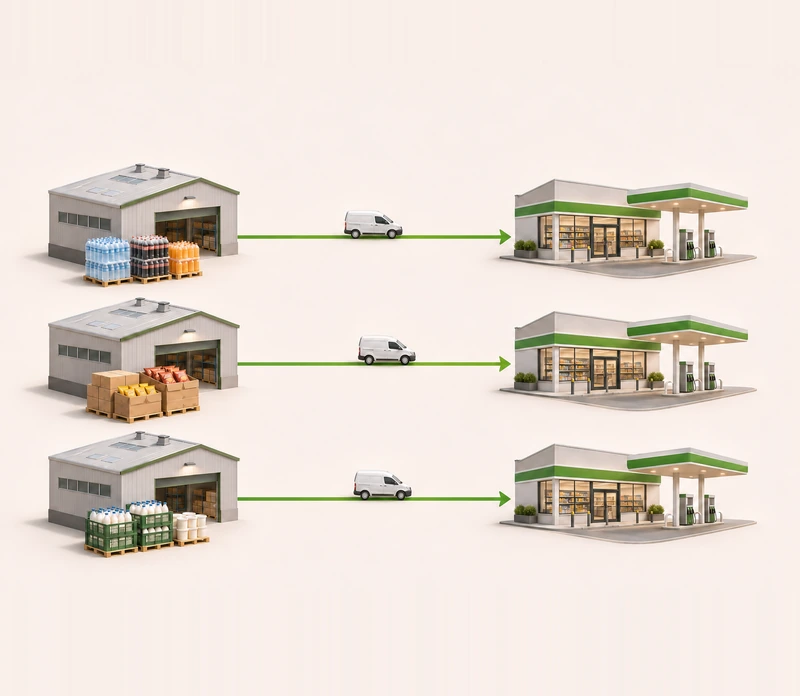


Take a 35-store fuel and convenience chain with no distribution center (DC). Each station takes deliveries from about a dozen suppliers, and every supplier has its own order day, minimum order and case size.
To order directly from suppliers to stores, size each order to what that store will sell before the same supplier delivers again. Then check it against the supplier's minimum, the case size and the space the store has. When a supplier's minimum is bigger than what a store sells between deliveries, change the delivery rhythm or the terms. Extra stock in a small backroom is the most expensive way to meet a minimum.
Direct store delivery (DSD) means goods travel from the supplier straight to the store, skipping the retailer's warehouse. Who writes the order and who stocks the shelf is a separate agreement. In many DSD programs, the supplier's driver or rep does both. This guide is for chains that write the order themselves, store by store.
Without a distribution center, the backroom becomes the warehouse
A distribution center normally absorbs the friction between supplier terms and store demand. It buys in full pallets and ships each store the units it needs. Remove it, and every supplier rule lands on the store.
The result shows up in two places at once. Fast sellers run out a day before the truck, while slow items sit in the backroom for weeks and tie up cash. The same squeeze runs through convenience store inventory management in general, but without a DC it starts with the order itself. The supplier's minimum is a fact to plan around. It should never be the starting point of the order.
Case packs and minimums apply to every address
Case packs are the first rule to hit. A supplier that sells chips in cases of 12 does not care that one station sells four bags a day and another sells one. A $250 minimum applies to each delivery address. A low-volume station has to buy the same minimum as a busy one on the highway.
Supplier calendars rarely line up
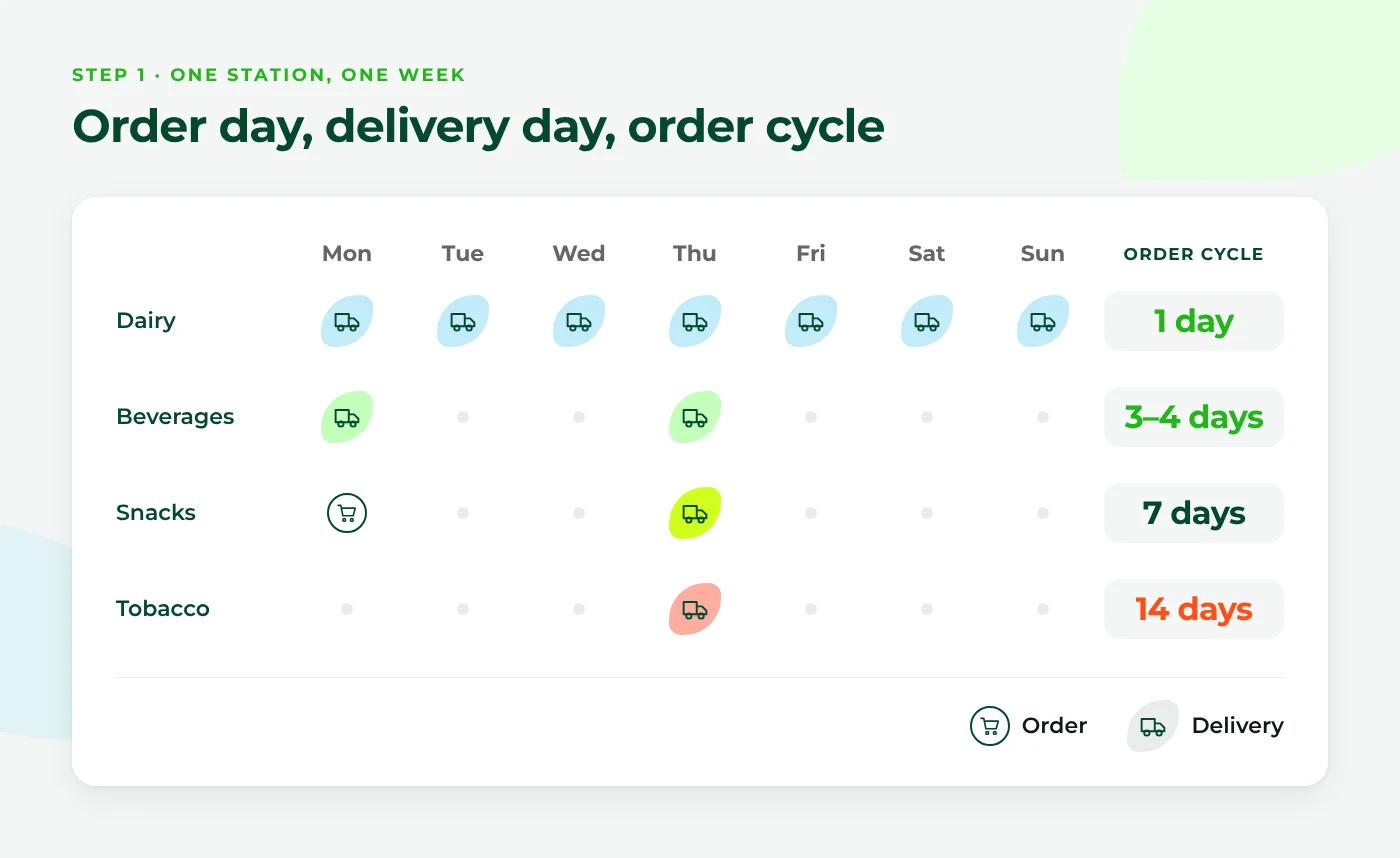
Calendars don't line up either. Beverages come on Monday and Thursday, snacks on Thursday, dairy every morning and tobacco every other week. On a busy Thursday the station manager may sign for four deliveries before lunch and then look for somewhere to put them.
The rep's suggestion often becomes the order
In many chains without a DC, the order is still written in the store, often from the supplier rep's suggestion. Reps know their products well. Their suggestion can still lean toward full cases and the current promotion. (Who approves those orders is a separate question, covered in our guide to centralizing store ordering.)
A six-step method for direct-to-store orders
Direct-to-store ordering holds up when every order starts from the store's own sales and only then meets the supplier's rules.
Step 1: Map each supplier's order and delivery calendar for every store
A calendar for each store and supplier pair records three things: the order day, the delivery day and the days until the following delivery. That last number is the order cycle, the time between deliveries, and it decides how much each order has to cover.
A supplier that delivers on Thursday with a Monday cutoff has a three-day lead time and a seven-day order cycle. A dairy supplier with daily drops has a one-day cycle, so its orders stay small. Keep the calendar per store. The same supplier often visits a highway station more often than a low-volume one.
Step 2: Size the order to sales until that supplier's next delivery
A typical calculation adds expected sales for the order cycle and a safety stock, then subtracts the stock expected on hand when the truck arrives. Stock at arrival matters more than stock today. If the order goes out on Monday and the truck comes on Thursday, three days of sales leave the store before the new cases do.
Order quantity = expected sales for the order cycle + safety stock − stock expected on hand at arrival
Use a forecast by store and day of week rather than a flat weekly figure. Fuel retail traffic swings hard between a weekday commute and a holiday weekend. For the safety part, our guide to safety stock calculation shows how to set it by store.
Check the sales history behind the forecast as well. If the shelf ran empty last week, those days look like weak demand, and the next order comes out short. Our guide to forecasting demand when stockouts hide sales shows how to correct for it.
Step 3: Test every case pack against one order cycle of store sales
The case-pack test divides the case size by the store's sales in one order cycle. A result near 1 means one case covers about one cycle, and the item can follow the regular rhythm. A result of 3 means one case covers three delivery cycles. With daily deliveries that is three days of sales. With weekly deliveries it is three weeks.
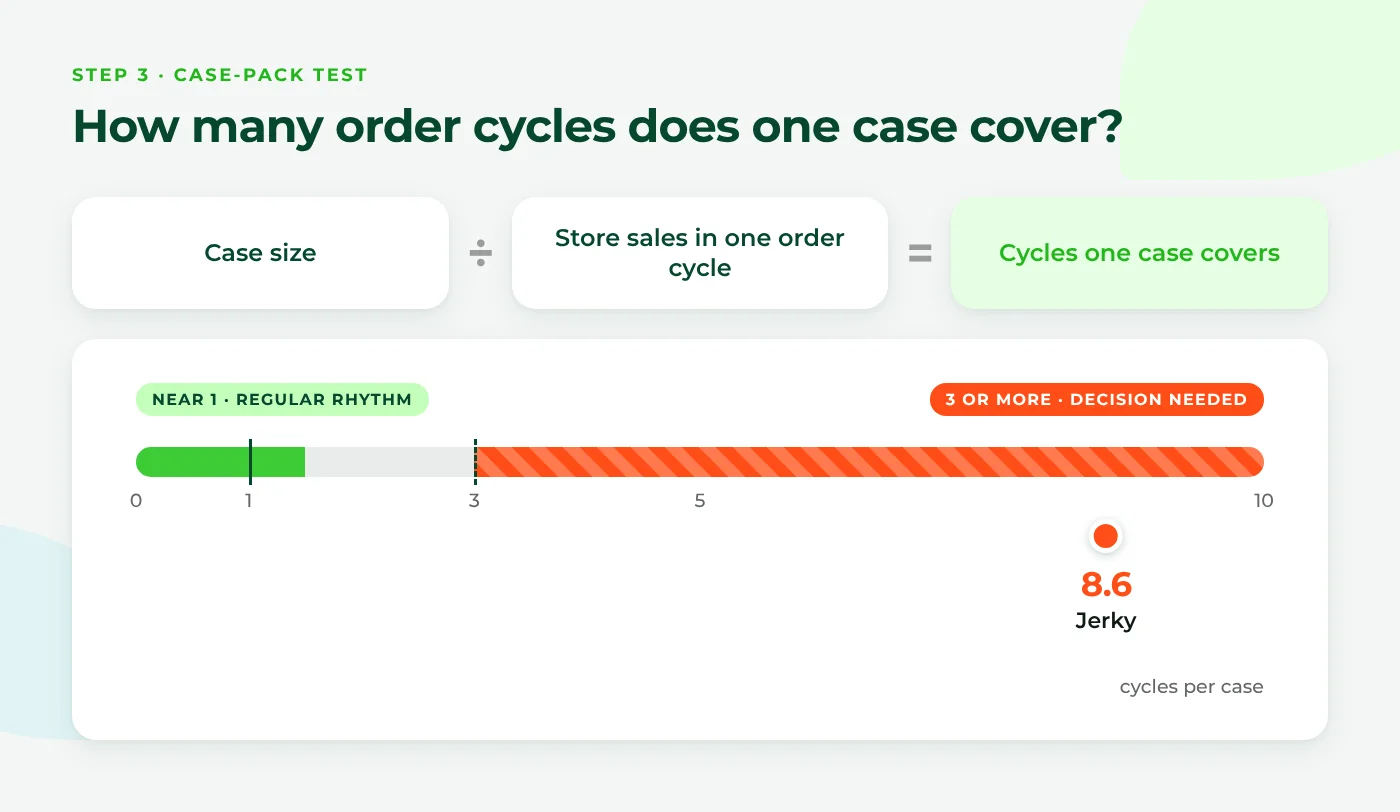
That item needs a decision. You have three options:
- Ask the supplier for a smaller pack.
- Order the item every few deliveries. The supplier can keep coming every week while this one item skips most orders.
- Remove the item from that store's assortment.
A practical cutoff is around three cycles; set your own by shelf life and margin.
Run the test per store. Jerky that clears in a week at a truck stop can sit for two months at a commuter station. The same logic applies to a supplier's minimum order quantity per item.
Step 4: Cap the order by the space the store actually has
A replenishment system can cap each order at what the shelf and the backroom actually hold. Measure that space in units per item or in cases per supplier, and update it when fixtures change.
An order that does not fit does not disappear. It gets stacked next to the cooler, and part of it can expire before anyone finds it. So count the space that will be free on delivery day. If the shelf holds 30 units and 8 will still be there when the truck arrives, there is room for 22.
Step 5: Reach the supplier's minimum with fast sellers, not slow ones
When a store's order falls short of the supplier's minimum value, start with fast sellers that have room on the shelf or in the backroom. The usual reflex is the opposite. People add whatever the rep has on promotion, or one more case of a slow item to round the number up. Promotion stock added this way can outlast the promotion itself, which our guide to avoiding leftover stock after a promotion ends covers in detail.
Topping up the fastest sellers costs a few extra days of stock on items that sell every hour. Include that extra stock when you calculate the next order. If the same store misses the minimum every week, the minimum does not fit that store. That is a signal to talk to the supplier about a lower drop size or a different delivery schedule.
Step 6: Plan around supplier holidays before they empty the shelf
A supplier that skips one weekly delivery over New Year (or after a route change) doubles the order cycle for that week. The last order before the break has to cover two weeks of sales.
Put the break on the Step 1 calendar a month ahead. Check the double order against the space limit from Step 4, and plan it as a one-off order. Without it, the shelf can run empty in the busiest week of the season.
Two products, one supplier and a $250 minimum
Take one station in a 35-store fuel and convenience chain and its snack supplier, which delivers on Thursday for orders placed on Monday. The minimum order is $250 per delivery.
Chips: rounding to full cases
The station sells 4 bags of chips a day, in cases of 12 at $18. On Monday it has 20 bags, and about 12 will sell before the truck, so 8 remain on arrival. The next seven days need 28 bags, and the planner keeps 6 more as safety stock. That makes 34 bags, minus the 8 on the shelf, which gives a requirement of 26 bags before rounding to full cases.
Two cases bring 24 bags, which gives the store 32 bags, or eight days of sales. After the cycle's 28 bags sell, 4 bags of safety stock remain, two below the target. A third case would leave 16. For this order, the planner accepts the smaller buffer.
Jerky: the case-pack test says wait
Jerky sells 0.4 units a day, about 3 a week, in cases of 24 at $72. With 3 units on hand at arrival, the station has seven and a half days of stock. The case-pack test gives 24 divided by 2.8, or about 8.6 order cycles. So no jerky goes into this week's order.
Three ways to close a $70 gap
All items in the order, chips included, add up to $180. The station is $70 short of the minimum.
| Option | What changes | Order total | Effect on stock |
|---|---|---|---|
| A | Add one case of jerky ($72) | $252 | 24 units, about 60 days of sales |
| B | Add one 12-unit case for each of four fast-selling items ($18 per case, each selling at least 4 units a day) | $252 | Up to 3 extra days of stock per item |
| C | Move this station to a delivery every two weeks (a schedule change for future orders) | Recalculate for a 14-day cycle | Larger drops for some items |
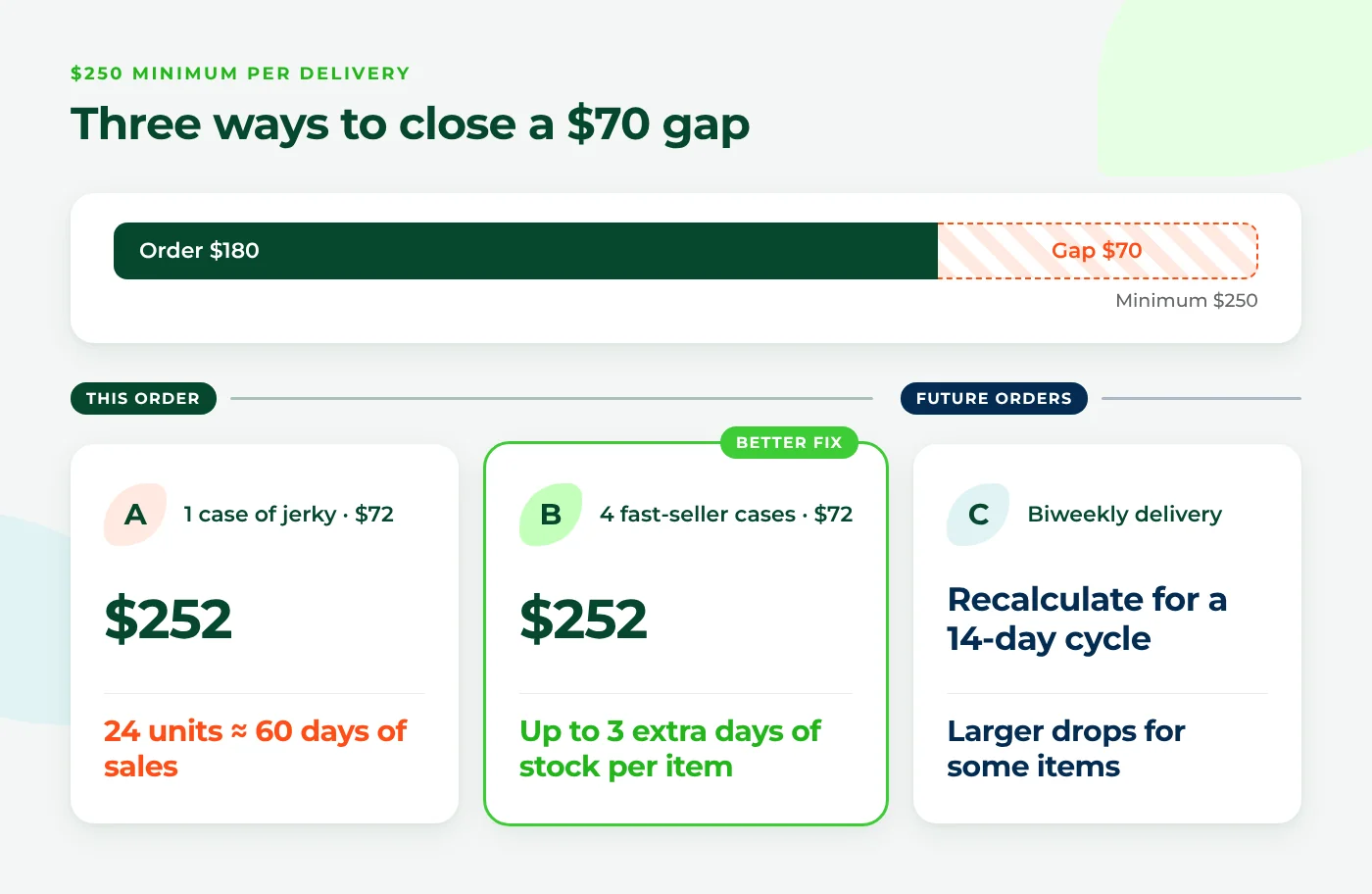
Options A and B close this week's order, while C changes the schedule for the orders that follow. Option B is the better fix for this station. It ties up the same $72 as the jerky case, but in products the store sells ten times faster. Whatever is left counts toward the next order, although case packs and the minimum still shape how much that order shrinks.
Option A meets the minimum and leaves $72 of jerky on a backroom shelf for two months. Option C can work at a low-volume station where most items fail the case-pack test, and slow items can then be ordered every few deliveries. It only works if the backroom can hold the larger drops.
How LEAFIO Inventory Optimization builds direct-to-store orders
LEAFIO Inventory Optimization builds a separate order for each store and supplier, on that supplier's own order and delivery days. The quantity comes from an ML forecast that reads sales history, promotions, seasonality and external factors such as weather. For each item, the quantity is rounded to the supplier's minimum quantity and case multiple.
Minimums for the whole order, set by value, weight or volume, follow the logic of Step 5. When a store's order falls short, the system can top it up with the items that sell fastest in that store.
In LEAFIO Inventory Optimization, the planner also sees where a supplier's minimum order quantity for an item is larger than what a store sells between deliveries. This works like the case-pack test from Step 3, run across every store and item. The buyer gets numbers for the next talk with the supplier, so the conversation no longer starts from the rep's suggestion.
Before a supplier's holiday break, the module plans a one-off order to cover the gap and then returns to the regular rhythm. Orders can go to suppliers automatically. That works best once buyers trust the automated orders, and the station manager's job shifts to receiving and checking deliveries. When retailers use Shelf Efficiency together with Inventory Optimization, facings and shelf capacity from published planograms can also feed the replenishment model.
In fuel retail, Baltic Petroleum moved ordering for its 86 stations from 84 station managers to four specialists in the head office. Across the network, overstock fell by 50%. That result came from the full project, which combined LEAFIO Inventory Optimization with Shelf Efficiency.
Where direct-to-store ordering breaks, and when to leave it to the supplier
Stock records and one chain-wide calendar break most orders
Direct-to-store ordering fails most often on stock records, not on the math. If the system believes the backroom holds 12 bags and it holds none, every order from Step 2 comes out short. Fix receiving and stock counts first. Our guide to preventing replenishment failures caused by messy data lists what to check.
Another common mistake is one calendar for the whole chain. A rule that works for a station with daily traffic of 2,000 cars will overload a station that sees 300.
When the route driver should keep the order
Some categories are better left with the supplier. Bread, beverages and ice often come with a route driver who restocks the shelf several times a week. Taking those orders in-house can add work without adding much control. The better move is a monthly audit that compares what the rep delivered with what the store sold. Our guide to vendor-managed inventory explains how such programs are set up.
And sometimes the numbers say no. Say an item fails the case-pack test in a small store, and the supplier will not change the pack or the schedule. Then the honest answer is to remove it from that store's assortment.
Without a distribution center, every order lands in a small room at the back of the store. Sizing it to that store's sales until the next truck keeps the room for stock that will actually sell.
FAQ
What is the difference between direct store delivery and warehouse delivery?
With direct store delivery, the supplier ships to each store, and the store receives the goods. With warehouse delivery, the supplier ships to the retailer's distribution center, which then sends stores mixed loads. DSD removes a stop in the chain but moves case sizes, minimums and delivery traffic to the store.
Who should write direct store delivery orders, the retailer or the supplier?
Who writes direct store delivery orders depends on the category and on the retailer's data. Bread or beverages are often restocked by a route driver several times a week. There the supplier usually writes the order, and the retailer audits it. A retailer can take over a category once it has accurate stock and sales data for it in every store.
How often should a small store get deliveries from one supplier?
A small store should get deliveries from one supplier often enough that one case covers about one order cycle of its sales. If only a few items sell slowly, order them every few deliveries and keep the regular schedule. Change the whole supplier's schedule only when most items need several weeks to sell one case. Check first that the backroom can hold the larger drop.


Have a question?

Katrina Walker
Retail Inventory Optimization Specialist